Why Mexico Tried to Reconquer Texas Six Years After the Alamo
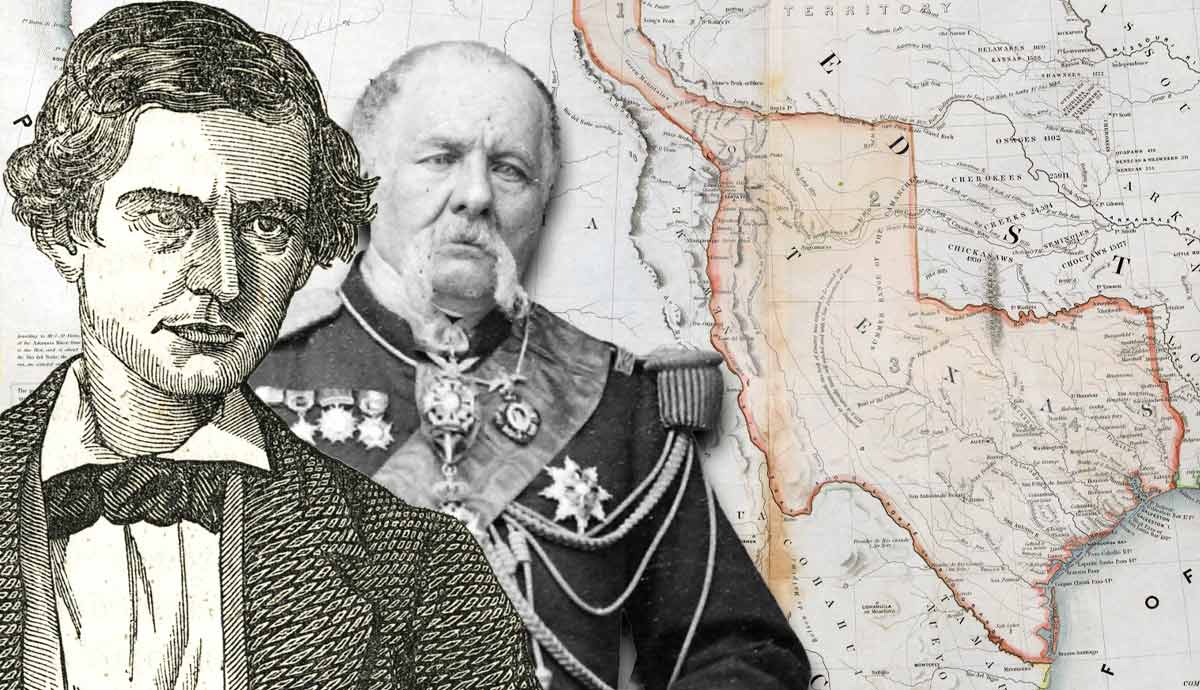
Mexico never forgot the stain of 1836, but internal strife held back its hand from immediate reconquest. But Mexico never forgot, and in 1842 its armies once again marched over the Rio Grande in an effort to reclaim possession of Texas. The Texians, however, had something to say on that account.The Renewed Mexican ThreatBattle of San Jacinto by Henry Frank McArdle, 1901. Source: Wikimedia CommonsThe fateful year of 1836 was on Sam Houstons mind when he stood before the Congress of Texas as the Republics President. It had been an eventful one for him after all, crowned in glory with his victory over the Mexicans at San Jacinto, and the captivity of that nations political and military leader, Generalissimo Santa Anna. The geopolitical implications of his capture were monumental. At a stroke, Texas was hacked from the body of Mexico, its border pushed southward to encompass the northern banks of the Rio Grande. A national humiliation for the Mexican nation, and one Santa Anna himself would never forget.But revenge would have to wait. Santa Annas was a Mexico in turmoil. The old Federal Republic had bound them together, but the growing authority of the militarists in Mexico City left many inclined to secede. The flames of rebellion spread far and wide as several states formed their own republics. On top of this, Mexico suffered the sting of foreign military interventions. Insults to French citizens, for example, led to a naval expedition descending upon Vera Cruz in 1838. In the subsequent fighting, Santa Anna, given command over Mexican forces, was blown from his horse. The loss of a leg led to his return to politics at a time when tensions with Texas began rising again.Combat de Vera Cruz by Pharamond Blanchard, 1840. Source: Palace of VersaillesIndeed, in addressing his fellow Texians in the last month of 1841, Houston warned that Mexicohas, at no time since 1836, been in a position so favorable for annoying our country as at the present moment. (Houston, p. 415).Santa Annas return to power south of the Rio Grande was not the main reason. Instead, his cause for war rested largely upon the shoulders of the Texians. In the five years since its independence, the Lone Star Republic strutted about like a conqueror, for conquest was on its mind.Grandiosely claiming lands as far afield as California, the Texians spent a considerable amount of time and effort in pursuit of a foreign policy that was questionable to say the least. With its modest navy, the Texians harassed Mexicos coasts and shipping, backing separatists movements against Mexico City, whilst simultaneously attempting to gobble up Mexican territory in New Mexico. The final straw from the Mexican standpoint came in 1841, when an expedition a few hundred men strong under the auspices of Texass President Mirabeau B. Lamar attempted to take Santa Fe.Marching hundreds of miles through the summer heat, poorly supplied, the Texians managed to reach Santa Fe before surrendering without firing a shot. They were lucky to be spared by their captors, but the entire episode illustrated the idiocy of the strategic overreach so common to the Lamar administration.It was an overreach that now goaded Santa Anna to send an army north in an invasion that Sam Houston, duly reelected to a second term as Texass chief executive, had to deal with. And knowing the temperament of the average Texian in the field, it was enough to give him cause to shudder.The Mexican Invasions of 1842Alamo Memorial in Texas. Photograph by gillfoto, 2014. Source: Wikimedia CommonsThe United States Marine Corps prides itself on the notion that every Marine is a rifleman. The same could be said of the Texians in 1842. As a frontier region vulnerable to attack from Native Americans and Mexicans, the Republic of Texas could look nowhere else but to its own citizens in times of war.Hailing overwhelmingly from the United States, Texians carried American traditions of civic militarism, enshrined in the Republics Constitution that called for all male citizens between the ages of 17 and 55 to be enrolled in the militia, and have himself armed and supplied for at least ten days service if necessary.Like the minutemen who fought the British at Lexington and Concord, the Texians were citizen soldiers and prone to all the limitations that status entailed. Officers were elected, and the independent minded Texians baulked at military discipline. Their forces were accordingly varied in quality but capable of fighting with great ferocity.Houston knew these limitations well. The San Jacinto campaign had shown him firsthand the lack of discipline so common to these citizen soldiers. Luck and bravery won the day then, but with the country imperiled, Houston urged upon his commanders that proper respect to discipline will ensure to Texas a speedy riddance of our invaders, (Houston, p. 491) regardless of how strong the Mexican forces may be.In March 1842, 700 men under General Rafael Vasquez, arrived before San Antonio. Their arrival was enough to send its citizenry fleeing eastward, whilst Texian reinforcements were too late to assist the towns garrison, who voted to withdraw rather than fight. But Vasquezs foothold was given up just as quickly, and within days he had turned back south since he was too weak to retain San Antonio should the Texians appear in force.Map of Texas and the Countries Adjacent by Matthew Emory, 1844. Source: The University of Texas at Arlington Libraries Special CollectionsWhile no more than a raid, it illustrated the ease with which Mexico could project power northward and the difficulties faced by the Texians in formulating a response. With no real standing army to hand, Texian volunteers could only be called up after the fact and rush to the frontier to do battle. This could take considerable time depending on where they were raised and where they had to go, and all without the benefit of modern transportation.Yet Vasquezs March assault thoroughly roused the Texians from their stupor. Having been unprepared in the spring, they would remain on the alert in the coming months. The big problem for Houston now became one of restraining his peoples warlike urges to go on the counterattack. Mexico had invaded their soil, occupied one of their towns, and sent their people fleeing in fear. Such an insult had to be met with force.Houston sought no such offensive action, but bowed before the mounting public pressure to beg the United States for volunteers and money to assist in a limited offensive towards Corpus Christi. Gathering an army under James Davis, Adjutant General of the Army of Texas, the Texians occupied Fort Lipantitlan on the Nueces River. There, on July 7, 1842, Davis encountered a second Mexican invasion force.Outnumbered three to one, the Texians stood firm, repulsing the invaders in a sharp action that many thereafter believed had ended Mexican incursions for good. Houston himself was amongst those lulled into a false sense of security and ordered the disbanding of the field army. But events were to prove this decision to be premature.Salado CreekA photograph of General Adrian Woll, 1875. Source: Repositorio del Tecnolgico de MonterreyMid-September brought a surprise to the people of San Antonio. It came in the form of an army led by a general who had once fought in French uniform against Napoleon. After leaving his native France, Adrian Woll went to Mexico and served under Santa Anna in the 1836 campaign. In late August 1842, he was ordered to launch another campaign against Texas. Crossing the Rio Grande at Presidio, Woll marched a division of 1,400 men through the hills west of San Antonio and descended upon the startled town on September 11.Once again San Antonio had fallen. But Woll made no real attempt to move beyond it in strength. For a week he held the town while Texians volunteers scrambled to respond. Chief respondent was Colonel Matthew Caldwell, veteran of Comanche raids and 1836, who mustered some two hundred men on Salado Creek, about seven miles distant from San Antonio.Joining a handful of Texas Rangers under their leader, John Coffee Hays, Caldwell understood that his meager force could not hope to storm San Antonio in the face of Wolls much larger army. However, he hoped to even the odds by luring them out to battle on the open prairie fronting the tree-lined creek.Hays took up the task with another 20 riders. Their purpose was to ride up to the Mexican lines and goad their cavalry into a chase where an ambush lay in wait. Hayss goading had the desired effect, and he found himself chased by most of Wolls cavalry. This forced the Mexican general into an action he did not necessarily want yet was obliged to fight by his undisciplined horsemen.An illustration of John Coffee Hays. Source: University of Texas ArlingtonHayss horsemen were almost ridden down by the Mexican cavalry, but they managed to rejoin Caldwells men, who were cooking beef when their exhausted comrades crashed in amongst them with half the Mexican army at their backs. Opening fire, Caldwells Texians drove the Mexican cavalry back just as Wolls infantry appeared on the scene. Forming his men in line of battle, Woll answered Caldwells fusillades with musketry of his own, but his men proved largely unwilling to close upon the Texian position.When he eventually managed to cajole them forward, the Mexican advance stalled in the face of Caldwells fire. Under cover as they were, the Texian rifles easily outdistanced the muskets of their foes. Caldwell didnt have to move a muscle to inflict damage whilst Wolls command either had to advance or withdraw from the exposed prairie. When his attack failed, Woll decided to disengage and withdrew back into San Antonio.But things had not all gone Caldwells way. Whilst his main force was engaging Woll, a company of volunteers hurrying to join him were caught out in the open by Mexican cavalry and promptly slaughtered. Known as the Dawson Massacre, it is often treated as a separate event from the Battle of Salado Creek, but the two are inextricably linked. Even so, Wolls losses, close to 60 men killed or wounded, was enough to spoil the generals taste for further fighting.In a matter of days, he evacuated San Antonio for good. For the third time that year, a Mexican army retreated southward.ConsequencesDrawing the Black Bean by Frederic Remington, 1896. Source: Museum of Fine Arts, HoustonThe various raids into Texas in the year of 1842 were to be Mexicos last against the Republic of Texas, but the Texians would have the last say. Encouraged by their victory at Salado, the public once again demanded Houston go on the offensive. Forced to oblige, the President raised a force to march on the Rio Grande and show the flag. Stepping beyond its waters was not in the Presidents plan.The men on the ground did so anyway, carrying the war into Mexico itself. These men, operating outside of Houstons authority, were ultimately brought to bear in the town of Mier, where after a fierce action they surrendered. The Texians in captivity were forced to draw beans from a sack, and those who drew black ones were shot by Mexican firing squads in a notorious episode known forevermore as the black bean incident.The incident showed there was no love lost between the two republics. But within three years, the conflict changed irrevocably as Texas was annexed by the United States, bringing its land dispute with Mexico to the very halls of Congress in Washington. These halls brimmed with the spirit of Manifest Destiny, a spirit that was to soon annex all of Mexicos territory north of the Rio Grande at the point of the sword.SourceThe Writings of Sam Houston 1813-1863: Volume II, July 16, 1814 March 31, 1842, eds. Amelia W. Williams and Eugene C. Baker. (Austin: The University of Texas Press, 1939).










 Arabic
 French
 Spanish
 Portuguese
 Deutsch
 Turkish
 Dutch
Dutch
 Italiano
 Russian
 Romaian
 Portuguese (Brazil)
 Greek
Greek