The Scandalous Donation of Constantine That Granted Emperor Status to the Pope
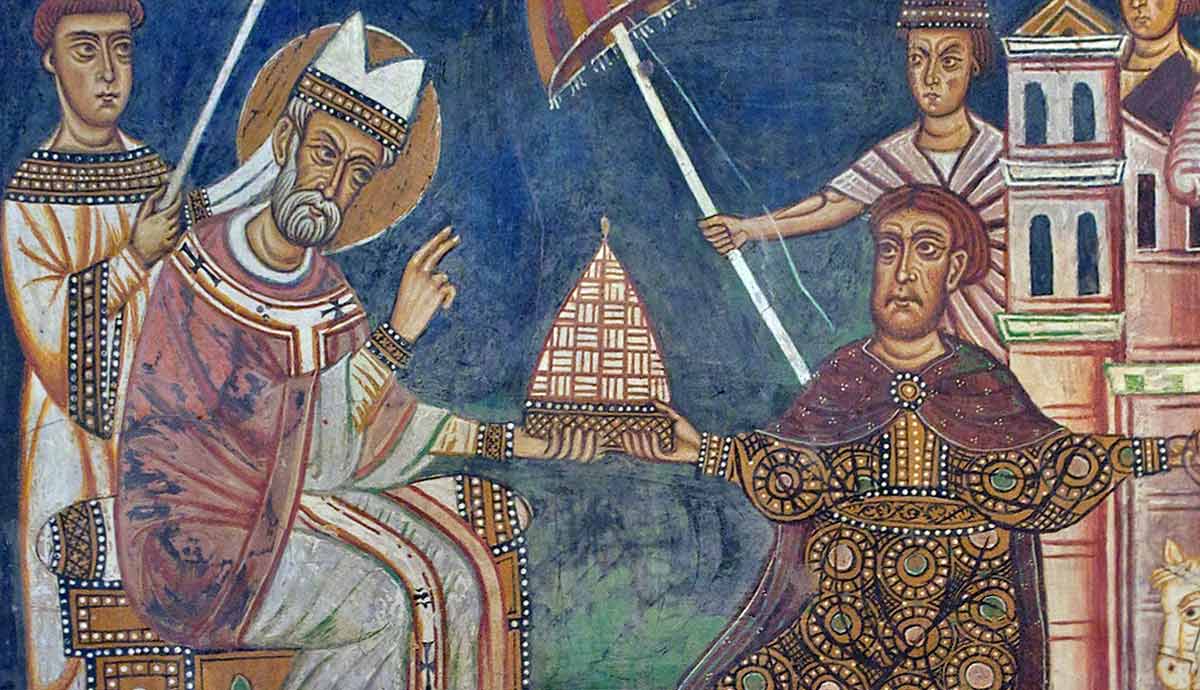
Throughout the Middle Ages, the papacy claimed that the legitimacy of its temporal and spiritual power originated from the so-called Donation of Constantine. According to this document, Constantine conferred the Roman archbishop with supremacy over the worlds churches. Most importantly, he granted the pope temporal authority over Italy and the Western World. Proven to be a forgery in the 15th century, the Donation of Constantine had a profound impact on the religious and political affairs of medieval Europe, especially in the often uneasy relations between the papacy and the empire.What Was the Donation of Constantine?Fragments of the Colossus of Constantine at the Capitoline Museums in Rome, ca. 312-315 AD, photograph by CCCP, 2012. Source: Wikimedia CommonsThe exact date of the composition of the Donation of Constantine is still unknown; however, scholars generally date the document back to the 750s or 760s. Its author was probably a cleric of the Lateran in Rome, who wrote the Donation possibly with the consent of Pope Stephen II (or III).The text of the Donation of Constantine is based on the Legenda S. Silvestri (The Legend of St. Sylvester). According to this 5th-century myth, Roman Emperor Constantine I converted to Christianity after Pope Sylvester I miraculously cured him of leprosy: And so, on the first day after receiving the mystery of the holy baptism, and after the cure of my body from the squalor of the leprosy, I recognized that there was no other God save the Father and the Son and the Holy Spirit; whom the most blessed Sylvester the pope doth preach; a trinity in one, a unity in three.The grateful Constantine then repaid the pope who baptized him by issuing a document that bestowed upon Sylvester and his successors spiritual supremacy over all other archbishoprics and de facto temporal authority. In particular, the forged donation alleged that the first Christian Roman emperor granted to the pope administrative rights over the estates donated to the church, and, most importantly, control of the territories of the Western Empire:In imitation of our own power, in order that for that cause the supreme pontificate may not deteriorate, but may rather be adorned with power and glory even more than is the dignity of an earthly rule: behold we-giving over to the oft-mentioned most blessed pontiff, our father Sylvester the universal pope, as well our palace, as has been said, as also the city of Rome and all the provinces, districts and cities of Italy or of the western regions; and relinquishing them, by our inviolable gift, to the power and sway of himself or the pontiffs his successors-do decree, by this our godlike charter and imperial constitution, that it shall be (so) arranged; and do concede that they (the palaces, provinces etc.) shall lawfully remain with the holy Roman church.Pope Sylvester and Emperor Constantine depicted in the fresco cycle at the Santi Quattro Coronati in Rome, 1247. Source: Wikimedia CommonsGiven the extensive rights conferred upon Pope Sylvester, it is not surprising that the donation became the legal basis for the papacys temporal authority and its claims of supremacy. Moreover, the fact that Constantine allegedly granted the archbishop of Rome control over the western territories came to imply that the pope had the right to appoint secular rulers in Europe.Throughout the Middle Ages, the political impact of this claim was extensive, especially as the papacy vied for power against the Holy Roman Empire and its rulers (more on that later). The unknown forger, however, could have hardly imagined the long-term effects of his handiwork. Indeed, the Donation of Constantine can be best understood as a product of the papacys efforts to secure independence from the Byzantine Empire in the 8th century through an alliance with the Carolingian rulers.Setting the Stage: The Papacy & Italy in the Early Middle AgesDestruction from The Course of Empire series, by Thomas Cole, 1836. Source: New York Historical SocietyIn the 5th century, the large-scale migration of the Germanic peoples (also referred to as barbaric invasions) into the western territories of the Roman Empire inaugurated a period of chaos. The final collapse of the empire (476 AD) and the disintegration of its administrative structures left a political vacuum in the West, where the constant warfare had already caused widespread disruption to agriculture, trade, and urban life.In the general instability, one entity emerged as the only guarantor of order: the Roman Church. During the first decades of the early medieval period, churchmensome of the few remaining members of the Roman elitetook up most of the legal and administrative duties of the imperial bureaucracy. As Germanic tribes repeatedly poured into Italy, the archbishops of Rome (the popes) were the ones who dealt with the invading forces.Map of the Lombard Kingdom at the maximum of its extent. Source: Wikimedia CommonsBy the 6th century, the papacy had secured its authority over Italy, and Rome, once the city of emperors, became known as the city of popes. In the 8th century, however, the Roman Church felt its power threatened by the Lombards, a Germanic tribe who invaded vast parts of northern Italy toward the end of the previous century. The Lombards soon eroded the Byzantine presence in the Italian peninsula, settled in Pavia, and, from there, began to expand.The popes, still nominally under the control of the Byzantine Empire, feared for their safety, feeling that the emperor in Constantinople could no longer be relied upon to provide assistance. The situation worsened in the 750s, when Pope Stephen II (or III) was forced to flee from Rome following a round of unsuccessful negotiations with Aistulf, the Lombard king. It was time to find a new protector and claim independence from the Byzantine Empire.New Alliances: The Donation of Pippin & the Donation of ConstantineMiniature of King Pippin III the Short, ca. 1112-1114, author unknown, from the Imperial Chronicle (Anonymi chronica imperatorum). Source: Wikimedia Commons/Corpus Christi College, CambridgeIn 753, Pope Stephen crossed the Alps to reach Gaul, where Pippin III, the son of Charles Martel, had become the king of the Franks. Pope Zacharias, Stephens predecessor, had approved the move, and, in 751, Archbishop Boniface anointed Pippin as king. Now it was Stephens turn to anoint the Frankish monarch alongside his sons and heirs, Charles and Carloman.During his stay in present-day France, Stephen secured Pippins military assistance against the Lombards. In 754, the Frankish forces invaded Italy, besieging the Lombard king at Pavia. It would take Pippin a second campaign, launched in 756, to finally subdue King Aistuff and his forces. It was around this time that the Frankish king, during a meeting at Quierzy, promised Pope Stephen that he would restore to the papacy the lands taken by the Lombards.Known as the Donation of Pippin, the oral (or written) agreement is commonly regarded as the event marking the establishment of the Papal States. Having finally severed ties with the Byzantine Empire, Stephen was thus the first pope to rule as a temporal sovereign over the papacys territories.What Was the Impact of the Donation of Constantine?The Coronation of Charlemagne, by Friedrich Kaulbach, 1903. Source: Wikimedia Commons/Maximilianeum MnchenPapal accounts of the meeting at Quierzy declare that Pippin III granted Pope Stephen II the exarchate of Ravenna (previously part of the Byzantine Empire), the districts of Venetia and Istria, and the duchy of Rome. The Frankish monarch, however, had no legal claim to much of the territories he promised to restore to the papacy, as they were under the jurisdiction of the emperor in Constantinople.As the Donation of Constantine, most probably forged around this time, maintained that Constantine had already bestowed upon the Roman Church control of Rome and the Western Empire, Pippin was simply restoring the status quo. At the same time, the document provided legal confirmation to a situation that had been developing since the 5th century: the emergence of the papacy as the political and administrative heir to the Roman Empire. Indeed, alongside statements of papal primacy, the unknown cleric who penned the document emphasized how Pope Sylverster was granted imperial honors, the imperial palace, and imperial power.Illumination from the Passionary of Weissenau (Weienauer Passionale) showing Pope Leo IX defeating a demon, ca. 1170-1200. Source: Wikimedia Commons/Fondation Bodmer, Coligny, SwitzerlandThe Donation of Pippin cemented the alliance between the papacy and the Carolingians. In 778 and 817, his successors, Charlemagne and Louis the Pious, confirmed the anti-Lombard agreement, which was also later cited by the Roman Church as proof of the authenticity of the Donation of Constantine. The documents vast impact on the political and religious affairs of medieval Europe, however, would emerge only later on.Indeed, the first pope to cite the Donation of Constantine in an official act was Leo IX (1049-1054). Determined to transform the papacy into an international power and make his primacy as the successor of St. Peter real, he took a strong stance in his quarrel against Michael I Cerularius, the patriarch of Constantinople. In a vitriolic attack against the patriarch, Cardinal Hubert directly quoted from the 8th-century forgery. The dispute eventually led to the Great Schism of 1054 between the Western and Eastern Churches.Church and State, Papacy and EmpireEnamel panel from Cologne featuring the investiture of a bishop, 12th century. Source: Wikimedia CommonsAfter Leo IXs pontificate, subsequent popes relied upon the Donation of Constantine in the long struggle with the Holy Roman emperors and other secular leaders. According to a popular medieval theory, probably originating with Pope Gelasius I (492-496), two swords (or powers) had been created by God to rule over humankind: the church and the state. Over the years, however, the theory came to mean that the papacy held both powers: the spiritual and the secular.As the 8th-century alliance between the papacy and the Franks created a new tension, popes and secular rulers vied for primacy. Emperor Charlemagne, for example, claimed the right to appoint bishops. In subsequent centuries, secular rulers continued to involve themselves in ecclesiastical affairs, leading to a series of struggles culminating in the Investiture Controversy, a conflict pitting Pope Gregory VII against Henry IV.While a 1122 compromise ended the controversy, tensions between popes and emperors remained high until the mid-13th century, intermittently leading to open conflict. Despite various challenges, the papacy managed to maintain sovereignty over the Papal States and even expanded its territories. Meanwhile, as the papacy vied for supremacy with the secular authorities, the Donation of Constantine served as the centerpiece of the papal anti-imperial rhetoric.When & How Was the Donation of Constantine Revealed to Be a Forgery?Engraving of Lorenzo Valla, after a work by Jean Jacques Boissard, printed by Theodor & Johann Theodor de Bry, ca. 1597-99. Source: Wikimedia Commons/Rijksmuseum, AmsterdamFor a long time, the authenticity of the Donation of Constantine was not challenged. In his Divine Comedy, Dante, believing its truthfulness, referred to the dowry as the root cause for the corruption of the church (Inferno, 19.115-7) during his meeting with Pope Boniface VIII. By then, the Donation of Constantine had become a key part of the papal political propaganda backing the papacys involvement in the 14th-century Guelph-Ghibelline conflicts.It was only a century later that Italian humanist Lorenzo Valla exposed the donation as a forgery, turning the most well-known piece of papal propaganda into a cornerstone of antipapal rhetoric. In his 1440 Declamatio (Treatise of Lorenzo Valla on the Donation of Constantine), Valla, a biting critic of medieval traditions, listed the anachronism, inconsistencies, and misunderstandings of the piece, providing a detailed analysis of documentary proofs.At the time, Valla was a royal secretary and historian at the court of Alfonso of Aragon, King of Naples. As King Alfonso was enmeshed in a territorial dispute against Pope Eugenius IV, Vallas harsh attack on the very basis of the papacys authority was particularly convenient. The Declamatio, however, was first formally printed only in 1517, the same year that Martin Lutheraffixed his Ninety-Five Theses, setting in motion what would become the Protestant Reformation.Portrait of Martin Luther, by Lucas Cranach the Elder, 1528. Source: Wikimedia Commons/Veste CoburgBy then, Vallas text had already been widely circulated and read. It was not only Vallas revelation of the Donation of Constantine as a forgery to create a scandal around his 1440 oration, but also the violence of his language. O thou scoundrel, thou villain! wrote the Italian humanist addressing the unknown forger. And then doubled down: Numskull, blockhead!What had once been the cornerstone of the papacys claims for temporal power now contributed to the outcry against the moral bankruptcy and corruption of the Church of Rome.













 English
 French
 Spanish
 Portuguese
 Deutsch
 Turkish
 Dutch
Dutch
 Italiano
 Russian
 Romaian
 Portuguese (Brazil)
 Greek
Greek