Swaziland: The Last Autocratic Monarchy in the World
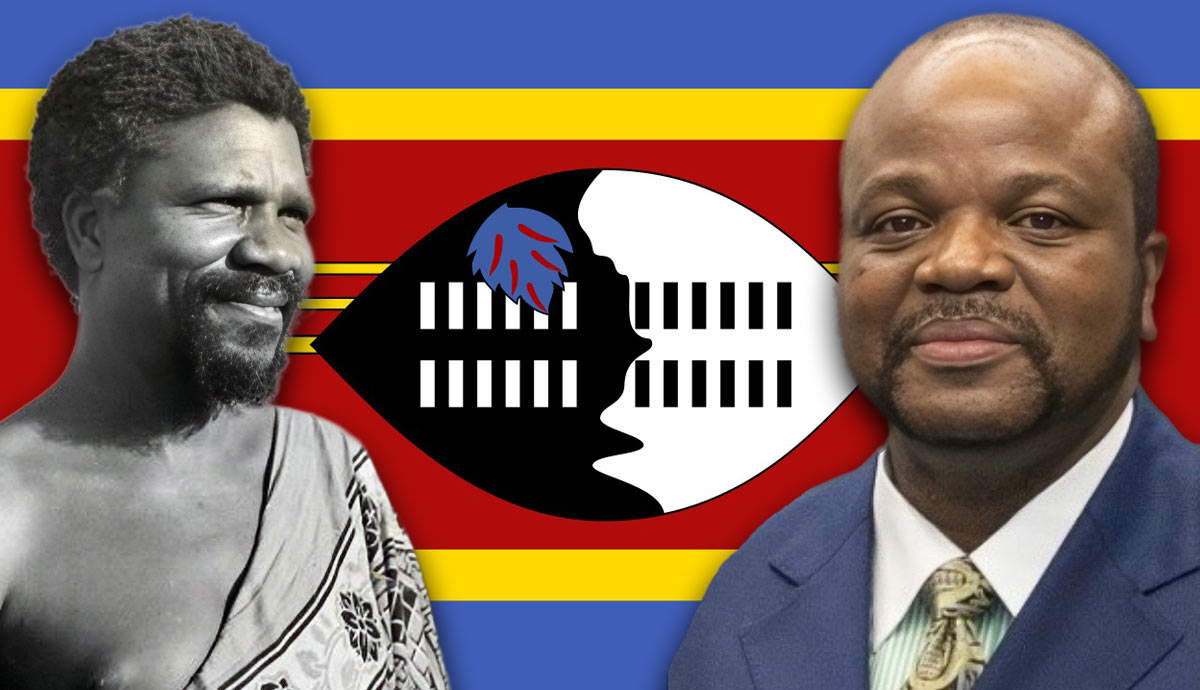
One of the smallest countries in Africa, Eswatini (formerly Swaziland) is the last country on the continent to be an autocratic (or absolute) monarchy. It is one of only a handful of countries around the world with this form of governance.How and why this dynamic exists is rooted firmly in the countrys past and draws much debate and media attention in the modern world.Read on to discover more about the last autocratic monarchy in Africa.Autocratic Monarchy Countries: The Story of Swaziland (Eswatini)Map of Southern Africa with Eswatini in yellow, by Burmesedays, minor amendments by Joelf. Source: Wikimedia CommonsA little smaller than New Jersey, Eswatini is one of the smallest countries in the world. Wedged between South Africa and Mozambique, the country covers 17,364 km2 (6,704 sq mi) and is home to around 1.2 million people.Unlike many other traditional hereditary monarchies, Eswatinis kingship does not automatically pass from father to son. When the king dies, a council called the Liqoqo decides which one of the kings wives is declared the great wife and Indlovukazi or Ndlovukati, meaning She-Elephant. The Indlovukazi is chosen on the basis of her character, and her son will automatically become the next king. While the king is the administrative head of the state, the Indlovukazi is seen as the spiritual head.The monarchy is, in part, characterized by its polygamous nature, which exists for many reasons. The king is expected to have wives from all the clans in the country in order to solidify unity within the kingdom.A royal fiance is referred to as a bride known as a liphovela, and upon becoming pregnant, the liphovela becomes a full wife, and the king marries her in a traditional ceremony. The first two wives, however, are not the choice made by the king. The national councilors choose these women, who must be from the Matsebula and Motsa clans. These wives fulfill ritual functions, and their sons can never become kings.A Brief Timeline: Ngwane III, Ndvungunye, and Sobhuza IThe landscape of Eswatini, photograph by Sara Atkins on Flickr, 2005. Source: Wikimedia CommonsFor its entire existence, all kings of Eswatini have been from the ruling Dlamini dynasty, originating with Dlamini I, who is said to have migrated with the Swazi people from East Africa in the 15th century.Ruling from 1745 to 1780, Ngwane III is considered the first king of modern Eswatini. Under his reign, settlements were established south of the Pongola River, which were later moved to the north bank of the river. He ruled his kingdom from the southeast of present-day Eswatini, and under his rule, the ritual of kingship, incwala, was performed for the first time.As a result of his kingship, the land became known as kaNgwane, meaning the country of place of Ngwane, although this name is not the official name today and refers to the historical kingdom.After a brief regency by Ndlovukati LaYaka Ndwandwe in 1780 (Ngwane IIIs son), Ndvungunye became king and ruled until his death in 1815. His reign was characterized by expansion, albeit on a very limited scale. He died around the age of 54-55 after being struck by lightning, and after a brief regency by Queen Lomvula Mndzebele, Ndvungunyes son became King Sobhuza I.Sobhuza, known as Somhlolo, meaning Mysterious Man, was a popular king who garnered much respect and admiration throughout the kingdom. His reign was marked by significant territorial conquest, as well as the marriage to a Ndwandwe princess, Tsandzile. The Ndwandwe were a significant and threatening power in the region.In the late 1830s, at the age of 41, Sobhuza I died. Tzandzile was one of Sobhuza Is many wives, and she bore Mswati II, who would succeed his father as king. After the regency of Lojiba Simelane, Mswati II became king in 1840 but began effective rule in 1845 after the rite of circumcision, which marks the transition of a boy to man in local tradition.A Brief Timeline: Mswati II to Sobhuza IIBoth the Boers and the Zulus posed a threat to Swaziland. Frieze from the Voortrekker monument in Pretoria, South Africa, photograph by Joonas Lyytinen, 2006. Source: Wikimedia CommonsMswati II is perhaps Eswatinis most revered king and the country is named after him. His reign saw the expansion of territory into the Lowveld and cemented his nations status as an influential and powerful polity. During his rule, he also dealt with rebellions and tensions with the Boers and the Zulus.Mswati II, however, died in the late 1860s, at the height of his power, and his successors were unable to completely capitalize on his successes. After the death of Mswati II, Tsandzile Ndwandwe became queen regent and ruled until 1875. During this time, power struggles resulted in the death of the heir, Ludvonga II, who was poisoned. He was succeeded by his half-brother, Mbandzeni, who reigned from 1875 as King Dlamini IV.Dlamini IV made concessions to white settlers during his time in power, granting mining and farming rights to the British and Boers from the Transvaal. The Boers tricked the king, who could not read or write, into signing concessions, which they claimed were not permanent. These claims, however, were false. Conventions were signed in 1884 and 1894, which reduced the size of Swaziland and then turned it into a protectorate of the South African Republic (Transvaal).A postage stamp from the Swaziland Protectorate (1933). Source: A Stamp a DayDuring his reign, however, his countrys future independence was helped on account of support given to Britain during a war against the Bapedi. This won international recognition and secured the prestige of the nation during the Scramble for Africa. Dlamini IVs reign ended upon his death from an illness in 1889. The kingdom was passed to the regency of Tibati Madvolomafisha Nkambule, Dlamini IVs mother, who reigned until the Kingdom of Swaziland became a protectorate of the South African Republic in 1894.In 1895, Ngwane V, the son of Dlamini IV, became king. The beginning of his reign coincided with the classification of Swaziland as a protectorate of the South African Republic. The latter, however, came into conflict with Britain during the Second Anglo-Boer War, and the Boers lost control over Swaziland. In 1899, Ngwane died unexpectedly at the age of 23. It was suspected that he had been poisoned. His son, four-month-old Nkhotfotjeni, would reign as Sobhuza II. However, until 1921, the throne was in the hands of the childs grandmother, Labotsibeni, and his uncle, Prince Malunge, who administered the monarchy as regents.King Sobhuza II in 1945. Source: UK National Archives via FlickrAfter the defeat of the Boers in the war, Britain assumed control over Swaziland, and it became a protectorate againa state of affairs that lasted from 1903 to 1968, when the country became fully independent. Until 1968, Sobhuza II, although a king, did not have direct control over his kingdom. That job was in the hands of the British Resident Commissioners of Swaziland, of which there were a total of eleven during the protectorate era.Sobhuza II reigned for almost 83 years (including the regency during his minority). He had at least 70 wives and upwards of 210 children (some sources estimate as many as 500), one of whom was Mswati III, who began his reign as king in 1986, three years after the death of his father, and after the regencies of Queen Dzeliwe, Prince Soziwa Dlamini (acting regent), and Queen Ntfombi.King Mswati IIIKing Mswati III, photograph by on Flickr, 2024. Source: Wikimedia CommonsToday, the Kingdom of Eswatini (officially changed from Swaziland in 2018) is ruled over by Mswati III. Like the kings before him, his rule is absolute, and he is one of the handful of absolute monarchs in the world. Mswati III has reigned as King of Eswatini since April 25, 1986, when he ascended the throne at the age of 18.As an absolute monarch, he has veto power over all branches of government and cannot be legally prosecuted within the Kingdom of Eswatini. He also has a heavy hand in the day-to-day lives of his subjects and has garnered much media attention for his lifestyle and the way he has run his country.Mswati lives a lavish lifestyle, with many palaces for him and his wives and a huge fleet of hundreds of cars, including many luxury vehicles. This has drawn harsh criticism as it stands in stark contrast with the standard of living in the kingdom, where 60 percent of the population lives below the national poverty line. After he was criticized for buying so many luxury vehicles, Mswati III banned people from photographing them.The flag of Eswatini. Source: Wikimedia CommonsIn 2001, Mswati III barred women under the age of 18 from having sex in a bid to fight the immensely high rates of HIV/AIDS in the country. His decree prohibited young women from wearing trousers or even shaking hands with men. A few days later, he took a 17-year-old to be a royal fiance, breaking his own decree. He fined himself one cow for the offense.Another scandalous issue occurred in 2002, when, at the age of 18, Zena Soraya Mahlangu was abducted and taken to Ludzidzini Royal Village on the orders of the king. When her mother reported the abduction to the Swazi police, she received no response. Her pleas were ignored, and when the story broke, it garnered widespread condemnation from the international media and Amnesty International. Nevertheless, Mahlangu became King Mswati IIIs tenth wife in 2010.In 2018, one of the kings wives, Senteni Masango, allegedly committed suicide, but the reason for the death was not confirmed. There were rumors that depression and abuse were involved.At the time of writing, Mswati III has 16 wives and 45 children. His 16th and latest wife, Nomcebo Zuma, is the daughter of former South African president Jacob Zuma, a leader who has been embroiled in scandal for many years and has been involved in ongoing legal drama over charges of corruption so severe that they constitute state capture.A Future for the Monarchy?Signs in Eswatini, photograph by Bernard Gagnon, 2017. Source: Wikimedia CommonsAs the world shifts inexorably towards the redundancy of monarchies, the future of any monarchy cannot be said to be guaranteed. Like any dictator, Mswati III holds an iron grip on his country, controlling the media and banning political parties.Despite these actions, there has been resistance to the kings autocratic rule. Protests and movements for democracy have grown in recent years, and the government has reacted with violence. In 2021, protests resulted in the government murdering 100 unarmed protesters and injuring hundreds more.What the near future will bring for the country of Eswatini and its monarchy is a subject of fierce debate, fueled by strong emotions.














 English
 Arabic
 French
 Spanish
 Portuguese
 Deutsch
 Turkish
 Dutch
Dutch
 Italiano
 Russian
 Portuguese (Brazil)
 Greek
Greek