The Argentine Junta in the Dirty War
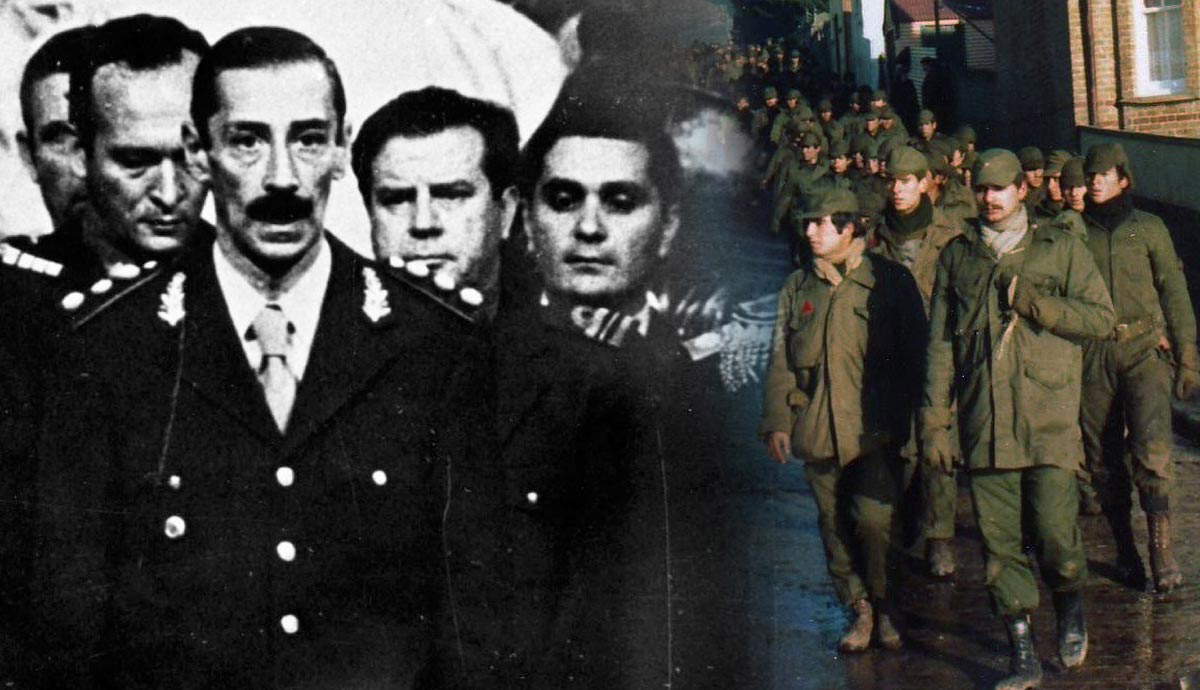
When Argentinas democracy gave way to a period of military rule in the 1970s, it followed a trajectory common in Latin American politics. However, the scale of violence inflicted by the regime in Buenos Aires was unprecedented in the region. It is estimated that 30,000 people were killed by the regime in the Dirty War until its fall. Democracy returned to Argentina in 1983 only after defeat to Britain in the Falklands War.The Peronist Dynasty and the MilitaryJuan Pron and Isabel Pron, 1973. Source: Everett Collection via Deutsche WelleFor much of the 20th century, Argentine politics played host to a struggle between military and civilian factions that often turned violent. From 1930 to 1981 alone, there were six military coups in the country, meaning that its politics became inherently unstable. Throughout Argentine history, the military had been considered a professional and stable force. This led to the belief that they were the only institution that could govern the country. Their professionalism ironically undermined their commitment to the state.Contrasting this vision was the policy of President Juan Pern, who ruled Argentina from 1946-1955 and 1973-1974. The leader of the Justicialist Party, Pern was one of Argentinas longest-serving leaders, husband of the famous Evita. His ideology, known as Pernism, consisted of non-alignment in the Cold War, economic self-reliance, and an inclusive society that embraced minorities. However, he also cracked down on opponents and sought to control the press. His cult of personality and support for legalizing divorce and prostitution rankled military leaders, many of whom were very conservative.In 1955, the military overthrew him as part of an effort to break his control of the country. He and his third wife, Isabel, fled into exile to avoid being arrested. Elections continued, but his party was banned. Nonetheless, he still exerted a major influence on Argentine politics from abroad and returned to the country in 1973 after the election of Hctor Jos Cmpora. He returned to the presidency in October a few months before his death in July 1974, which was mourned throughout the country.The 1976 CoupSoldiers on patrol in Buenos Aires during the Coup, 1976. Source: The GuardianAfter Pern died in 1974, he was succeeded by his wife and vice president Isabel. Isabel Pern hoped to win over the support of the military and weaken the small communist insurgency in the country by enacting ruthless anti-terror measures. She identified with the right-wing in the country because of her hostility to communism. Nonetheless, the military became convinced that she was not up to the task of defeating the communists. Senior officers believed that the country not only needed a new way forward; they also believed that the Pernists were privately connected to the communists.On March 24, 1976, Isabel Pern was flown to a military camp instead of her private residence and told that she was being arrested. At the same time, soldiers and sailors seized control of several newspaper headquarters, arrested other members of the cabinet, and occupied trade union buildings. Surprisingly, the coup was relatively non-violent, thanks to a lack of resistance by Pernist loyalists. Many Argentines had grown accustomed to military involvement in the countrys affairs and day-to-day life did not change immediately.Pern was placed under house arrest until 1981, when she was allowed to leave for Spain. The juntas leaders argued in a press conference after the coup that her politics were not the problem, it was her failure to deal with communists and anarchists. Nevertheless, the new military government would crack down aggressively on her supporters.The Junta and Its IdeologyMembers of the Junta including General Jorge Rafael Videla holding a press conference, 1976. Source: New York TimesInitially, the new government was led by a troika of military leaders: General Jorge Videla, Admiral Emilio Massera, and General Orlando Agosti, with the former as president. From 1976-1983, there would be four military governments. At a press conference after the coup, they promised that people would be allowed to live peacefully as long as they didnt associate with enemies of the state. They claimed that they would bring stability to the country, especially in the major cities.The juntas ideology has been defined as a mix of neo-fascism, corporatism, and anti-communism. They believed that the country needed a societal overhaul to prevent people from supporting leftist politics. They also believed that Argentinas Jews were supporters of communism. Many Argentine army officers spoke of a final solution for Argentine Jews, who represented five percent of the juntas victims during the Dirty War even though they were less than one percent of the population.Unlike some other regimes in Latin America, the so-called National Reorganization Process was not led by one individual strongman but rather a clique of senior military officers. This was due to internal rivalries and their desire to avoid a Pernist-style strongman. The economic policies they pursued were a mix of capitalism and corporatism that led to massive inflation and economic hardship. While Argentina had several military governments before, this one became infamous for its repressive policy towards its people.Resistance to the JuntaFlag of the Peoples Revolutionary Army. Source: Wikimedia CommonsWhen Argentinas generals and admirals spoke of enemies of the state, they often referred to the Montoneros and the Peoples Revolutionary Army. The Montoneros were an organization formed in 1970 by left-wing Pernists who wanted to restore Juan Pern to power and sought to use force to accomplish that goal. They were mainly composed of students and by the time the coup took place, they had been decimated by the state security services.The Peoples Revolutionary Army (ERP) was also engaged in hostilities with the Argentine government in the early 1970s. Composed of a couple of hundred militants, it had broken with the Montoneros and vowed total armed struggle against the government. Its weakness meant that it lacked any real ability to control territory but it was capable of inflicting violence. Similar to the Montoneros, the ERP was weakened after years of state action by the time the coup had taken place.General Videlas government made it clear that they considered anyone who opposed their rule as enemies. This went far beyond the Montoneros and ERP; it included trade unionists, members of leftist parties, homosexuals, and opponents of the Catholic Church. The journalist Jacobo Timerman spent several years in jail for his criticism of the junta even though he had no connection to the left-wing insurgents. While many newspapers managed to stay active during the junta years, they faced enormous pressure from the government to report the official narratives. Argentinas government carried out some of the most intense repression seen in Latin America since the time of Spanish rule more than a century and a half earlier.Disappearances and Operation CondorRemembrance march in Buenos Aires on March 24, 2024, the 48th anniversary of the coup. Source: Pablo Cuarterolo via Buenos Aires TimesWhile the term Dirty War is commonly used to describe the juntas actions, it is a misleading one. What the junta actually did was to practice a form of state terrorism against its own people. Isabel Perns government had targeted leftist dissidents, even using death squads, before the coup. However, the scale of state terror expanded massively after 1976. Instead of mass killings in the street, the junta sought to make its enemies disappear without attracting too much attention from the public. This practice was an international operation in South America known as Operation Condor.Much of the work done by the Junta was conducted by the Intelligence Secretariat, Argentinas security agency formed in 1946. Working with the police, the SI operated from secret locations where they tortured and murdered opponents and then got rid of their bodies. The junta sometimes took the children of their victims and sent them to another country. They also looted homes of disappeared people to send a message to their families. SI operated with total impunity and had the full backing of the state.Operation Condor enabled every Latin American right-wing dictatorship to target dissidents in their neighbors territory and there was no safe place for opponents of these regimes in Latin America. If the Pinochet regime in Chile identified opponents living in Argentina, then the SI could arrest and disappear them on behalf of the Chileans. While Condor ended in 1978, the Argentine juntas practice of disappearing enemies continued right up until its collapse.US Support for the JuntaHenry Kissinger meeting with President-elect Jimmy Carter, 1977. Source: Buenos Aires HeraldOne of the main reasons that the junta could act with impunity was because of the support it initially received from the United States. When the coup took place, President Gerald Ford was in office. His secretary of state, Henry Kissinger, was a major supporter of the Argentine military and ensured that the junta received American diplomatic backing. Argentina bought military equipment from a variety of sources including US arms manufacturers. Officials in Washington believed that this relationship was more important than human rights concerns.Declassified documents released in 2019 revealed that not only did the CIA know that a coup was coming, they knew what the junta planned to do. Even when American citizens were killed by the junta, the US stood by their partners in Argentina. The typical US response to the presence of leftist insurgents in Latin America was to arm the militaries opposing them, even when they committed horrendous atrocities. While the Carter administration paused US security assistance to Argentina in protest to their actions, the intelligence relationship continued.Ronald Reagans election in 1980 made it seem like everything would go back to normal. Reagan restored military ties in response to Argentinas closer ties with the USSR. They stopped public criticism of the junta by the White House and hoped that media scrutiny would decrease. However, when the junta decided to seize the Falkland Islands from Britain, Reagan supported the British, marking an end to the US governments relationship with the junta.The Falklands War and the Fall of the JuntaArgentine prisoners of war repatriated from Port Stanley in the Falklands, 1982. Source: Ken Griffiths / Wikimedia CommonsIn 1982, the junta faced a crisis of legitimacy. Scrutiny over its actions led to massive demonstrations. The economy was collapsing, prompting once-friendly businesses to turn against the government. Fearing a loss of control, Argentine President General Leopoldo Galtieri and Admiral Jorge Anaya developed a plan to seize the Falkland Islands off the Argentine coast. This would encourage rise in nationalism and give the military a sense of purpose. In April 1982, the navy and army took the British garrison prisoner and declared sovereignty over what they called the Islas Malvinas.This time, the junta met its match. British forces were better trained and equipped. In April and May, they mounted a ferocious counterattack using a large force of soldiers and sailors. The Argentine military may have been good at attacking its internal enemies but it didnt stand a chance against a NATO power. Argentinas defeat opened the floodgates of anger towards the junta and demands for elections.Disgruntled veterans, the relatives of the juntas victims, and supporters of democracy used the anger from the defeat to demand change. The Mothers and Grandmothers of the Plaza de Mayo marched every week in Buenos Aires to demand accountability. In 1983, the junta finally collapsed and allowed an election in which Raul Alfonsin won legitimately. Although the junta leaders hoped that they would escape scrutiny, they started to go on trial in 1985. Nine leaders were tried by courts of inquiry and five were found guilty. In its determination to root out its enemies, the junta killed over 30,000 people, started a war it lost, and wrecked the economy. Argentina has never had a military government since.











 English
 Arabic
 French
 Spanish
 Portuguese
 Deutsch
 Turkish
 Dutch
Dutch
 Russian
 Romaian
 Portuguese (Brazil)
 Greek
Greek