What Was the Nullification Crisis of 1833?
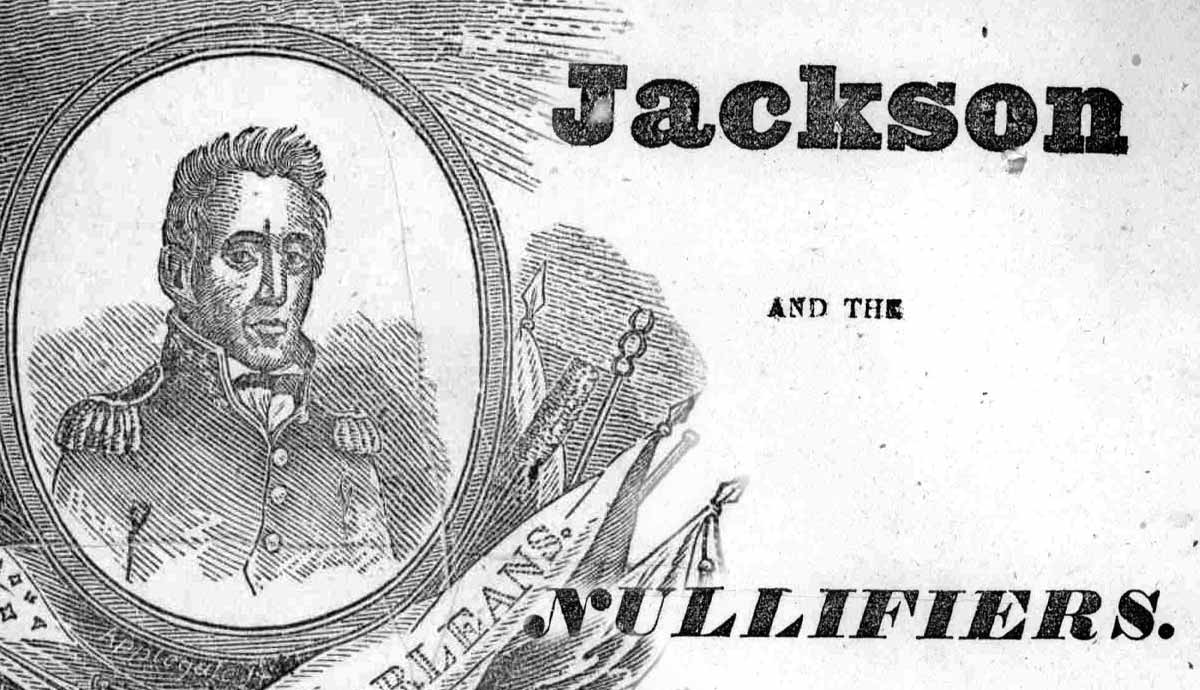
After saving the nation in the War of 1812 and enjoying the relative prosperity of the following Era of Good Feelings, Americans began to face internal tensions again during the early 1830s under Southern populist president Andrew Jackson. The Northeast was industrializing, while the South remained mostly agrarian and reliant on slave labor. Southern states began fearing loss of political power. This was acutely felt regarding tariffstaxes on importsbecause the South more heavily relied on imported goods than the pro-manufacturing North. The South, bound by federal law, was upset at having to charge these tariffs on imports. What would happen if a southern state decided to reject federal law and not collect Congressionally-mandated tariffs?Setting the Stage: The Articles of ConfederationAn image of a 1777 printing of the Articles of Confederation, which was ratified in 1781 as the United States first governing charter. Source: Library of CongressThe United States was created on July 4, 1776 with the signing of the Declaration of Independence. This famous document, however, provided no framework of government and simply proclaimed that the US was an independent nation from Great Britain. The work of government was established five years later with the ratification of the Articles of Confederation, which was created during the American Revolutionary War while true independence was still in jeopardy. During its writing in 1777, it was likely that Britain would still squash the independence movement with military force.Fearful of allowing a tyrannical leader similar to King George III of Britain to rise, the Articles did not allow for a chief executive of the United States. A small Congress existed, but virtually all representativesone from each statehad to approve a bill for it to become law. This Congress had almost no money to work with, as states could not be compelled to provide tax revenue to the tiny central government. For better or worse, almost all governing power rested within each individual state. Within five years, the new nation was on the verge of collapse as states could not work together or manage internal crises.Setting the Stage: The Constitution of 1787An image of the framers of the Constitution of 1787 meeting in Philadelphia, Pennsylvania that summer to create a new national charter. Source: National Park ServiceAfter Shays Rebellion almost tore the nation apart, George Washington and many other Founding Fathers agreed that the Articles of Confederation needed to be reformed to provide more power to the central government. Delegates from the states met in Philadelphia during the following summer to revise the Articles, working in Independence Hall, where the Declaration of Independence had been signed eleven years earlier. Quickly, they decided to scrap the Articles of Confederation altogether and craft a new constitution. This was a radical undertaking, and convention chair George Washington demanded complete secrecy to avoid public pressure.By autumn, the new Constitution of 1787 had been unveiled to the public, and many were displeased and suspicious. The Constitution created the position of chief executive, known as the president, and gave additional power in a new bicameral Congress to states with larger populations. This Congress and president could pass federal laws that applied to all states much more easily than under the Articles, which raised concerns that smaller states could be forced to adopt federal laws with which they disagreed. Could a Congress dominated by more populous northern states inflict unpopular laws on southern states?The South and TariffsAn image of a tariff stamp, which was used to indicate that a tax had been paid to import that product. Source: Mises InstituteIn addition to Indian affairs, another hot political topic circa 1830 was tariffs, or taxes on imports. During this era, tariffs were the largest source of tax revenue for the federal government, which would not be able to levy income taxes until the passage of the 16th Amendment in 1913. Tariffs were controversial in the 1820s, as they are still today. States with varying economies and industries were affected differently by tariffs, creating a growing political divide during that decade. States with industries benefited from tariffs limiting the import of competing foreign goods.The South had little industry and was mostly agrarian. Thus, it saw little benefit from tariffs. On the contrary, the South had to pay higher prices for imported goods due to the tariffs. Since the South had little industry, it relied proportionally more on imported goods from Europe than did the North. Many Southerners disliked the American System economic plan proposed by US Senator Henry Clay of Kentucky, which they saw as using tariffs to enrich the North and West at the expense of their own region.The Tariff of Abominations (Tariff of 1828)A map showing strong southern resistance to the Tariff of 1828, also known as the Tariff of Abominations. Source: Council on Foreign Relations (CFR)The tariff issue came to a head in 1828 with Congress passage of a high tariff known as the Tariff of Abominations. Tariffs were supported by incumbent president John Quincy Adams, a Northerner whose base of support lay in manufacturing states in New England. While the high tariff on imported goods from Europe would benefit New England factories, it would hurt other industries. The South was outraged because the lower demand for European cloth in the North meant that Europe had less demand for cotton, the Souths major export.Vice President John C. Calhoun, a Southerner, publicly criticized the tariff. In a political oddity, Adams vice president, Calhoun, was chosen as the running mate of Adams opponent, Andrew Jackson, making him the only vice president to serve under two separate presidents. Calhouns public dislike of the 1828 tariff meant opponents of the tariff had a new presidential candidate to vote for: Southerner Andrew Jackson. As a North Carolinian by birth and a former US Senator from Tennessee, Jackson was thought to be a firm supporter of Southern causes.The Rise of Jacksonian DemocracyA painting of US President Andrew Jackson (1829-1837), whose brand of populist politics created an era known as Jacksonian Democracy. Source: Society for US Intellectual HistoryEarly US presidents had considerably less power than modern chief executives until the rise of Southern populist figure Andrew Jackson, a hero from the War of 1812. Jackson disliked the elites in Congress and the federal courts; he believed that more political power should rest with the will of the voters. Jacksons distrust of Congress was likely intensified by the House of Representatives choosing his rival, John Quincy Adams, as president in the 1824 election despite Jackson winning more popular votes and electoral votes. Four years later, Jackson returned to run for president again, bolstered by lower- and middle-class men demanding populist reforms.Jackson won the presidential election of 1828 in a landslide. He quickly exercised unprecedented power for a chief executive and accused his predecessors of running a lax and wasteful bureaucracy. In regard to Indian policies, Jackson quickly showed himself to be a supporter of states rights and refused to honor federal government agreements to protect Native Americans in the South. Many Southerners felt that Jackson, an enslaver, was an overall proponent of states rights and could be counted on to quash Congress actions that were unpopular with them. Would Jacksons support for the South be put to the test?Would a Southerner Like Jackson Betray the South?A historical marker in North Carolina giving some information about the early career of future US President Andrew Jackson. Source: State of North CarolinaAs the first US president from the South, Jacksons loyalties were tested. He was not sympathetic to Congress or the courts, but would his own position as chief executive of the United States prevent him from caving to Southern demands? He disagreed that Native American tribes should be treated as sovereign states, which was the policy of his presidential predecessors. In 1830, he urged the creation of what would become the Indian Removal Act, which he signed into law on May 28. This led to the infamous Trail of Tears, in which Native Americans in the South were forcibly relocated to Oklahoma Territory eight years later.Those looking for a signal of Jacksons support for the South may have found it in the presidents controversial response to the US Supreme Court decision in Worcester v. Georgia (1832). The Court ruled in favor of the Cherokee Nation, finding that the state of Georgia was wrong to annex the Cherokee lands, which were part of a sovereign state with a constitutional government (Cherokee Nation v. Georgia, 1831). Jackson ignored the Supreme Court decision and did not force Georgia to stop its annexation of Cherokee territory, becoming the first US president to ignore a direct Supreme Court ruling.1832-33: Jackson vs. South CarolinaA pamphlet detailing the governor of South Carolinas opposition to the Tariff of 1828 and exploring nullification. Source: Library of CongressPerhaps emboldened by Jacksons refusal to enforce Worcester v. Georgia, plus the presence of anti-tariff vice president John C. Calhoun, the South was particularly incensed in 1832 when Congress passed tariff reform that was seen as insufficient. South Carolina had been dropping hints that it might nullify (refuse to enact) federal tariffs ever since the passage of the Tariff of Abominations four years prior and was upset that Congress did not seem to take its anger seriously. When Jackson was re-elected that fall, South Carolina announced it would not collect the tariffs beginning on February 1, 1833.An 1832 pamphlet praising US President Andrew Jackson as a hero and criticizing the nullifiers who were violating federal law. Source: Ashland UniversitySouth Carolinas Ordinance of Nullification was a serious threat to the power and authority of the central government. If a state was allowed to nullify a federal law with which it disagreed, what would hold the union together? Any state could theoretically nullify any federal law or executive order, making the central government moot. To ward off threats of force, the Ordinance of Nullification also stated that South Carolina would secede from the union if Congress put forth any punitive actions. All eyes turned to President Andrew Jackson, whose authority as chief executive was being directly challenged.Decision Time: Central Government Power AssertedAndrew Jacksons response to the Nullification Crisis was issued on December 11, 1832, and rejected South Carolinas efforts. Source: Library of CongressJacksons southern sympathies were not strong enough to sway his role as chief executive and commander-in-chief. The president swiftly responded to South Carolinas Ordinance of Nullification by ordering preparation for war. A militia was prepared to invade the state if necessary and prevent secessionand collect the tariffsby force of arms. Publicly, Jackson denounced South Carolinas attempt at nullification and asked Congress to give him the okay to use his presidential powers to preserve the union.On March 2, 1833, Congress approved the Force Bill of 1833, which allowed the Jackson administration to use force to collect the tariffs. Violence was ultimately averted thanks to some diplomacy by Senator Henry Clay, who passed the Compromise Tariff of 1833 on the same day. Tariffs would be reduced to an acceptable 20 percent, which was agreeable to Senator Clay, Vice President Calhoun, and President Jackson, as well as the government of South Carolina. This is sometimes known as the Compromise of 1833, and it preserved the union without the need to implement the Force Bill. Jackson received praise for thwarting nullification and asserting central government power.Looming Struggle: The Civil WarA January 1861 document revealing that the same anti-establishment feelings that led to the Nullification Crisis were strong in the South thirty years later. Source: Virginia HumanitiesDespite Jacksons decisive political victory over South Carolina, southern disdain for northern politics continued. A divisive new political issue arose beginning in the 1840s: slavery. While slavery had always been contentious, with northern states being predominantly free states and southern states predominantly slave states, public criticism of slavery as an institution intensified after the 1830s. The Second Great Awakening religious movement moved debates over slavery from the halls of Congress to the streets of the nation. Again, the South felt threatened.In 1861, almost thirty years after the Nullification Crisis, South Carolina again took political action against the Union. This time, it moved straight to secession and formally seceded from the United States. A few months later, soldiers affiliated with the new Confederate States of America fired on and captured the United States military fort located at Fort Sumter, South Carolina. This action began the deadly American Civil War, which raged for four years. This time, the Union was preserved by force of arms at the cost of over one million casualties. By 1865, the federal government had shown that states could not nullify or secede, putting the issue to rest.Nullification Issues Today: Immigration and CrimeA map of the US southern border with Mexico, where high rates of illegal immigration in recent years has led to conflict between some of these states and the central government. Source: NPRAlthough states have not attempted nullification or secession since 1865, they have not accepted unpopular federal laws or executive orders quietly. The Civil Rights Movement, especially, saw southern states publicly criticize the actions of Congress, the Supreme Court, and the president. Fortunately, decisive action by President Dwight D. Eisenhower in 1957 showed that states would be made to comply with Supreme Court rulings. This answered the question of whether presidents would use force against state attempts to nullify Supreme Court decisions.Today, states still publicly criticize federal policies, particularly concerning issues like immigration and criminal justice. Immigration policy is a federal issue, meaning states cannot create their own policies. This has led to states protesting immigration laws and threatening to enact their own enforcements, with conservative southern states desiring stricter restrictions on immigration. Some conservative states also disagree with federal policies on illegal drugs and other aspects of criminal justice, viewing them as too lenient. This is somewhat different from the Nullification Crisis, however, as the states are attempting to be more strict on an existing policy rather than less strict. Hopefully, the Supreme Court, rather than military force, will decide these debates.












 English
 French
 Spanish
 Portuguese
 Deutsch
 Turkish
 Dutch
Dutch
 Italiano
 Russian
 Romaian
 Portuguese (Brazil)
 Greek
Greek