Why Did the Bronx Break Down and Burn in the 1970s?
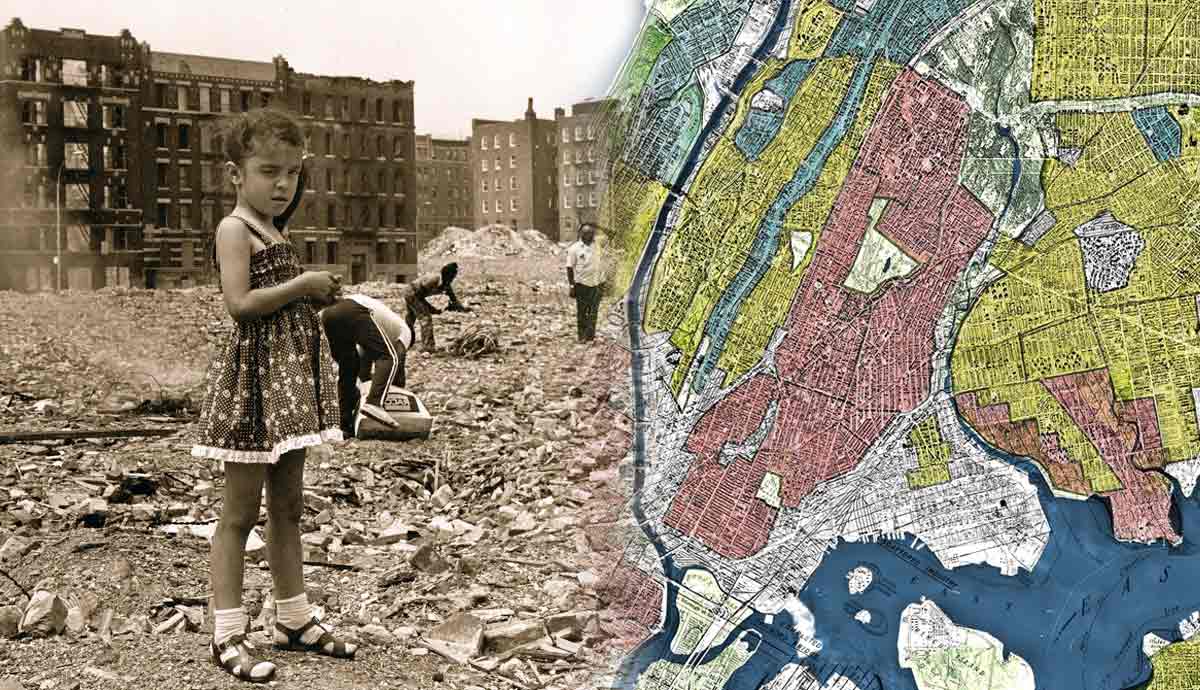
In the 1970s, the South Bronx was the symbol of post-industrial urban blighta wasteland of rubble, charred buildings, and deteriorating social services. Contrary to the prevailing belief, though, the people of the neighborhood were not setting the fires themselves, nor were they indifferent to their environment. Victims of deleterious government policy and entrenched racism, they nonetheless advocated tirelessly for help for their neighborhood and by the end of the decade began to coalesce into community organizations that finally helped bring about assistance and recovery.The Bronx BeforeThe view from Broncksland a century after Jonas Broncks death. Source: Ephemeral New YorkThe borough was mostly rural throughout the 19th century, attracting people who wanted to live in the country. But in the years between the turn of the 20th century and the Second World War, its population grew sevenfold, to 1.4 million people. The construction of the subway in 1905 helped bring people into the neighborhood, leading a journalist for the New York Times to marvel that block after block of new flats and apartment houses[are] springing up as if by magic. During the Great Depression, New Deal programs helped construct over one hundred housing projects, which were initially viewed as a positive development for the borough because they helped provide housing during a time in which people were struggling to attain a basic standard of living.Post-WWIIPublic Housing ruins, South Bronx, Camilo Vergara. Source: Library of CongressA major demographic shift happened after World War II. Now, mostly Puerto Rican and Black Americans were moving into the South Bronx, where they joined Jewish, Irish, and Italian immigrants. The neighborhood was integrated in a way that was healthy and meaningful for the residents. Vivian Vzquez Irizarry, the documentary filmmaker behind Decade of Fire (2018), remembered, When I grew up in the South Bronx, it was integrated. We spoke to so many people who talk about the South Bronx as diverse and vibrant, where you can ask for sugar from your neighborThere was an excitement to coming to New York and living in the Bronx with people they have never met before. The lady upstairs was my mothers best friend, and she was Jewish and also our babysitter. And there was the lady who was Irish on the second floor and also in my building there was an African-American and Cuban family. When I was a little girl, I didnt see that integration as anything but normal.But, as a result of various factors further detailed below, the neighborhood began to deteriorate. Crime soared, and the murder rate in the Bronx tripled in five years. Drugs became ubiquitous. The city pulled back on essential services. In 1969, the New York City Department of Planning described the South Bronx in its Master Plan as an area of turbulence and changeFrequent tenement fires force residents to move and leave gutted buildings or vacant lots. Residential densities are highFour-story walkups on 60-by-100 lots house as many as 21 families. Most of the housinggrim, crowded tenementsis concentrated between 134th Street and Bruckner Boulevard. The majority of residents are black and Puerto Rican. Mobility is highAn estimated two-thirds to three-quarters of the dwelling units in the district will be vacated over the next five years.The Bronx BurnsMy Playground, from South Bronx by Perla de Leon, 1980. Source: Latinx Project at NYUIn Game 2 of the 1977 World Series, sportscaster Howard Cosell apparently said, There it is, ladies and gentlemen. The Bronx is burning, as the ABC aerial camera panned around the neighborhood. Reports differ as to the veracity of Cosell uttering those words, but the statement, succinct and resigned, seems to sum up what was happening in the borough.In the 1970s, buildings were indeed beginning to burn, and the statistics are shocking: every building saw a fire at least once; 80% of the buildings were lost to fires; 250,000 people were displaced. One resident of the area remembered how the fires came about: We noticed it slowly, with two-story homes and small apartment buildings emptying out, then stripped for pipes and wires, and finally torchedthere was more money in insurance than rebuilding. Arsonists working for landlords would at least warn tenants of impending fires so they would not be asleep at home. Some people took no chances and slept with their clothes on. A retired firefighter, Tom Henderson, commented, The smell is one thing I rememberThat smell of burningit was always there, through the whole borough almost.The narrative in the media, perpetuated by the popular 1981 film Fort Apache, the Bronx, was that residents were lawlessly and callously burning their own houses down. By 1981, the media was declaring that The South Bronx is now a household synonym for abandonment, hellish crime, devastation, [and] terminal urban disease.Burned buildings and rubble in the early 1980s, David Gonzalez. Source: New York TimesPresident Jimmy Carter came to the South Bronx to see the extent of the destruction and pledge federal assistance. Nicole Gelinas recounts this visit in her article The Bronx is Up, writing that Carter saw row upon row of burned-out buildings, the brick facades scorched black, windows hastily boarded up withtin flashingjunkies nodded out in vacant buildings surrounded by charred artifacts such as smashed-up televisions, wheel-less roller skates, cracked bathtubs. It was a shocking, sobering scene, and Carter promised aid. The money never came, and the next president, Ronald Reagan, was certainly less inclined to help the beleaguered neighborhood.So what actually happened? Did the residents burn down their own homes, or was something bigger going on?What Actually Happened: Austerity, Benign Neglect, and Urban RenewalFirefighters in the South Bronx by Joe Conzo. Source: Latinx Project at NYUThe city of New York was in the depths of a major financial crisis in the 1970s. Officials implemented austerity measures, which meant bringing in consultants to trim budgets. Social services, education, enrichment programs, employment opportunities, and more were weakened. This translated to cutting firehouses, so in the Bronx, it was impossible to fight fires when they occurred. The South Bronx alone lost 12 fire companies between 1974 and 1976.Benign neglect is a term most likely coined by Daniel Patrick Moynihan, an advisor on urban and social policy to President Nixon. It advocates doing nothing to address social issues in the hope that they will resolve themselves. Scholars Roderick and Deborah Wallace claim Moynihan looked at the arson happening in the Bronx and concluded that the poor people of New York [were] lawless, pathological, and irredeemably locked into an antisocial behavior pattern. This meant that it was okay to take resources from their areas, and, regarding the fires specifically, not answer alarms when they went off in poor minority neighborhoods. As a senator in 1978, Moynihan fought against constructing new buildings in the South Bronx, stating, People in the South Bronx dont want housing or they wouldnt burn it down. Its fairly clear that housing isnt the problem in the South Bronx.A northeasterly view from Charlotte Street and Boston Road in the Bronx featuring the immense destruction of abandonment and arson on the boroughs urban landscape, 1984. Source: Camilo J. Vergara, Library of CongressAnother almost interchangeable term for benign neglect is planned shrinkage, which the Wallaces explain was the withdrawal of city services from sick neighborhoods that were seen as unfit or undeserving of survival. Roger Starr, the executive director of the Citizens Housing and Planning Council and later Mayor Beames Commissioner of Housing Preservation and Development, advocated for this policy in order to, as the New York Times said in 1976, hasten the population decline already begun in those neighborhoods so that, ultimately, cutbacks in city services could be concentrated in a limited number of areas.Starrs plan was a lot more insidious than those words suggest, especially as hed argued that community wasnt a real thingAmerican communities can be disassembled and reconstituted about as readily as freight trains. The Wallaces write that By denying the existence of the community social fabric and by evoking dysfunctional poor families, [Starr] helped provide the intellectual basis for massive demolition of the housing of the poor.Urban renewal was another term bandied about during this era and referred to the tearing down of slums to replace them with middle-class housing and civic centers. James Baldwin called it Negro removal, and its not hard to agree with him. Landlords sold their buildings to speculators, who divided the apartments into even smaller spaces, which is where those people displaced by the loss of their housing congregated. Drugs and crime began to proliferate under these strained circumstances.What Actually Happened: RedliningRedlining in the Bronx. Source: Segregation by DesignRedlining was the New Deal-era government policy of sending government surveyors into cities and drawing up maps for use by insurance companies and mortgage lenders that indicated which parts of the area were home to mostly Black or Brown people. The red areas were undesirable, and thus those companies and lenders refused to make it possible for people of color to attain home ownership there. At the same time, the Federal Housing Administration subsidized developers who produced all-white neighborhoods, furthering this de facto segregation in American cities. Ultimately, many people of color were pushed into housing projects.Richard Rothstein explains in his study of redlining, The Color of Law (2017), how there were white projects, but they had a lot of vacancies, while the Black projects had long waiting lists. Eventually, this was so conspicuous, he notes, that public housing authorities in the federal government opened up the white-designated projects to African-Americans, and they filled with African-Americans. At the same time, industry was leaving the cities, African-Americans were becoming poorer in those areas, the projects became projects for poor people, not for working-class people. They became subsidized, they hadnt been subsidized before And so they became vertical slums that we came to associate with public housing. All of this was relevant to the Bronx, which found its Black and Brown residents crammed into deteriorating public housing.The Neighborhood ResponseAerial view of the Bronx, New York City. Source: Ajay Tallam via FlickrTired of the racist, demeaning, and false narrative that suggested the fires were the fault of the residents themselves, and equally exhausted by the physical destruction of their homes, neighborhood organizations rallied using culture and community programs to reshape the Bronx. They pressured the city to create an arson investigation team, which was assigned to the area in 1982 and resulted in a reduction in the number of fires. In 1986, Mayor Ed Koch funded a $4.4 billion program to rehabilitate 100,000 units of housing. In the 21st century, the Bronx is a safe and stable area to the point that gentrification is starting to become a real issue for the borough, with poorer residents being pushed out.Walking in the Bronx today, its almost easy to forget the fires. But members of the community want to make sure that the efforts of the people who took back their own neighborhood arent forgotten. In addition, the Bronx River Alliance explains, it is also important not to forget that The Bronx residents were victims of fundamentally racist and classist policies that were sugarcoated as an improvement. In addition to that, the blame was placed on them. They had lost their lives, their loved ones, their homes, and so much more. To recenter their story on anything but that is unjust.












 Arabic
 French
 Spanish
 Portuguese
 Deutsch
 Turkish
 Dutch
Dutch
 Italiano
 Russian
 Romaian
 Portuguese (Brazil)
 Greek
Greek