King Charles Is Turbulent Life in 10 Artworks
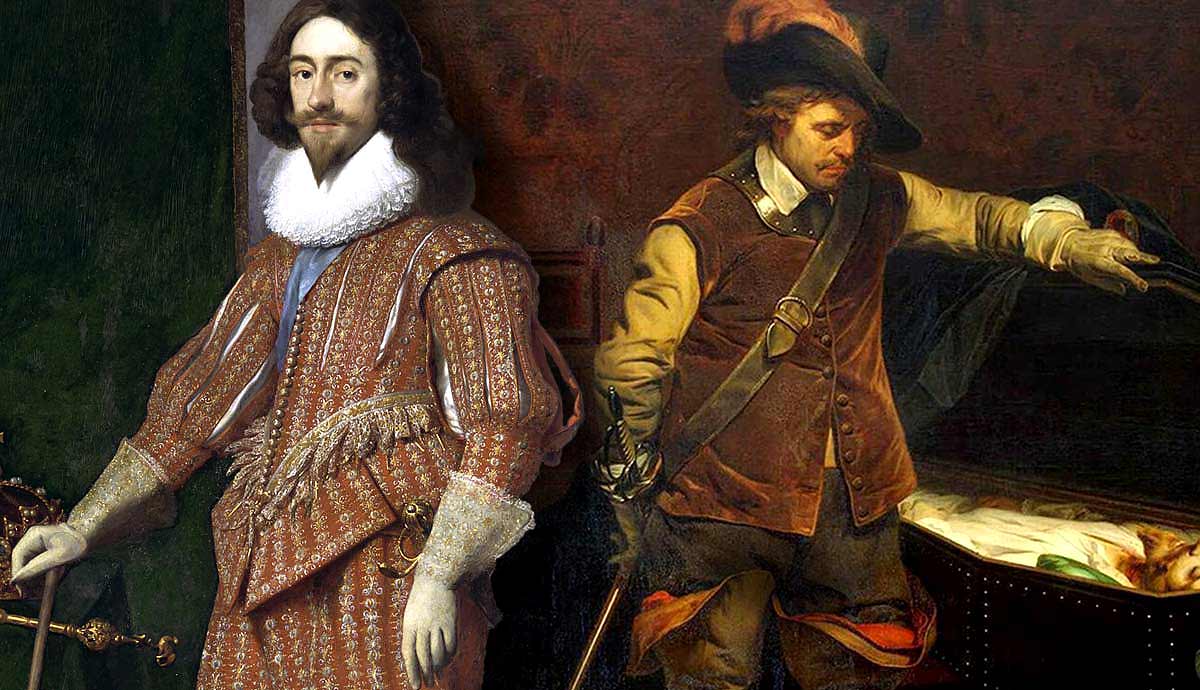
King Charles I ruled England between 1625 and 1649. He is most famous for being the only British king to have been openly tried and executed following an official court sentence. It is for this reason that his story continues to fascinate historians. One of the ways in which his astonishing tale can be recounted is through art.When it comes to artistic depictions of King Charles I, there are a myriad of works to choose from. Londons National Portrait Gallery alone is home to 346 pictures of the king at various stages of his life.1. King Charles I in Three Positions, by Anthony van DyckKing Charles I in Three Positions, by Anthony van Dyck, 1635. Source: The Royal Collection TrustWhat better artwork to begin with than this famous work? This vivid and realistic depiction shows us the appearance of King Charles I, but also who he was and how he chose to present himself to the world. The work, known artistically as a triple portrait, is appropriately and simply entitled King Charles I in Three Positions. It was completed by the Flemish artist, Anthony van Dyck, in 1636, the 11th year of King Charless reign.It is likely that King Charles would have been extremely proud of the finished result. He was a great admirer of Anthony van Dyck, for he granted him English citizenship and lifted him to the position of dominant portraitist at his court. It has been argued that while van Dyck lived (1599-1641), King Charles would not sit for another artist. King Charles I in Three Positions is just one of over 40 of van Dycks depictions of the Stuart monarch.So, why is King Charles I painted three times in the same portrait? Well, it is thought that van Dyck was inspired by the work of Lorenzo Lotto (1480-1556), who was known to create triple portraits, such as the notable Triple Portrait of a Goldsmith, which was completed in 1530. In turn, van Dycks triple portrait is thought to have inspired Philippe de Champaignes 1642 work, Triple Portrait of Cardinal de Richelieu.Triple Portrait of a Goldsmith, by Lorenzo Lotto, 1525-35. Source: Kunsthistorisches MuseumIn this triple portrait, the viewer is treated to three viewpoints of the king. The colors worn by King Charles are different in each depiction, but his lace collar remains in place, and he is consistently adorned with the blue ribbon of the Order of the Garter.In a world where cunning portraiture and clever angles had been used to hide all manner of scars and blemishes, (many historic figures such as King Henry V and Cardinal Wolsey were both only ever depicted side-on for this reason), King Charles I declared to the world that he was happy to be painted from all directions, and therefore made it clear he had nothing to hide.Here, King Charles I depicts himself as an open, honest, and powerful monarch at the height of his popularity and power in Britain, which gradually declined over the years, as we will discover after a few more artworks. But first, let us return to the very beginning of his life, to find out more about where his story starts.2. King James I and His Royal Progeny, by Charles TurnerKing James I and His Royal Progeny, by Charles Turner, 1814. Source: Wikimedia CommonsOn November 19, 1600, the boy who would one day become King Charles I of England was born. His parents were King James I of England (James VI of Scotland) and his wife, Anne of Denmark.This artwork, created by Charles Turner in 1814, is entitled King James I and His Royal Progeny. It is also significant to the future King Charles I, who appears prominently in the scene. When retelling the life story of King Charles I through art, this work is important because it explains where exactly he came from and showcases his royal lineage. Here, the then Prince Charles is surrounded by those with whom he grew up.At the center of the scene, sitting on a throne with the crown on his head, is King James I. Beside him, on his right and our left, is his wife Anne of Denmark. Charles had a particularly close relationship with his mother, and cared for her dutifully during her sickness in later life. Directly in front of Anne is the first son of the king and queen; his name was Henry, Prince of Wales. Just before Henry, we finally see Charles, the future King Charles I. Seated on the steps beside Charles are two of his sisters, Mary and Sofia, both of whom died in infancy.The rest of the figures belong to the family of Frederick V, Elector Palatine and King of Bohemia, to whom King James I married his eldest daughter, Elizabeth.3. Charles as Prince of Wales, by Daniel MytensCharles as Prince of Wales, by Daniel Mytens, 1623. Source: Wikimedia CommonsThe thing to remember about Charles I is that he was not born to be king. Just like a selection of notable monarchs before him, Charles unexpectedly became Prince of Wales and first in line to the throne on the death of a relative. His 18-year-old elder brother, Henry Frederick, died suddenly of suspected typhoid in 1612.As the eldest surviving son of the king, the eleven-year-old Prince Charles found that he was now heir apparent, which meant that, assuming he outlived his father, which was more than probable even in this era, he would definitely be king. This artwork depicts Charles as Prince of Wales, the title he inherited from his brother.It was not until many years later, on March 27, 1625, that he became king. He was crowned at Westminster Abbey on the second day of February the following year.4. King Charles I and Henrietta Maria, by Daniel MytensKing Charles I and Henrietta Maria, by Daniel Mytens, 1631. Source: Wikimedia CommonsThis work, also by Daniel Mytens and completed in 1631, is a very meaningful and romantic portrait. It depicts King Charles I passing a laurel wreath to his wife of five years, Henrietta Maria of France. The laurel is traditionally used to represent intimacy and purity, and is applied here as a symbol of their union and public declaration of love.King Charles I, unlike many of his predecessors, was renowned for his adoration of his wife and his faithfulness and loyalty to her. The couple married on June 13, 1625, just a month after his accession to the throne. Although deeply cherished by her husband, Henrietta was remarkably unpopular in England and was forced to seek refuge in France in 1644, years before Charless defeat and death.5. King Charles I With Prince Charles, by Anthony van DyckKing Charles I with Prince Charles, by Anthony van Dyck, 1635. Source: Wikimedia CommonsHere we have another depiction of King Charles I, painted by Anthony van Dyck. This time, King Charles has a small child at his side, its two tiny hands resting on his knee. This young boy is Prince Charles Stuart, the first surviving son of the king and queen. In around three decades, after the ever-changing and turbulent years that were yet to come, this sweet-looking child would eventually be crowned as King Charles II of England. This is one of a handful of portraits consisting solely of King Charles I and his first heir.With his wife Henrietta Maria, King Charles I produced nine legitimate children. Charles James, the first of their children, came into the world and departed from it on the same day, May 13, 1629. Prince Charles, the prince depicted in this portrait, arrived almost exactly a year later, on May 29, 1630. A little brother for Charles, the future King James II of England, and the second of King Charles Is children to succeed him, was born on October 14, 1633.The other children of King Charles I and Henrietta Maria were Mary Stuart (1631-1660), Elizabeth Stuart (1635-1650), Anne Stuart (1637-1640), Catherine Stuart (1639-1639), Henry, Duke of Gloucester (1640-1660), and Henrietta Stuart, Duchess of Orleans (1644-1670).6. The Eve of the Battle of Edgehill, by Charles LandseerThe Eve of the Battle of Edgehill, 1642, by Charles Landseer, 1845. Source: Wikimedia CommonsThe English Civil War was fought between 1642 and 1651. As we know, the opposing sides were the Royalists (cavaliers) and the Parliamentarians (roundheads). The first battle of this conflict was the Battle of Edgehill, which was fought on Sunday, October 23. The artwork above, entitled The Eve of the Battle of Edgehill, depicts King Charles I and his entourage as they prepare for what awaits them the following day. It was painted two centuries later, in 1845, by the British artist Charles Landseer.There are many notable figures depicted in this scene. King Charles I stands at the center, and can be identified by the sash of the Order of the Garter. Rupert of the Rhine sits at the table on his right, and on his left, Lord Lindsey stands with his baton pressed against the map. Directly behind Lord Lindsey, if you look carefully, you will see the faces of the Prince of Wales (later King Charles II) and the Duke of York (later King James II).King Charles I and his army were victorious at the Battle of Edgehill, but this was only the beginning of a nine-year war. Other notable battles of the English Civil War included the Battle of Wakefield (1643), the Battle of Marston Moor (1644), and the Battle of Naseby (1645).7. King Charles I at Carisbrooke Castle, by Eugene LamiKing Charles I at Carisbrooke Castle, by Eugene Lami, 1829. Source: The LouvreOur next artwork, King Charles I at Carisbrooke Castle, was painted by the French artist Eugene Lami. It depicts the moment at which King Charles I arrived at his new place of residence. Carisbrooke was, and still is, located on the Isle of Wight, a small island off the South Coast of England. This was not a holiday-like excursion or pleasure trip. King Charles was held captive here for around a year, in the midst of the English Civil War, his imprisonment having begun on November 13, 1647.There were many escape attempts during this short time. Many Royalists living on the island were keen to take part in a heroic expedition to set their king free. The most notable attempts occurred on March 20, 1648, and on May 29, 1648. Unfortunately for the king and his supporters, none were successful.After the moment depicted in this artwork, King Charles I did not walk free again. He left Carisbrooke on the 6th of September in 1648. From there, he was transported to Newport, the capital of the Isle of Wight. Next, he was transferred to Hurst Castle, and from there to Windsor Castle and eventually to London, where he was executed in January of 1649.To many, this depiction of King Charles I is representative of all the time he spent imprisoned or captive at the hands of his enemies.8. King Charles I Insulted by Cromwells Soldiers, Paul DelarocheKing Charles I Insulted by Cromwells Soldiers, by Paul Delaroche, 1837. Source: Wikimedia CommonsNext, we have the first of two paintings on this list by the French artist Paul Delaroche. It is entitled King Charles Insulted by Cromwells Soldiers, and was completed in 1836. This painting depicts King Charles during the days leading up to his execution, as he is taunted and mocked by supporters of Oliver Cromwell. The man on his right blows cigar smoke into his face, while the man on his left is laughing and smiling, and a few other men watch and perhaps participate in the torment from the background.Although it may not initially seem so, this artwork is actually quite sympathetic to King Charles I. It was painted not to make a mockery of the king, but to evoke some emotion in the viewer on his behalf.The king remains calm, which showcases his strength of character. The only annoyance this mistreatment seems to have caused him is the distraction from his reading. The open book in his hands reminds us of his love of art and literature.9. The Execution of King Charles I, UnknownThe Execution of King Charles I, 1649. Source: Wikimedia CommonsIt was on January 30, 1649, that British history was made, for it was then that King Charles I of England was beheaded outside the Banqueting House of Whitehall in London. The event took place at precisely two oclock in the afternoon, on a particularly cold day in the middle of winter.When he appeared before the crowd just before the time of his death, he was described by his loyal servant, Thomas Herbert, as the saddest sight he ever saw. King Charles I was determined not to seem afraid before his audience, and it is often said that after realizing he was trembling, he requested an extra shirt, so that the people should not mistake his cold for fear.King Charles I, by Daniel Mijtens, 1629. Source: Wikimedia CommonsThis work, entitled The Execution of King Charles I, is a rare depiction of this miserable day. Very few scenes of the execution exist, partly due to the fact that they were suppressed in England by Cromwell, and perhaps because artists did not want to appear sympathetic to their former king. Nonetheless, European artists who had no involvement with the affair were free to depict what they pleased. For example, this work was originally attributed to a painter named Jan Weesop, but is now labeled as belonging to an anonymous Dutch artist.There are some interesting details to look out for in this work. At the front of the scene and the back of the crowd, a young woman dressed in gold falls to the floor after fainting. The axe remains in the hand of the executioner, and the detached head of King Charles is held up by another man on the scaffold.King Charles I remains the only king in British history to have been tried for treason and executed. Even in the 21st century, this decision is considered one of the most controversial in our history.10. Cromwell Opening the Coffin of King Charles I, by Paul DelarocheCromwell and the Corpse of King Charles I, by Paul Delaroche, 1831. Source: Kunstmuseum BaselAfter the death of King Charles I, Oliver Cromwell took his place as the newly styled Lord Protector of the Realm. This was an unprecedented situation, and under this new ruler, great change was in store for the people of England. A Dutch Diplomat named Abraham de Wicquefort recorded the events that immediately followed the execution of King Charles. Immediately after the death of the late King, he said, Oliver Cromwell had no sooner made himself Sovereign, under the Quality of Protector, than all the Kings of the earth prostrated themselves before this idol.This painting by Paul Delaroche, completed in 1831, is entitled Cromwell Opening the Coffin of King Charles I. It depicts a legendary event, as there is no evidence or even suggestion that Oliver Cromwell visited the corpse or expressed a desire to do so. This rather macabre scene shows Cromwell lifting the lid of the kings black coffin and staring directly at the body. This is not just a quick glance, but a clear and lasting look. It seems almost as if Cromwell intends to ensure that Charles is truly dead. Interestingly, although the king is quite clearly deceased, no unmistakable evidence of decapitation is actually visible to the viewer.This artwork is cleverly done and masterfully created. Because it gives no clear sign of what Cromwell is thinking, it could appeal to anyone in England, whether they favor Cavaliers or Roundheads. Is Cromwell gloating over his triumph, or is he showing remorse for what his campaign had caused? Is King Charles a stubborn and obstinate ruler deserving of his fate, or is he an unfortunate but worthy martyr? The choice belongs entirely to the viewer.Cromwell with the Coffin of King Charles I, by Eugene Delacroix, 1831. Source: Wikimedia CommonsThis work is poignant as it is one of only a handful of works that portray a king of England after his death. There is one other portrait, extremely similar in content, which depicts Cromwell visiting the kings body. This version is entitled Cromwell with the Coffin of King Charles I, and was painted by Delacroix in 1831. It portrays an accidental meeting rather than a purposeful one.The defeat and execution of King Charles I was not the end of the Stuart story. Had it not been for the Restoration of the Stuart monarchy in 1660, King Charles I may very well not only have lost his own crown, but also the crowns of many kings and queens of England who were to come after him. Fortunately for Royalists, that was not the case. Just as King Charles I would have so desperately desired, his eldest son reigned from the Restoration until his natural death in 1685. He was known in his day as King Charles II of England, Scotland, and Ireland, and is now remembered fondly by the population as Britains Merry Monarch.













 English
 French
 Spanish
 Portuguese
 Deutsch
 Turkish
 Dutch
Dutch
 Italiano
 Russian
 Romaian
 Portuguese (Brazil)
 Greek
Greek