Why the US Army Stormed Santiago to Topple Spanish Rule in Cuba
In a mere matter of months in 1898, the United States managed to destroy what remained of the Spanish Empire. The American siege of Santiago in Cuba was a textbook assault by a joint army-navy force and it presaged Americas use of amphibious assaults in later wars.How Did the Sinking of the USS Maine Trigger the Cuban Campaign?A painting of the explosion aboard the USS Maine, 1898. Source: Naval History and Heritage CommandFor decades following the Civil War, American political leaders had their eyes on Cuba as a strategically valuable piece of territory to control. Spain had ruled the island since Christopher Columbus claimed it for the Spanish crown in 1492. After the loss of continental Latin America, Cuba became the main Spanish possession in the Americas. Its sugar plantations and ports made it a tantalizing target for American policymakers who hoped to establish some form of control over the island. When Cuban rebels rose up under the leadership of Jos Marti in 1895, American hawks found an opportunity to assist the rebels. Spains ruthlessness in attempting to crush the Cuban rebels encouraged the American public to offer the Cubans further support.In January 1898, Spanish loyalists in Havana rioted due to fears that the liberal government in Madrid would give Cuba independence. These disturbances led to the US consulate in Havana demanding American protection for US citizens in the city. The Navy Department agreed to send the USS Maine to Havana harbor in case Americans in Cuba needed to be evacuated. At this point, the administration of William McKinley was opposed to going to war with Spain, though public pressure in America was increasing.In February, the Maine was docked in the harbor when the ship exploded and hundreds of men died. A navy investigation claimed that a Spanish naval mine destroyed the ship, though most historians believe it was an internal explosion. In April, the US Congress issued a demand that Spain evacuate Cuba. When Madrid refused, the Americans declared war and began mobilizing forces to fight.Why Was Santiago de Cuba the Primary Target of the 1898 Invasion?A map of Santiago during the siege, 1898. Source: Milhaud MapsThe American plan at the onset of the Spanish-American War was to blockade Cuba and send weapons to the revolutionaries, with the aim of toppling Spanish rule without introducing any army personnel. This came alongside additional operations to seize Puerto Rico, Guam, and the Philippines. The administration had more faith in the navy than it did in the army and believed that Spain would sue for peace if its navy was destroyed and its ground forces in Cuba were cut off. The plan was based on years of intelligence gathering by the US and claims made by Cuban revolutionary leaders then in talks with the United States government.However, the Spanish Caribbean Squadron under Rear Admiral Pascual Cervera y Topete went into the harbor of Santiago, where they were protected by earthworks dug by the Spanish garrison. The US Navy could not enter the harbor without risking its warships. Therefore, the plan changed. American forces would land near the city of Santiago and besiege the fortifications. In doing so, they would drive the Spanish fleet out of the harbor, where it could be destroyed by the Americans at sea.To land in Cuba, the US military assembled a formidable force. The V Corps, commanded by Maj. Gen. William Shafter, had around 20,000 men in its ranks. It contained two infantry divisions, a cavalry division, and a large artillery train. It was supported by Cuban General Calixto Garcia and his force of some 5,000 men. The Spanish commander Gen. Arsenio Linares had a force of 10,000-12,000 men available to defend the city, composed of a mixture of Spanish regulars and loyal Cubans. They occupied formidable positions around the city and sought to hold off an American advance. The fighting in Santiago became the focal point of fighting for the entire war.Who Were the Rough Riders and Buffalo Soldiers at San Juan Hill?Theodore Roosevelt (front-center with glasses) standing with other Rough Riders. Source: US National Park ServiceAfter US forces landed in Cuba, they drove through several Spanish blocking forces and arrived at the outskirts of the defenses of Santiago. One of the hills the Spanish controlled was called San Juan Hill, and its seizure would allow American artillery to place guns directly targeting Santiago. General Shafter ordered men of the Cavalry Division to dismount and seize the hill on foot. Concurrently, American forces were to take El Caney village and Kettle Hill (connected to San Juan Hill). The Spanish, composed of 750 men in several different battalions on the hills, were very well fortified, but outnumbered and outgunned by the Americans.Three regiments played a crucial role in taking both hills. Lieutenant Colonel Theodore Roosevelt, who had resigned as Assistant Secretary of the Navy to serve in the war, was temporarily in command of the 1st Volunteer Cavalry Regiment, nicknamed the Rough Riders. His men were joined by the 9th and 10th Cavalry Regiments, both of which were majority-Black units (Buffalo Soldiers). These three units stormed up Kettle Hill under a maelstrom of fire to seize Spanish trench lines in advance of a larger American assault on San Juan Hill. Roosevelt gained a lot of sympathetic press due to his heroics. The Buffalo Soldier regiments did not, a reflection of the hostility Black men in the military faced at the time.Elements of the 1st Infantry Division marched up San Juan Hill. They were supported by Lt. John Henry Parker and his detachment of Gatling Guns, which laid down suppressing fire to assist the infantrymens advance. After several hours, the Americans took the rest of the Spanish positions and El Caney, dooming the Spanish inside the city. General Linares began to prepare negotiations for the surrender of the city when it became clear that Spanish troops elsewhere were not coming to his aid.What Role Did Cuban Insurgents Play in the American Victory?Cuban rebels during the War of Independence. Source: Lujo CubaThe American offensive would have been much more difficult to execute without the support of the Cuban Liberation Army under General Calixto Garcia. Around 5,000 Cubans helped shield the flank of the American advance and cleared the beaches before the Americans landed on the island. Garcias men had plenty of battle experience against Spanish forces. They also knew the terrain and were prepared to help the Americans avoid the worst effects of yellow fever and malaria, historically rampant in Cuba.Elsewhere on the island, Cuban insurgents attacked Spanish garrisons relentlessly. They aimed to keep the Spanish from reinforcing the defenses of Santiago and to keep the defenders guessing where the Americans might land, in addition to Siboney. The American War Department happily provided humanitarian and military aid to the Cubans, intending to turn them into a formidable guerrilla force.Armed with Winchesters and Krag-Jorgensen rifles, they happily hunted down Spanish troops all throughout the island and withstood Spanish counter-insurgency sweeps. Even when Spain began transferring the Cubans into concentration camps, the insurgents maintained control over large swaths of the countryside and developed a political infrastructure to assume control once the Spanish were driven out.Despite American sympathy for the Cubans, many American officers and politicians denigrated the Cuban rebels. They were regarded as savages who could not fight a conventional battle. When US forces took control of Santiago, the Cubans were prohibited from taking part in the surrender ceremony. General Garcia fiercely protested, but to no avail. Even when Cuba formally gained independence in 1902, the US still sought to influence Cuban domestic politics, which played a role in Cubas turn towards Communism in 1959.Why Did the Battle of Santiago Mark the End of the Spanish Empire?An illustration of the Naval Battle of Santiago, 1898. Source: Naval History and Heritage CommandOnce the Americans began fortifying the heights around Santiago, Admiral Cervera took his squadron of six ships out to sea. He feared that American artillery would destroy his ships at anchor. The poorly maintained Spanish ships proved sluggish and were prone to catching fire. Commodore Winfield Scott Schley led an American squadron of six to eight ships blockading the harbor and began to chase the Spanish down.The American ships were better built and their crews better trained. Over the next couple of hours, Commodore Schleys ships hammered the Spanish at very low cost to themselves. Cerveras flagship, Infanta Maria Teresa, was destroyed and the Americans captured the Spanish admiral at sea. Every Spanish ship burned easily and the Americans won a victory as lopsided as the Naval Battle of Manila Bay. 323 Spaniards died, 151 were wounded, and roughly 1,700 were taken prisoner. Remarkably, American casualties amounted to one dead and one wounded.The destruction of the Spanish fleet proved fatal for Spanish forces in the Caribbean. Hundreds of thousands of troops were stationed in Cuba and Puerto Rico, but their continued presence was only tenable if they could be supplied and reinforced by Spanish ships. Once Admiral Cerveras ships were sunk, Madrid could not send supplies across the Atlantic, dooming its overseas garrisons. They had no choice but to sue for a peace that would mark the end of their overseas empire.How 1898 Transformed the United States Into a Global EmpireA cartoon of Uncle Sam invading Cuba, 1898. Source: PBSVictory over Spain enabled the United States to become a major power in the Americas and the Pacific. The United States acquired territories covering over 115,000 square miles and displayed a knack for expeditionary warfare. On the other hand, Spanish power was degraded and the ensuing political instability in Madrid led indirectly to the Spanish Civil War. Gaining control over Guam and the Philippines (along with Hawaii in a separate process) enabled the United States to project its naval power across the Pacific. Even though the United States got stuck in an insurgency in the Philippines, few observers around the world doubted that America was a global power.By removing the last vestiges of the Spanish Empire, the US effectively turned the Caribbean into an American lake, clearing the way for the eventual construction of the Panama Canal and ensuring American strategic dominance in the Western Hemisphere.Since President Monroe formulated the Monroe Doctrine in 1823, the United States always sought to assert its influence over the whole American continent, and it now had a free hand to do so while Europe competed over control of Africa and Asia. The United States took control of Guantanamo Bay and established a naval base and a prison, which it still controls to this day. Additionally, the United States began deploying troops and ships to several Central American and Caribbean countries as part of its efforts to protect American property and business. While this strategy did backfire at times (the insurgency in Haiti and the Cuban Revolution of 1959), it affirmed the power that the United States continues to have over the region.




 0 Reacties 0 aandelen 36 Views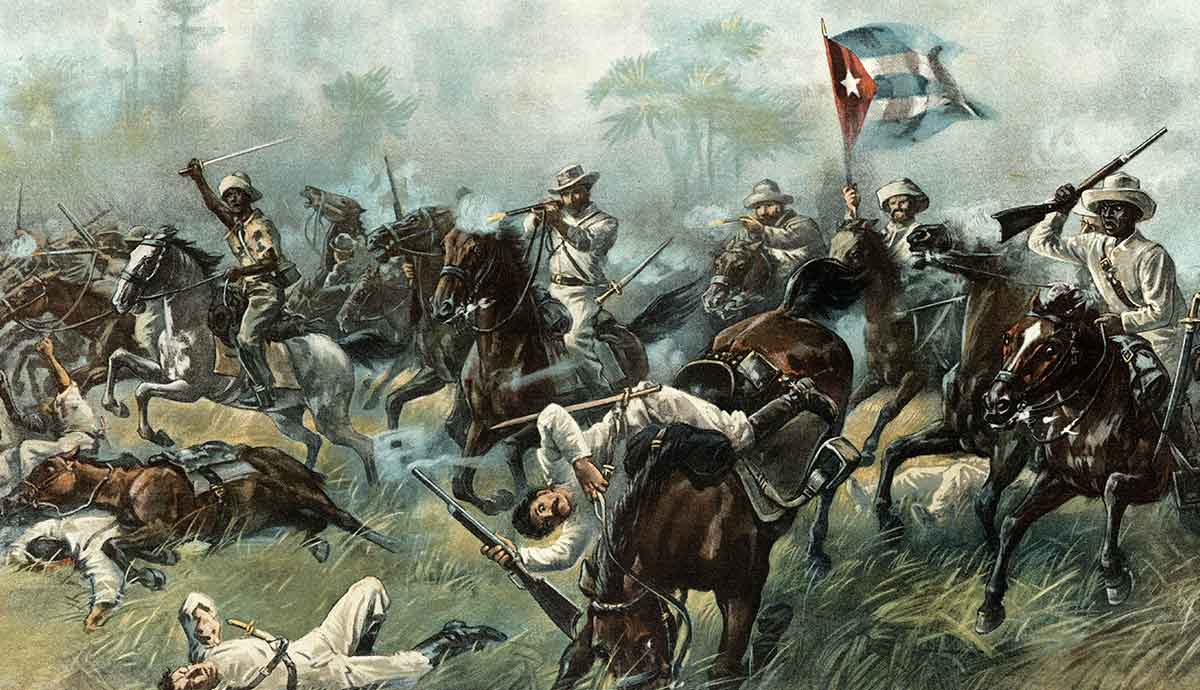






 English
 Arabic
 French
 Spanish
 Portuguese
 Deutsch
 Turkish
 Italiano
 Russian
 Romaian
 Portuguese (Brazil)
 Greek
Greek