'It sounds so impossible': Student studying fungus that makes users hallucinate tiny people may be on the verge of a scientific breakthrough
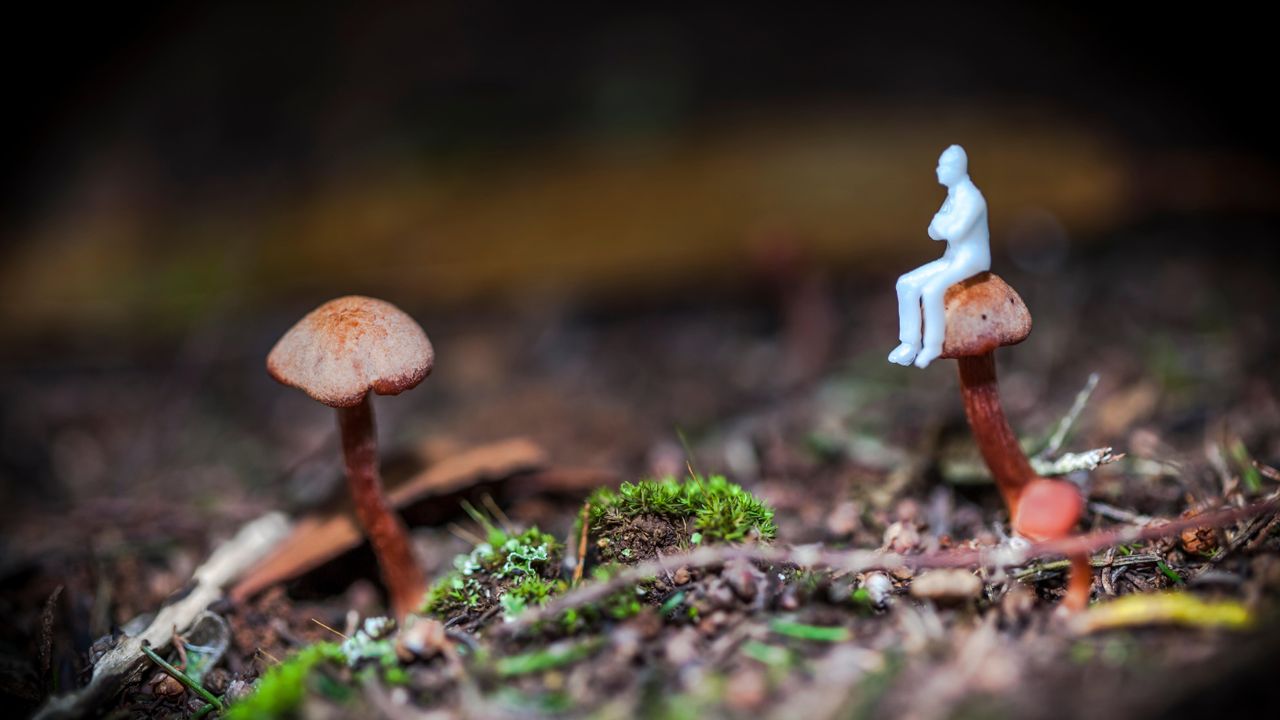
It takes a dozen or so hours for the mushroom to kick in. Then, the hallucinations are unlike any others known to science. On this trip, there are none of the heightened colors, breathing or pulsing objects, nor geometrical patterns typically reported by users of psychedelic substances. In fact, the hundreds of people who enter clinics in China's Yunnan province during each year's summer mushroom season tend to report their vision as being clear and largely unaltered.Well, aside from one major exception: nearly all users see visions of hundreds to thousands of highly-rendered miniature people, dressed in bright colors like elves, gnomes, clowns or other fairy-like figures. The hallucinated sprites wriggle under doors, dive off spoons into soup bowls and make lewd and mischievous gestures, among other strange behaviors. These visions are reported by 90% of those who consume a single species of bolete mushroom, called Lanmaoa asiatica, in its raw or undercooked form. Yet despite decades of anecdotal reports, the fantastical claims were dismissed by western scientists as a form of "mushroom madness" until Colin Domnauer, an undergraduate student taking an optional university module on funguses, caught wind of the reports.Domnauer, now a doctoral student at the University of Utah, made finding and analyzing the mushroom the purpose of his PhD, a goal that took him to China and the northern Philippines on the trail of a hallucinogenic compound that is likely completely unknown to science.Live Science sat down with Domnauer to discuss L. asiatica, the bizarre revelations it could hold for how we perceive reality, and the barely-discovered fungal universe that surrounds us. Here's what he had to say.Ben Turner: Let's start by introducing this mushroom. What is Lanmaoa asiatica?Colin Domnauer is a doctoral student studying ethnobiology at the University of Utah and the Natural History Museum of Utah whose search for an underdocumented psychedelic mushroom is revealing a completely new hallucinogenic compound. (Image credit: Colin Domnauer)Colin Domnauer: Lanmaoa asiatica is a species of mushroom from Yunnan, China. It was described to science only 10 years ago in 2015, so it's a relatively newly discovered species, but it was actually being sold in the markets in Yunnan for decades before scientists realized it was its own species.Through the work I've been doing, we've come to the conclusion that this species is responsible for really strange reports of hallucinations that people are getting after eating wild mushrooms in China, and elsewhere in the world as well.It's a species that grows with pine trees. It has a symbiotic relationship called a mycorrhizal relationship and so, for that reason, it's something that can't be cultivated artificially. And it's still only found in its wild habitats, so it's difficult to distribute in that sense. But it's still relatively common and popular in the places that it is found.BT: The mushroom is growing in notoriety because of the uniquely bizarre hallucinations it's reported to cause. Lets say I ingest a significant dose of raw or undercooked L. asiatica right now, what's my next week gonna look like?CD: Alright, so we don't know exactly the amount of mushroom that's required to get this effect, because in all these cultures they're eating it accidentally, or they're eating it just as food, but they're not intentionally pursuing the psychoactive effects. These effects are seen as an accidental side effect of eating too much, or if they're not cooked enough.But if you do have a substantial amount, what we do know is that after about 12 to 24 hours you're going to start getting Lilliputian hallucinations, which is a clinically defined syndrome that's characterized by seeing little people or animals all around your environment.And these aren't like some vague hallucinations, these are like three-dimensionally-rendered, highly-detailed figures inhabiting your exterior world. And they're also interacting with objects in the real world like crawling up chairs and tables or crawling under doorways, people say. So there's a very strange and specific type of reality-grounded, projected hallucination. Even to this day science doesn't understand what's going on in the brain to cause this, or how to treat it, and this mushroom is the only thing that we currently know of to reliably produce this effect.In southwestern China's Yunnan province, Lanmaoa asiatica is prized for its umami-rich flavor. (Image credit: Colin Domnauer)BT: Okay, so immediately there's a lot I want to ask you. Firstly, these tiny people are pretty reliably reported, right?CD: At first scientists dismissed it as a folk tale or something, because it sounds so impossible, but this is actually something that affects hundreds of people every year in Yunnan, China, and there's many hospital reports of people getting affected in this way. In fact, one study looked at about 400 cases in a year of people who were affected by this mushroom, and 90% of them said that they had these Lilliputian hallucinations. It's a very hallmark symptom of this mushroom.BT: From the case reports we have hundreds to thousands of clearly-rendered, often brightly-colored, gnome or fairy-like little people clambering about and crawling under things. What else are they doing? Are they talking to the people having the hallucinations, is there much interaction going on?CD: That's something that's not as commonly reported, but it has been mentioned in a handful of cases, both in China and in other cultures where this phenomenon has been noted.The little people are said to typically like teasing, playing with or harassing the person seeing them, so there is some level of interaction there. They're typically viewed to be amusing, mischievous, that sort of attitude. They're not usually seen as threatening, although in a few cases people felt that way.BT: Are there any other clinically-reported effects on the mind and body?CD: Yeah, there are. The Lilliputian hallucinations are the most striking symptom, but there's other things as well. About 50% of people reported having some gastrointestinal upset after eating this mushroom. It's not clear exactly the severity of that, because this was just a statistic that was noted in these papers, and it's also not clear if it was caused by this mushroom specifically or other things they were eating in the meal. So these aren't really robust studies in that sense, they're just collecting data of people who happen to get these effects. And then another key thing that a lot of people note is that they seem to be typically weakened, more tired and delirious, so this could give us a hint as to the mechanisms that this unknown compound is working through. So it sounds quite different from the known psychedelic compounds.And it's not only because of that. This is actually something I forgot to mention, but these hallucinations can last several days long. So it's not something that is experienced over a few hours like other compounds.BT: If people are hallucinating thousands of miniature people taunting them for several days, are there any injuries or fatalities linked to cases? Or is it just unpleasant and irritating, but harmless?CD: Yeah, that's something I really was curious about, because it sounded like it must be quite harmful if it's something that's sticking around in the body for several days and having these strong effects.But interestingly, all those hundreds of hospital reports reported zero deaths or fatalities. They also reported no abnormalities in vital organ function, so it seems to be physiologically safe. But then, at the same time, we don't know if that's because those people were admitted to the hospital and they were getting proper treatment, or if we only have the records of people that were committed to the hospital, so it might be a skewed sample.BT: You mentioned that this mushroom is found in China's Yunnan province. And you personally also identified it in the northern Philippines too. I was wondering how widespread and integrated into the cultures of these regions it is. How widely known is it? Is it treated as a mischief of little significance, or has it been integrated into any religious practices? CD: In all these places, the mushroom is viewed as a very prized edible. It tastes very good and has a great flavor, but it's never been integrated into any spiritual or religious practices for the psychoactive effects. The psychoactive effects are like an accidental side effect of a food, and they're viewed as sort of an amusing side effect of that. They're not something that they intentionally pursue, but it's also not something that they feel fearful of and avoid. Everyone knows that this mushroom has this property and can make you see little people, but they'll continue to eat it anyway, because they're just not afraid of that effect. But they're also not pursuing it, if that makes sense. It's sort of a middle ground viewpoint they have.Yunnan province is known as the wild mushroom capital of China, with the Mushuihua wild mushroom trading center selling over 200 species of edible funguses. (Image credit: Colin Domnauer)BT: And that's so strange. I mean you're a scientist, I'm a science journalist, to me this thing is so fundamentally bizarre that I struggle to understand how it has flown under the radar for so long. It was only scientifically described 10 years ago, and even then without much mention of the psychoactive properties. Why are we only just talking about this now?CD: The first reports of psychoactive boletes actually go back to the 1930s to 1960s in Papua New Guinea. That's actually a time before we even knew about psilocybin mushrooms, and yet psilocybin mushrooms have exploded in the last century to become globally popular.But this mushroom went the opposite way and faded into obscurity. And I think the reason for that is twofold. One, the scientists who were initially studying this mushroom in Papua New Guinea were unable to isolate any psychoactive compounds and couldn't determine the species responsible for the effects. And secondly, because these symptoms sounded so bizarre and fantasy-like seeing little people I think this biased them toward believing that it wasn't possible.In fact, they concluded that this whole phenomenon of "mushroom madness" was all just a social act, a myth, or a way for the people to behave in ways they ordinarily wouldn't. But they concluded the mushrooms were just like a scapegoat, they weren't actually physiologically active, it was just an excuse to do these things. It sounded so impossible, and we just couldn't figure out the chemistry of these mushrooms. But since that time, over the last two years, we've had more reports coming from other cultures from China, and now from the Philippines. That's multiple independent cultures reporting the same specific type of hallucination. And what I was able to show was that they were due to the same mushroom, verified by DNA sequencing. It wasn't just random attribution, it was the same species. That, to me, confirms that there's an underlying physical cause of this.BT: How did you first hear about L. asiatica?CD: I first heard about this when I was an undergraduate student taking an elective course about mushrooms, and the teacher briefly mentioned one paper writing about these mushrooms in China that have this effect.It was written sort of as an anecdotal story. The mycologist was traveling in Yunnan, and the local people told him: "Oh, these mushrooms will make you see little people if you don't cook them." But in that paper he was unable to identify the mushrooms, and he shared his story and said this is something that needs more attention. I tried to look more into it after hearing about that, and I found that, amazingly, no-one was studying it. It had gone just unnoticed or dismissed for decades. This sounded so weird and groundbreaking to me that, even if it had a small chance of being true, it was something worth pursuing and I needed to know everything I could about it. So that's when I decided to do a whole PhD research project to try to answer that question.BT: So what did you do next?CD: My first task was to go to China, because that's where it was most popular and most well known. And, upon getting there, it was immediately obvious that the local people knew much more about it than we scientists did. It was actually a very well-known and common phenomenon. Everyone there was very open and welcoming and happy to talk about everything they knew about this mushroom with me. So I learned a lot just speaking with the local people who were selling this mushroom.I just asked them: "Which ones will make you see little people?" they pointed to them, and I collected them. After getting back to my lab here in Utah, I was able to sequence the mushrooms to determine their identity, and it turns out they were all this one species, so that was a first big hint.There weren't even any known psychoactive compounds, so it seemed like this must be some new hallucinogenic compound waiting to be discovered, because there's nothing that matches anything in our database.Colin DomnauerBT: There must have been a moment when you went from hearing about this as a tall tale to realising it was the real deal. What was that like?CD: Going into my whole PhD was sort've a wild goose chase a long shot. We didn't even know if this was real, and even when I made this trip to China, as I was traveling there I asked myself: "Am I even going to find anything? Is this going to be a whole waste of time?"But it was immediately obvious that it was incredibly well known. As soon as I started talking with the locals and mentioning this mushroom, their faces lit up, and they started sharing amazing stories. It wasn't some obscure, lesser-known myth. It was a big part of their mushroom knowledge and practices, and that just built up over the days as I was in China, and talked to more people, and just confirmed how integral and well known this psychoactive mushroom is to them. It felt like it was too popular to be dismissed as a folk tale.The real smoking gun then came a few years later when I heard some remarkably similar reports of mushrooms causing Lilliputian hallucinations in a completely different part of the world in the northern Philippines.That really got my attention. I wanted to know if this is the same species as the one in China, or something completely different? But no-one had ever sequenced or studied the mushrooms in those regions, we just didn't know what it was. So I traveled there, went into the forest and on the last day was able to finally find the mushroom that the local people said was the one that made you see little people. At first when I collected it I couldn't tell if it was the same as the one in China.When I got the DNA sequencing back it was like one of the most exciting moments of my whole research. It was actually the same species as the one in China, which was completely unexpected, because that species, L. asiatica, was thought to only be found in China. Now we have a whole new record in a country that has independently discovered the same specific psychoactive properties belonging to it.Domnauer's discovery of L. asiatica in the northern Philippines came on the final day of strenuous fieldwork in the region. (Image credit: Colin Domnauer)BT: Skipping forward to the more recent research that you've published this month, what have you found out about the pharmacology behind the mushroom's psychoactive properties?CD: Just this month I was finally able to publish research that sequenced the whole genomes of not just L. asiatica, but actually all of the species in this group. I did that because I wanted to understand what psychoactive chemicals might be causing this effect and if its something that's found more widely in the mushroom kingdom, or only in this one species; so I needed to understand the whole evolutionary relationships and history of the group.By sequencing the whole genome, we could look for genes within it that we know are responsible for synthesizing psychoactive compounds. For example, we know the genes that are needed to make psilocybin, and we looked for those genes and they were notably absent. We then confirmed this by looking at a chemical extract of the mushroom and screening all the compounds within it, finding again that there was no psilocybin.There weren't even any known psychoactive compounds, so it seemed like this must be some new hallucinogenic compound waiting to be discovered, because there's nothing that matches anything in our database.BT: What work are you doing now to isolate the psychoactive compound?CD: It can be a long and painstaking process to go from a complicated organism that has hundreds of molecules in it to one causing a single effect. We've been screening the chemical extracts, in mice, for example. We give them an extract of this mushroom, and we also give them an extract of a placebo or a blank control and we watch how their behavior changes. With L. asiatica, they behave strikingly differently than in the control, so that shows that there is a bioactive effect going on.We then take an extract and split it into like 20 fractions, with each fraction containing a different subset of the mushrooms chemicals. Then we test each of those 20 in the mice, and we see, okay, 19 of these have no effect, and then one of them does have an effect. That way we can narrow down the chemical responsible.There's also other more complicated methods that we're pursuing. But still to this day we haven't definitively found the actual chemical responsible.BT: Do you at least have a few candidates?CD: I'll say this: Weve narrowed down whatever is causing the activity in mice to a few candidates, but we don't know if the thing that's causing activity in mice is the same thing causing hallucinations in humans.Mushrooms can have a variety of different bioactive effects, and there's going to be more testing needed to confirm that it actually has the specific hallucinogenic property. It could all just be a red herring that we're chasing, and so that's one of the reasons why it takes a long time to definitively determine an active biochemical.BT: I know youre approaching this from the mycology side, but the same visions being consistently reported between cases implies one or more regions of the brain responsible for seeing little people. What work has been done on the neuroscience behind Lilliputian hallucinations? Has anyone identified the regions of the brain it's hitting?CD: I mean, that's a great question. As far as I know there's really nothing known about the parts of the brain that are being activated. Lilliputian hallucinations have been documented for over 100 years from causes outside of mushrooms people get them sometimes during alcohol withdrawals or certain neurological conditions associated with old age, like dementia or Charles Bonnet syndrome.But in all those cases, psychiatrists and neurologists don't really have a treatment for those people because they don't know how it works in the brain. If you don't understand the mechanisms involved, you can't treat it, so it remains a mystery to this day. Hopefully more neuroscientists can use this mushroom to study it, because that's one of the reasons it's remained mysterious. We didn't have a tool that could produce these effects reliably. It was all random, inconsistent occurrences. But now, hopefully, this mushroom can provide a tool that can reliably produce these effects and give us insights into the brain and body mechanisms causing these Lilliputian hallucinations. BT: DMT, LSD, magic mushrooms most psychedelics usually hit serotonin receptors, yet weirdly there's no sign of that here. Is there any possibility it's doing something upstream with the same effect?CD: I would say we're not sure, but I'll say that there are very unique effects of these symptoms that they take 12 to 24 hours to kick in, and then can last several days that are unlike any known receptor interaction classical psychedelics work through. So it might be something more complicated going on in the body than just a single receptor being activated. BT: Have you spoken to anyone who has suspicions of what parts of the brain might be involved?CD: I haven't. However, I'll say that the very striking visual hallucinations of something being completely integrated with the real world environment around you can be a great tool to understand the mechanisms of perception, and how we perceive reality in the absence of this drug. I mean, this is... I don't know of anything else like this that can produce these very realistic hallucinations integrated with the real world. So, hopefully, it can give us insight into how we perceive reality normally.BT: With other psychedelics, people report seeing real objects altered or patterns appearing that aren't there. But the source of all that is a warped version of stuff you're already seeing. Here, your visual field is unaltered, except, of course, that there are hundreds of mischievous tiny people fooling about in it.CD: It's really different, yeah. Like you said, either the objects that are normally there are changed in some way, or people go to a different world in their minds, behind closed eyelids. But to see, with your eyes open, the world as it normally appears with the addition of very realistically-rendered people, that others don't perceive, is really striking. BT: So there have been scant reports of similar hallucinations occurring elsewhere. Papua New Guinea is a strong case, right? Does that mean that L. asiatica is also there, or could there be another mushroom that's kind of having effects? CD: That's one of the most exciting questions that I'm interested in. It still remains a big question mark. What mushroom in Papua New Guinea is causing these effects? There's no records of Lasiatica even occurring in Papua New Guinea, but it could be that mycologists just haven't documented it there. Mycology is still a very young discipline, and there's a lot of parts of the world where we still don't even know the mushrooms that exist there. Or it could be a completely different mushroom, which would be exciting for its own reason it would show that whatever compound is causing this is perhaps more widespread, and it's not just found in one species. More research needs to be done, for sure.The cultural use and consumption of these wild mushrooms in Papua New Guinea has faded since the 1960s, when they were prevalent and reported. There's been no cases of this "mushroom madness" for decades. The reasons could be twofold, either the local people have lost that tradition and practice, or the forests have also been deforested. It's still a big question mark as to what's going on in Papua New Guinea.Some of the earliest 20th century reports of Liliputian hallucinations came from the Western Highlands province of Papua New Guinea. (Image credit: Maria Cristina di Palma/VWPics/Universal Images Group via Getty Images)BT: DMT, LSD, magic mushrooms most psychedelics usually hit serotonin receptors, yet weirdly there's no sign of that here. Is there any possibility it's doing something upstream with the same effect?CD: I would say we're not sure, but I'll say that there are very unique effects of these symptoms that they take 12 to 24 hours to kick in, and then can last several days that are unlike any known receptor interaction classical psychedelics work through. So it might be something more complicated going on in the body than just a single receptor being activated. BT: Have you spoken to anyone who has suspicions of what parts of the brain might be involved?CD: I haven't. However, I'll say that the very striking visual hallucinations of something being completely integrated with the real world environment around you can be a great tool to understand the mechanisms of perception, and how we perceive reality in the absence of this drug. I mean, this is... I don't know of anything else like this that can produce these very realistic hallucinations integrated with the real world. So, hopefully, it can give us insight into how we perceive reality normally.BT: With other psychedelics, people report seeing real objects altered or patterns appearing that aren't there. But the source of all that is a warped version of stuff you're already seeing. Here, your visual field is unaltered, except, of course, that there are hundreds of mischievous tiny people fooling about in it.CD: It's really different, yeah. Like you said, either the objects that are normally there are changed in some way, or people go to a different world in their minds, behind closed eyelids. But to see, with your eyes open, the world as it normally appears with the addition of very realistically-rendered people, that others don't perceive, is really striking. BT: So there have been scant reports of similar hallucinations occurring elsewhere. Papua New Guinea is a strong case, right? Does that mean that L. asiatica is also there, or could there be another mushroom that's kind of having effects? CD: That's one of the most exciting questions that I'm interested in. It still remains a big question mark. What mushroom in Papua New Guinea is causing these effects? There's no records of Lasiatica even occurring in Papua New Guinea, but it could be that mycologists just haven't documented it there. Mycology is still a very young discipline, and there's a lot of parts of the world where we still don't even know the mushrooms that exist there. Or it could be a completely different mushroom, which would be exciting for its own reason it would show that whatever compound is causing this is perhaps more widespread, and it's not just found in one species. More research needs to be done, for sure.The cultural use and consumption of these wild mushrooms in Papua New Guinea has faded since the 1960s, when they were prevalent and reported. There's been no cases of this "mushroom madness" for decades. The reasons could be twofold, either the local people have lost that tradition and practice, or the forests have also been deforested. It's still a big question mark as to what's going on in Papua New Guinea.RELATED STORIESPsychedelics may rewire the brain to treat PTSD. Scientists are finally beginning to understand how.College student discovers psychedelic fungus that eluded LSD inventor'I was floored by the data': Psilocybin shows anti-aging properties in early studyBT: Finally, I cant get to the end of this interview and not ask you. Have you eaten raw or undercooked L. asiatica? Have you seen the tiny people?CD: Of course Ive been tempted to. But I haven't actually eaten it raw intentionally for two reasons. One, the effects last several days, and also apparently cause a delirium that might not be so pleasant. So, it's a pretty serious undertaking, I'd say.Then secondly, we also just don't know anything about the dose of the mushroom that causes the effects, because people are just eating this in a meal, and then in some cases they get these psychoactive effects. We don't know how much is required, so there'd be a lot of careful experimentation of consuming raw mushrooms and then increasing the amount. That would take, I think, a lot of time and mushrooms to go through.I'm certainly super curious, and thats why I'm studying this in the first place. But there's already hundreds of reports out there, I don't feel like I need to prove anything. Personally, at this point, I just don't feel like it's not worth the commitment to be having these hallucinations for several days.Editor's note: This interview has been edited and condensed for clarity.













 English
 Arabic
 French
 Spanish
 Portuguese
 Deutsch
 Turkish
 Dutch
Dutch
 Russian
 Romaian
 Portuguese (Brazil)
 Greek
Greek