What Was the Red Terror?
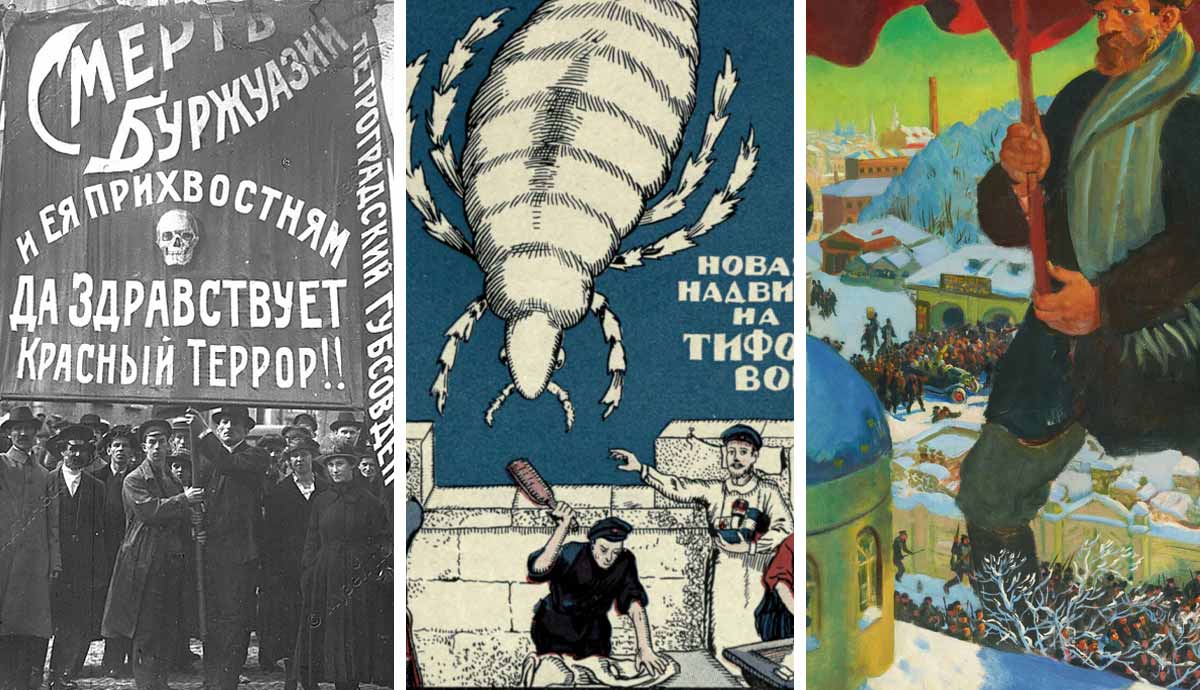
After World War I and the collapse of the Tsarist Russian Empire, the Bolsheviks conducted a massive campaign of terror during the Russian Civil War (1917-1922). They used the Cheka, the first Soviet secret police organization, to seek out political opponents, peasants, landowners, and anybody who stood in their way. The Red Terror lasted from August 1918 to February 1922. It should not be confused with the Red Scare or the Red Purge. The Soviets methods of political repression and expulsion included the infamous Gulag system of forced labor and relocation camps.The Russian Revolutions of 1917Vladimir Lenin giving a speech on Red Square, 1919; with Lenin Assassination Attempt by Vladimir Pchelin, 1927. Source: Wikimedia CommonsIn the 1910s, Russians suffered many economic hardships, and they mourned the civilian losses from World War I. Additionally, tsar Nicholas IIs rule was dissatisfactory and the government corruption contributed to the poor state of affairs. As a result, political factions rose up against their government.There were two revolutions in Russia in 1917. The first uprising gained popularity in February and forced Tsar Nicholas II to abdicate. The revolutionaries sent him and his family into exile and would later kill them all on July 17, 1918.Then in October and November 1917, the Bolshevik political party staged a coup detat and overthrew the provisional government led by the Socialist Revolutionary Party. The Bolsheviks, alternatively known as the Reds, were a far-left offshoot of the Mensheviks, and both were factions of the Marxist party called the Russian Socialist Democratic Labor Party.The Bolsheviks seized power in the October Revolution of 1917. Soon after, the Russian Civil War began. The Bolsheviks renamed their party a few times before settling on the Communist Party of the Soviet Union (CPSU). From 1922 to 1991, the Soviet Union operated as a one-party communist system.The Soviet Union was not just Russia, it was the federal union of 15 republics. The USSR would then occupy nine more countries to create satellite states that they controlled.Vladimir Lenin, the revolutionary leader and founder of the Soviet Union, quickly rose to power. There were a few assassination attempts on Lenins life, and the Soviets believed that he was always in danger. They began the Red Terror campaign to protect Lenin and other high-ranking Bolsheviks.The Red Terror BeginsMap of the Russian Civil War in 1918-1920. Source: Wikimedia CommonsNot only were the Bolsheviks afraid for their leaders, they were motivated to initiate the Red Terror for several more reasons: the massacres of communist prisoners during the October Revolution of 1917, the killings of Russians by the Finnish Whites (anti-communists) during the Finnish Civil War, and the international intervention from allied forces during the ensuing Russian Civil War.The campaign was not just to purge the enemies within the government who might harm Lenin or other communists; they targeted a wide range of people.Indeed, the Soviets purged supporters of the former tsarist government, liberals, conservatives, and anybody who did not fully adhere to the Bolsheviks agenda, such as the Mensheviks, the political group from which they originated.As the communists were anti-religion, they also targeted the Russian Orthodox Church and other religious minorities.During the Red Terror, the Soviets also persecuted foreigners and anybody who traveled to a Western nation and came back, believing they could be spies.They arrested civilians who sold their own goods and wares because they were against capitalism.Peasants, especially those who refused to hand over their land, food, or businesses to the new government, were fined and arrested. Sometimes, they were deported or killed on sight.The Reds even arrested industrial employees, who were the backbone of the communist system, if they did not meet quotas or went on strike for better working conditions.Enemies of the state became a broad term; nobody was safe from being potentially targeted.Dictatorship of the ProletariatFuneral ofMoisei Uritsky, Petrograd, September 2, 1918. The banner reads: Death to the bourgeois and their helpers. Long live the Red Terror. Source: Wikimedia CommonsDuring the period of transition from capitalism to communism, the Soviet Union became a dictatorship of the proletariat. Bolsheviks suppressed any opposition or resistance to the planned transitional phase that came from the upper class, the bourgeoisie. To create a classless society, they eliminated or exiled the wealthy. They arrested and deported landlords, capitalists, kulaks, and sometimes attacked people for no reason but claimed it was because they were part of the bourgeoisie.Kulaks were wealthy peasants who owned at least three hectares (eight acres) of land. They acquired the land or became credit lenders. During the Stolypin reform (1906-1914), the kulaks were pushed to become conservative and driven for profit. During the Red Terror, the term kulak was used to refer to peasants who owned property and hesitated to hand over their land, food, or animals, or actually did withhold their property from the Soviets. The term was vaguely derogatory and used to incorrectly identify peasants who withheld grain when the Bolsheviks demanded it.Vladimir Lenin believed in a revolution against the kulaks, and he promoted the idea that kulaks were the enemies, depicting them as bloodsuckers, vampires, plunderers of the people and profiteers (Rubinstein, 2001).The propaganda fueled hatred and division, causing civilian militias to attack those they believed were kulaks.The ChekaFelix Dzerzhinsky in a meeting of the Presidium of the Cheka, 1919. Source: Wikimedia CommonsDuring the Red Terror, hundreds of thousands of people were interrogated by the secret police, the Cheka, because they were deemed enemies of the state. The Cheka was established as a political police organization in December 1917 with the first director, Felix Dzerzhinksy. He was in charge of sniffing out all counterrevolutionaries and class enemies who might threaten the new Soviet dictatorship.The death penalty was reestablished in February 1918 to facilitate the elimination of the so-called enemies. In June, the Cheka was instructed to use the death penalty as the only punishment for counterrevolutionaries. The death penalty decree also allowed for people to be shot on the spot without trial. When regimes have a shoot-on-sight policy and ambiguous laws that allow for anybody to become a victim of persecution, violence can overpower every aspect of society.In February 1922, the Cheka became the State Political Directorate, a secret police organization that functioned to serve the state. They would go through a few more name changes before becoming the Committee for State Security, or KGB.The Cheka used many methods of torture on their victims, many of whom had not committed a crime nor been tried in court. Their methods included beating, skinning alive or scalping, using stretching devices, impaling, hanging, crucifying, water torture, heat and cold torture, beheading, twisting limbs or heads, making rats eat through the stomach of a person, sexual violence, and a litany of innovative ways to hurt another human being.The Death TollA Soviet propaganda poster. The text reads: The Red Army has crushed the White Guard parasitesYudenich, Denikin, and Kolchak. A new trouble has emergedthe typhus-bearing louse. Comrades! Fight against infection! Annihilate the louse! from the book Through the Russian Revolution by Albert Rhys Williams, published by Boni and Liveright (NY), 1921. Source: Wikimedia CommonsBolsheviks justified the campaign of violence on ideological grounds, claiming Marxism-Leninism called for the communists to use any available means to destroy the capitalists and class enemies.They dehumanized those whom they considered enemies by calling them rats, snakes, louses, cockroaches, and more. This tactic aimed to turn the Russian citizens against one another, believing certain people were less human, diseased, unworthy, and ruining the Soviet Union in one way or the other.Between 1917 and 1920, at least 12,000 people were killed, but the Soviet statistics indicated that only 766 people were executed in a judicial proceeding. That was almost twice the number of people sentenced to the death penalty between 1876 and 1905 in Russia under the tsarist government (Death Penalty Politics and Symbolic Law in Russia, 2013).During the Russian Civil War, the Bolsheviks purged every city they conquered of the class enemies.The exact number of victims will never be known because the Soviets intentionally hid information or fabricated records to hide the real death toll. As a result, there are unreliable, incomplete, and sometimes nonexistent records from which researchers can collect their data. Several scholars and historians have tried determining the death toll, and their estimates vary widely. Some even argue that the numbers have been inflated because of anti-communist propaganda.Vadim Erlikhman estimated that at least 1.2 million people were killed during the Red Terror.Robert Conquest believed that 140,000 people were shot by the Cheka just between the years of 1917 and 1922.Nikolay Zayats wrote that during the four years of terror, about 50,000 people were shot through judicial and extrajudicial executions.Charles Sarolea estimated that 1,766,188 people were killed during the Red Terror.Sergei Volkov claimed the death toll was 2 million, however his calculations are not corroborated by other scholars.Lenins Death and the Rise of StalinThe Bolshevik by Boris Kustodiev, 1920. Source: Wikimedia Commons / The Tretyakov Gallery, MoscowVladimir Lenin died in 1924. Joseph Stalin, his successor, was less moderate, consolidating power and initiating more purging. Stalin ruled with an iron fist and an iron wall until his death in 1953.The era known as Red Terror technically ended in 1922, but the repression continued. Fifteen years later, Stalin initiated the Great Purge.From 1937 to 1938, during the Great Purge, about 1.5 million political opponents, religious leaders, kulaks, and Red Army leaders were arrested, and about half, at least 700,000 people, were sentenced to death.During Stalins reign, a minimum of 14 million people were sent to forced labor camps (known as gulags), and another 7 to 8 million people were exiled or deported. The best estimates, based on the minimal evidence and unreliable records, are that 1-1.7 million people died in the gulags; however, Russians believe the number is much higher. People were sent away to labor camps where they died and were buried in mass graves, never spoken of again. Relatives continue to search for their family members, and burial pits continue to be uncovered.Researchers began studying archival data that was finally declassified after the Soviet Unions dissolution in 1991. They noticed that census data marked net losses of up to 10 million people in some cases. What historians have produced is that a bare minimum of 5.5 million peoples deaths can be directly attributed to Stalins regime, but the argument can be made that up to 20 million deaths should be attributed to Stalin.That includes operations of ethnic cleansing, intentional famines like the Holodomor, executions, and deaths at forced labor camps.However, by some estimates, more than 61 million people were killed as a result of the communist takeover and the creation of the Soviet Union.Reference List:Courtois, Stephanie, et al. (1999). The Black Book of Communism: Crimes, Terror, Repression. Harvard University Press.Hochschild, Adam. (2003). The Unquiet Ghost: Russians Remember Stalin. Mariner Books.Kovago, Jozsef. (1959). You Are All Alone. Praeger.Rayfield, Donald. (2004). Stalin and his Hangmen. Random House.Rubinstein, David. (2001). Culture, Structure, and Agency: Toward a Truly Multidimensional Sociology. Sage Publications.Rummel, R. J. and Horowitz, Irving Louis. (1994). Death by Government: Genocide and Mass Murder Since 1900. Routledge.Sebag Montefiore, Simon. (2003).Stalin: The Court of the Red Tsar. Weidenfeld & Nicolson.Semukhina, Olga, and Galliher, John. (2013). Death Penalty Politics and Symbolic Law in Russia. Marquette University.








 English
 French
 Spanish
 Portuguese
 Deutsch
 Turkish
 Dutch
Dutch
 Italiano
 Russian
 Romaian
 Portuguese (Brazil)
 Greek
Greek