The 8 Most Controversial Medieval and Renaissance Popes
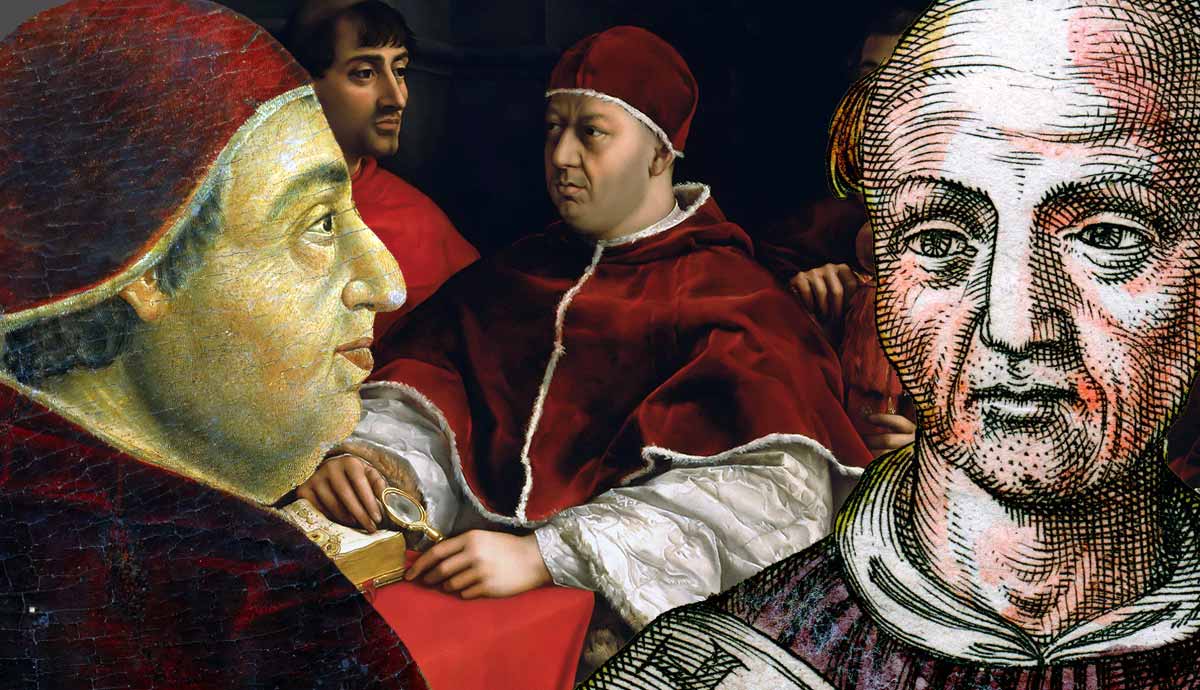
The ideal of the Papacy is to provide a spiritual leader and moral guide for the Christian faithful. Unfortunately, in the Middle Ages, many popes were more focused on factional violence, political intrigue, and extravagant decadence. While there were saints among the ranks of the medieval popes, there were certainly sinners as well. This list explores eight of the most controversial popes in the Middle Ages and the early Renaissance, whose actions range from theological error to outright criminality.1. Honorius I (625-638)Pope Honorius I, SantAgnese. Source: Wikimedia CommonsHonorius was a well-respected bishop before ascending to the Papacy. His tenure did not see the turmoil or outrages of some other figures on this list. However, the contents of his letters to his eastern colleagues saw him become the only pope to be officially branded as a heretic.A controversy raged in Christendom in the 7th century about the nature of Christs will. Did he have only one, divine will or one divine and one human will? This had echoes of the earlier Monophysite controversy, where it was debated whether Christ had only a divine nature or a divine and a human nature. It was decided at the Council of Chalcedon that Christ had two natures, and as such, official orthodoxy was that Christ also had two wills.In a letter to Sergius, the Patriarch of Constantinople, Honorius wrote, We confess one will of our Lord Jesus Christ, since our (human) nature was plainly assumed by the Godhead, and this being faultless, as it was before the fall. This seemed to endorse the Monothelite position that Christ had only one will. Whether that was what Honorius intended or not, that is how it was read by Sergius, and that is how the third Council of Constantinople saw it in 681. That council saw Honorius posthumously anathematized and declared a heretic.2. Sergius III (904-911)Depiction of the Cadaver Synod, by Jean-Paul Laurens, 1870. Source: Nantes Art MuseumSergius IIIs pontificate is often marked as the beginning of the Saeculum Obscurum, Latin for Dark Age. This era saw the Papacy consumed by factional infighting and moral decay.A supporter of Pope Stephen VI, and likely a bishop at the Cadaver Synod, he continued the attack on Pope Formosuss legacy. He convened a synod in Rome to reaffirm the outcome of the Cadaver Synod (overturning a previous annulment of the proceeding) and once again declared all acts and ordinations made by Formosus null and void.The intense factionalism that Sergius promoted led to some extraordinarily hostile sources about his reign. He was accused of murdering his predecessors Leo V and Christopher, of being under the sexual thrall of the women of the Theophylact family, and of fathering the future Pope John XI with Marozia, a teenage daughter of that family.While modern scholarship disputes some of the more serious claims, like the paternity of John XI, he was, without a doubt, a violently partisan figure that acted in a nakedly political manner. His successors would continue the trend.3. John XII (955-964)Pope John XII, from a 16th-century engraving. Source: Wikimedia CommonsJohn XII is one of the youngest popes in history, appointed to the seat in his late teens. He was a member of the Tusculum family, which dominated the Papacy for much of the 10th century.After a dispute with the Holy Roman Emperor Otto I, a synod was convened in Rome in 963 to try John for a long list of charges. John fled rather than face the accusations of sacrilege, simony, perjury, murder, adultery, and incest. John was also accused of toasting the devil, invoking pagan gods while gambling, ordaining deacons in a stable, and generally behaving more like a secular warlord than a cleric.The synod, unsurprisingly since it was called by supporters of Otto, found John guilty in absentia, declaring him deposed. This was the first time that a pope had been removed from office via a legal procedure.John refused to accept the sentence and excommunicated all who took part in the trial. A few months later, John managed to retake Rome and reinstall himself as Pope. However, this triumph would be short-lived as John would die soon afterward.There are two versions of the story of his death, neither likely true, but they have achieved legendary status. One is that during an affair with a Roman noblemans wife, he had a stroke and died on top of her. The other is that the womans husband walked in on the Pope and his wife and, in a rage, grabbed John and threw him out of a nearby window.4. Urban II (1088-1099)Pope Urban II preaching at the Council of Clermont, by Jean Colombe, 1474. Source: BnFUrban II was a reform-minded pope who, while not controversial in his own time, has certainly become so in the centuries after his death.Urban spent the first years of his Papacy strengthening the Gregorian reform movement that had begun after the dark days of the Saeculum Obscurum. Gregory took a firm stand against the selling of church offices (known as simony) and clerical concubinage. He strengthened the centralization of the Church and increased the authority of the Papacy.His most consequential action, though, was the preaching of the First Crusade at the Council of Clermont in 1095. Urban promised the remission of sins to those who took part in a holy war to aid the Byzantine Empire and retake Jerusalem from Muslim control. The concept that war against the enemies of the Church, specifically Muslims who had in previous centuries made serious inroads into the formerly Christian world, was not new. However, a full plenary indulgence, the removal of punishment for sins in exchange for papally directed military service, was a new innovation.The crusading movement would continue for centuries, its legacy shaping the way that the Christian and Muslim worlds interact with each other up until the present day.5. Boniface VIII (1294-1303)Boniface receiving some medical writings from Galvano da Levanto in the presence of his cardinals. Source: Wikimedia CommonsBoniface VIII was determined to exert Papal Supremacy over the monarchies of Europe. He forbade secular rulers to tax clergy without explicit papal approval in 1296, enraging Edward I of England and Philip IV of France, both of whom were in desperate need of war funding.Bonifaces feud with Philip IV continued when Philip arrested Bishop Bernard Saisset for treason. Boniface responded by summoning French bishops to Rome for a reform council and asserting papal superiority over kings. Boniface laid out in his decree Unam sanctam that, it is altogether necessary to salvation for every human creature to be subject to the Roman Pontiff.Philip then escalated matters dramatically. He sent his minister, Guillaume de Nogaret, to Anagni in September of 1303. In what became known as the Outrage of Anagni, Nogaret slapped the elderly pope and imprisoned him, possibly even torturing him. Boniface died only a month after his release. There was a rumor that his treatment had caused him to go mad, and at his death, he gnawed off his own hands. That rumor was disproven when Bonifaces body was exhumed, and his hands were perfectly fine.Bonifaces attempts at exerting papal authority backfired spectacularly. They resulted in his own imprisonment and, in a sense, the imprisonment of the Papacy at large with the start of the Avignon Period where the Papacy was under the thumb of the French king.6. Urban VI (1378-1389)Painting in the house of Catherine of Siena, showing Urban VI receiving the keys of Castel SantAngelo. Source: Wikimedia CommonsThe conclave of 1378 found itself under immense political pressure. The Papacy had only just returned to Rome from Avignon, and there was a fear that it would return there. An armed mob surrounded the Vatican Palace where the conclave was being held, and loudly demanded a Roman pope, or at least an Italian. The or else was unsaid, but implicit.So, the cardinals chose Bartolomeo Prignano, an Italian from the Kingdom of Naples, and he took the name Urban VI. They quickly came to regret their decision.Urban seemed to take delight in berating and publicly humiliating his cardinals. His hostility caused a faction to say that because his election had been made under fear, it was invalid, and they elected a rival pope at Avignon. This was the beginning of the Great Western Schism, the greatest crisis of legitimacy in the Catholic Church until the Protestant Reformation.The schism did nothing to calm Urbans violent and tyrannical tendencies. In 1385, Urban arrested six cardinals, convinced they were plotting against him. These cardinals were later tortured and executed on his orders. Egidio da Viterbo later called this action a crime unheard of through the centuries.7. Alexander VI (1492-1503)Alexander VI, by Pedro Berruguete, 1495. Source: Wikimedia CommonsWhile a cardinal, Rodrigo Borgia had a long-term mistress and openly acknowledged his illegitimate children with her. While clerical affairs were not new, most had the public decorum not to be so brazen about it. In the conclave of 1492, Borgia allegedly secured his election as pope with hefty bribes, including money, lands, and offices exchanged for votes.Upon becoming pope and taking the name Alexander VI, Borgia set out to use the office to benefit his family. Like clerical mistresses, nepotism was commonly practiced in the Church in the Late Medieval Period, but once again, Borgia took it to a level that had not been seen since the days of the Saeculum Obscurum. He made ten relatives cardinals, including his teenage son Cesare, and his former mistresss brother, who would later be elected as Pope Paul III. He was generous in granting lands and titles in the Papal States to his family, and was more than happy to sell church positions to his allies.Johann Burchard, papal master of ceremonies, wrote in his diary that Alexander and his children presided over an orgy in Cesares apartments known as the Banquet of Chestnuts. Modern historians believe that the lurid details from Burchards telling, including a contest to see who bedded the most prostitutes in one night, may have been exaggerations, though they do tend to believe that decadent entertainment did occur.8. Leo X (1513-1521)Pope Leo X, by Raphael, 1518. Source: Wikimedia CommonsA quote often attributed to Leo summed up his attitude toward being pope: God has given us the Papacy, let us enjoy it.Leo, a scion of the Medici family, was used to the finer things in life and spent papal funds lavishly. Leo had a large reserve of money left to him by his predecessors, but two years of his spending on art, architecture, ceremony, patronage, and gifts had burned through it all, and the Papacy was left in deep debt. To cover the shortfall, Leo sold everything from papal jewels and statuary down to tableware. Most infamously, he also greatly expanded the sale of indulgences.Angered by what seemed to be the brazen greed of selling the remission of sin, Martin Luther wrote his 95 theses and nailed them to the church door of Wittenberg. Leo greatly mishandled Luther. At first, he ignored him. Then, when that was no longer possible, rather than offering reform, he came down with the full force of papal authority and threatened Luther with excommunication. Luther, famously, burned his bull of excommunication, deepening the crisis. By the time of Leos death, the Protestant Reformation was well underway, splitting half of Europe from Romes authority.










 Arabic
 French
 Spanish
 Portuguese
 Deutsch
 Turkish
 Dutch
Dutch
 Italiano
 Russian
 Romaian
 Portuguese (Brazil)
 Greek
Greek