Peaceful vs Violent Decolonization, What Are Their Key Differences?
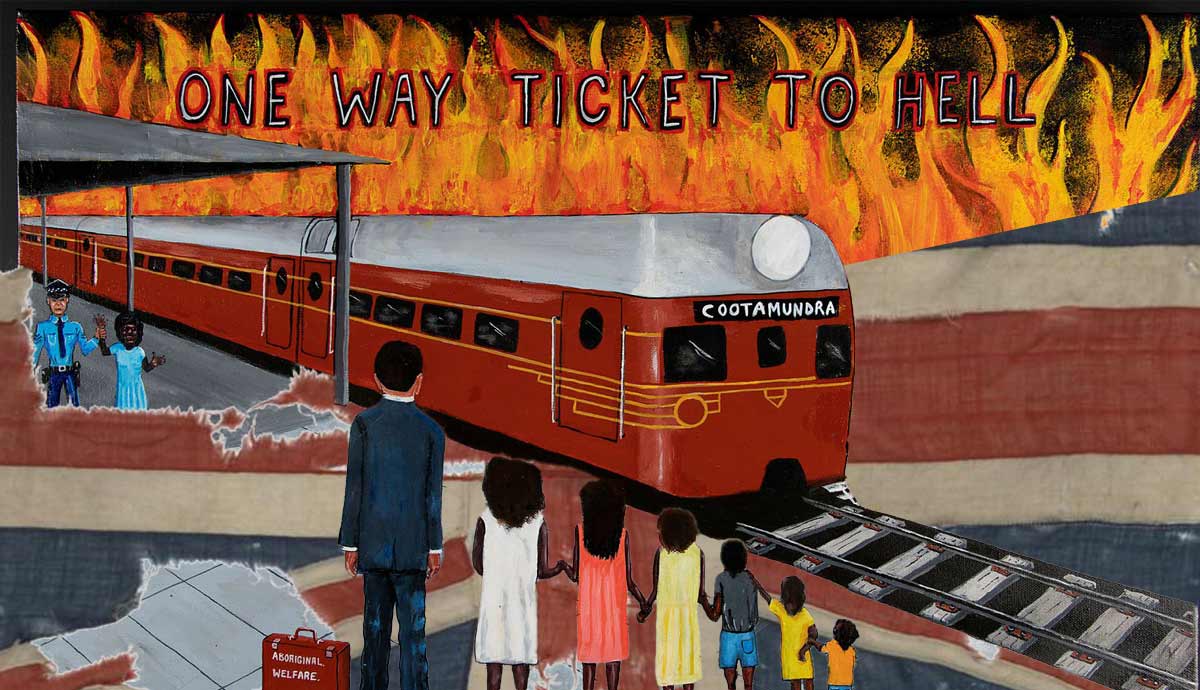
In December 1960, the General Assembly of the United Nations declared: All peoples have the right to self-determination; by virtue of that right they freely determine their political status and freely pursue their economic, social and cultural development. In the aftermath of World War II, as the world adjusted to a new global order, the process we call decolonization (the transfer of powers from the colonial power to a local, indigenous government) sent shockwaves around the world. In some cases, independence from colonizing powers was negotiated peacefully or achieved through boycotts, peaceful demonstrations, and large-scale strikes. In other countries, decolonization was a bloody affair.What Do We Mean by Decolonization?One Way Ticket to Hell, remembering the Stolen Generations in Australia, a vivid reminder of the disruptive effects of colonialism, painting by Aunty Fay Moseley, 2012-2020. Source: Australian MuseumDecolonization is the process of undoing colonialism, the transition of colonized countries from colonial rule and economic exploitation by a (typically) European power to the self-determination and independence of a local, Indigenous government. Decolonization in the 20th century has been both a global process, involving thousands of peoples around the world, and a very local and specific phenomenon, unfolding differently in different regions.Overall, it led to the dissolution (sometimes peaceful, sometimes violent) of intercontinental empires over a short period of time, followed by the creation of nation-states, with local masses and leaders asserting their right to self-determination and shaking off colonial rule. Indeed, decolonization goes hand in hand with self-determination, especially in the context of the 20th century.The Dachau concentration camp in 1945. Source: The National WWII MuseumIn their book Decolonization, a Short History, Jansen & Osterhammel define decolonization as an apparatus for the serial production of sovereignty, as a kind of sovereignty machine that produces political unities, unities that are a series of states, each with a defined national territory, its own constitution, legal order, government, police, flag, and national anthem.In its explosive force, 20th-century decolonization produced a series of states that were soon recognized by the already existing community of states as having equal rights and subject to no higher authority. 20th-century decolonization is a process that can be framed within certain dates, essentially three decades, roughly from 1945, after the end of World War II, to 1975, when, as Jansen & Osterhammel write, the oldest of the European overseas empires, the Portuguese, was the last to dissolve. However, it is also a longer process with nebulous chronological margins.Indian soldiers recruited in the British Indian Army in 1942. Source: Imperial War MuseumsWhile we can more or less pinpoint when the decolonization of a country begins, it is much harder to define when it ends. Just as the colonization of a country takes place at the hands of people, so does decolonization. And just as the colonization of a country affects its subjects politically, economically, and culturally, the process of decolonization must also take into account the internalized and psychological nature of colonial power. Ultimately, it must take into account the difficulty of people who have experienced the imposition of a different, sometimes alien, culture, to shake off the negative self-understandings imposed on them by the colonial power.A World of EmpiresThree young Indonesians in Yogyakarta in December 1947. Source: RijksmuseumOn the eve of World War I, the globe was divided into imperial blocs: different regions, sometimes very distant from each other, were controlled by different European empires. The largest and most powerful was, of course, the British Empire. The French Empire controlled the Caribbean, Polynesia, Madagascar, and some areas of Southeast Asia, known as French Indochina, as well as North and West Africa, including Algeria, Tunisia, Morocco (1912-1956), Guinea, Niger, Senegal, Mali, and Mauritania, to name but a few.Different European powers controlled parts of Africa. Libya, for example, had been an Italian colony since 1911. Portugal still ruled over Angola, Cape Verde, Guinea-Bissau, the islands of So Tom and Prncipe, and Mozambique, all of which became independent in the mid-1970s. Belgium ruled the Congo with a ruthless and barbaric iron fist.Benin bronzes are now housed in the British Museum in London. Source: British MuseumThe Dutch colonial empire, although not as vast as the British or French, included the Dutch East Indies, now Indonesia, the jewel of the Dutch crown, much as India was the jewel of the British crown, as well as the Dutch West Indies, and Suriname (officially known as Dutch Guiana).Although Germanys empire was short-lived, by the early 1910s Germany had colonies throughout Africa: present-day Namibia, Tanzania (which would become a British colony in 1919), Rwanda (from 1897 to 1916), Burundi, Cameroon (a German protectorate from 1884 to 1918, known as German Kamerun), Togo (from 1884 to 1919) and parts of Ghana (the latter two known as Togoland), as well as Samoa and various islands in the Pacific.As Jansen & Osterhammel point out, With the exception of the German colonial empire, all these empires survived the First World War and even saved themselves, however battered, for a time beyond the Second World War. By 1975, they had disappeared.Violent DecolonizationJomo Kenyatta, the first President of Kenya, 1978. Source: Wikimedia CommonsDecolonization, write Jansen & Osterhammel, is a technical and rather undramatic term for one of the most dramatic processes in modern history: the disappearance of empire as a political form, and the end of racial hierarchy as a widely accepted political ideology and structuring principle of world order.In many cases, when the colonial powers refused to relinquish power peacefully, the transition from a world of empires and colonies to one of sovereign nation-states was violent and resulted in humanitarian crises, wars, and thousands of deaths and displacements among both the colonized and the colonizers.This was the case of Algeria, for example, where for eight years between 1954 and 1962 the National Liberation Front (FLN) launched a series of pseudo-guerrilla attacks against the French army and French civilians, in the countryside and in the cities. France responded with mass arrests, torture, and forced relocations to concentration camps.Algerian children in the Algiers Casbah in 1962, photograph by Philip Jones Griffiths, 1962. Source: Magnum PhotosThe number of Algerians who died in the Algerian War of Independence is still disputed, but estimates range from 45,000 to 1.5 million. Nearly a million pieds-noirs, men and women of French origin born and raised in Algeria, were displaced and fled to France. The conflict also deeply scarred post-independence Algerian society, as those who fought the French persecuted thousands of harkis, Muslim Algerian auxiliaries who fought alongside France.The French repression in Madagascar, a French colony since 1896, between March 1947 and February 1949 was also particularly brutal. The uprising began on March 29, on the east coast, when thousands of Malagasy, supported by the local population, attacked, looted, and burned police stations, administrative centers, and military garrisons. The rebellion quickly spread across the island, from the southeast to the northwest. The French government responded with a brutality similar to that later used in Algeria.French soldiers gathered to execute Rainandriamampandry, the Minister of the Interior, and Prince Ratsimamanga, the Queens Uncle, accused of complicity with the rebellion of 1895 in Madagascar, 1896. Source: Wikimedia CommonsSuspected rebels were deported to labor camps and thousands were killed in mass executions. Tens of thousands of French troops were sent to Madagascar. As they began to burn fields and slaughter cattle in retaliation, thousands of civilians faced starvation. By 1949, most of the rebel leaders were dead or behind bars, but the uprising ultimately paved the way for the islands independence.The late 1940s were also particularly bloody in Indonesia, which had been under Dutch rule for decades and was still known as the Dutch East Indies. On August 17, 1945, shortly after the atomic bombings of Hiroshima and Nagasaki and Japans surrender, Indonesian leaders Su Karno (1901-1970), commonly known as Sukarno, and Mohammad Hatta (1902-1980) proclaimed Indonesias independence. Su Karno was elected as the first president of the newly formed Republic of Indonesia, while Hatta, the Proclamator became his vice president.Kenya was a British colony from 1920 until 1963, photograph by David Cashbaugh. Source: UnsplashUnsurprisingly, the Dutch refused to recognize Indonesias independence and sent troops to re-establish their authority. Two years of bloodshed, famine, and violent massacres followed, the most notorious occurring at Rawagede in December 1947 and in South Sulawesi, where Dutch officer Raymond Westerling (1919-1987) led a particularly bloody counter-insurgency offensive between December 1946 and February 1947, killing tens of thousands of civilians.In the countries where decolonization has been particularly violent, the colonizing power has often destroyed, lost, or made inaccessible state archives before leaving. This is what happened in Kenya, a British colony since 1920, where, in the 1950s the Kikuyu warriors of the Mau Mau movement waged a guerrilla campaign against the British, demanding the restitution of their ancestral lands and an end to forced labor. After years of brutal repression by the British colonial forces, Kenya finally gained independence on December 12, 1963. It became a republic in 1964, with Jomo Kenyatta, one of Africas most important (and controversial) anti-colonial activists, as its first president.Peaceful DecolonizationThe Union flag. Source: Royal Museums of GreenwichThe term decolonization conjures up images of violent power shifts, burning flags, massacres, armed groups storming the palaces of power, cities on fire, and foreign armies leaving. But this is not always the case. In some countries, the process of decolonization has been anything but violent.In countries such as Malaysia, Zambia, and Ghana, to name but a few, the transfer of power was peaceful, with the former colonizing force handing over political power to a newly formed local Indigenous government through treaties and a series of legal and economic agreements detailing the transfer of power and post-independence stability.This was the case of Malaysia, for example, which gained independence peacefully and through negotiations between the British authorities and local leaders of the United Malays National Organization (UMNO). On the night of August 30, 1957, as the royal anthem God Save the Queen resonated in the Royal Selangor Club in Kuala Lumpur, the flag at Merdeka Square was lowered. In its place, the new flag of Malaysia, the Stripes of Glory as it is often called, was raised.Kenneth Kaunda, first President of Zambia. Source: Wikimedia CommonsThe next day, Prime Minister-designate Tunku Abdul Rahman (1903-1990) read the Malaysian Declaration of Independence, written in both Malay and English, to thousands of Malays gathered at the Merdeka Stadium; Merdeka translates as freedom. That day the world echoed in the stadium as thousands sang it after Tunku Abdul Rahman finished reading the Declaration of Independence.Over time, particularly in former British colonies, such shifts of power took the form of what Jansen & Osterhammel call a well-rehearsed routine, a routine steeped in symbolism. Around the world, as the British flag was lowered and replaced by the local flag and colonial officials prepared to leave the country for good, the day of the handover became Independence Day, the day to be celebrated every year thereafter as the beginning of a new era. A moment frozen in time, shrouded in symbolism, that over time has become an annual celebration, cyclically revived through celebrations, marches, and costume re-enactments.Shakawe, Botswana, photograph by Wynand Uys. Source: UnsplashSeven years after Malaysias independence, on October 24, 1964, Zambia also gained independence from the United Kingdom and Kenneth Kaunda (1924-2021) became its first president. More than a century had passed since the Scottish explorer and missionary David Livingstone (1813-1873) first saw Mosi-oa-Tunya, the magnificent waterfalls on the Zambezi River, which he promptly renamed Victoria Falls in honor of Queen Victoria (1819-1901). His written accounts of the falls sparked a wave of European tourism that, along with Cecil Rhodess (1853-1902) British South Africa Company (BSA Company), would forever change the history of the region.On September 30, 1966, the British protectorate of Bechuanaland in Southern Africa became the independent Republic of Botswana. The transfer of power was peaceful, thanks to the combined efforts of the colonial government, Seretse Khama (1921-1980), who went on to become Botswanas first President, and his party, the Bechuanaland Democratic Party (BDP).Prime Minister of Ghana Kwame Nkrumah with Vice President Nixon and General Maxwell Taylor, 1958. Source: Wikimedia CommonsWhile Indias independence from Great Britain in 1947 was achieved peacefully, with Indian leaders pressuring the British to withdraw through a series of peaceful protests, boycotts, and mass strikes, what followed, the Partition of South Asia into India and the state of Pakistan, which also included modern Bangladesh, represented a humanitarian tragedy of enormous proportions. As thousands of refugees were murdered in large-scale massacres, particularly in border regions such as Punjab, millions of Hindus and Sikhs fled from what had become Pakistan into India while millions of Muslims fled what had become India to seek shelter in Pakistan.In 1957, Ghana became the first African colony to achieve independence by entirely peaceful means. In the decades that followed, many other African colonies eventually gained independence from France, Great Britain, and the Netherlands. In some of them, the colonial powers and local independence movements and leaders managed to negotiate a transfer of power through diplomacy, negotiation, and gradual constitutional reform, without bloodshed and military confrontation. This is what historians call peaceful decolonization.Other countries, such as Indonesia and Madagascar, were not so lucky. Here, the colonial powers refused to relinquish power or recognize the declaration of independence proclaimed by indigenous leaders and used military force to suppress what they considered an insurgency. Thousands of people died. Many were combatants and soldiers, but a great number of them were civilians, innocent men, women, and children who had the misfortune of living in a colonized country where diplomacy had failed.












 English
 Arabic
 French
 Spanish
 Deutsch
 Turkish
 Dutch
Dutch
 Italiano
 Russian
 Romaian
 Portuguese (Brazil)
 Greek
Greek