What Happened at a Medieval Tournament?
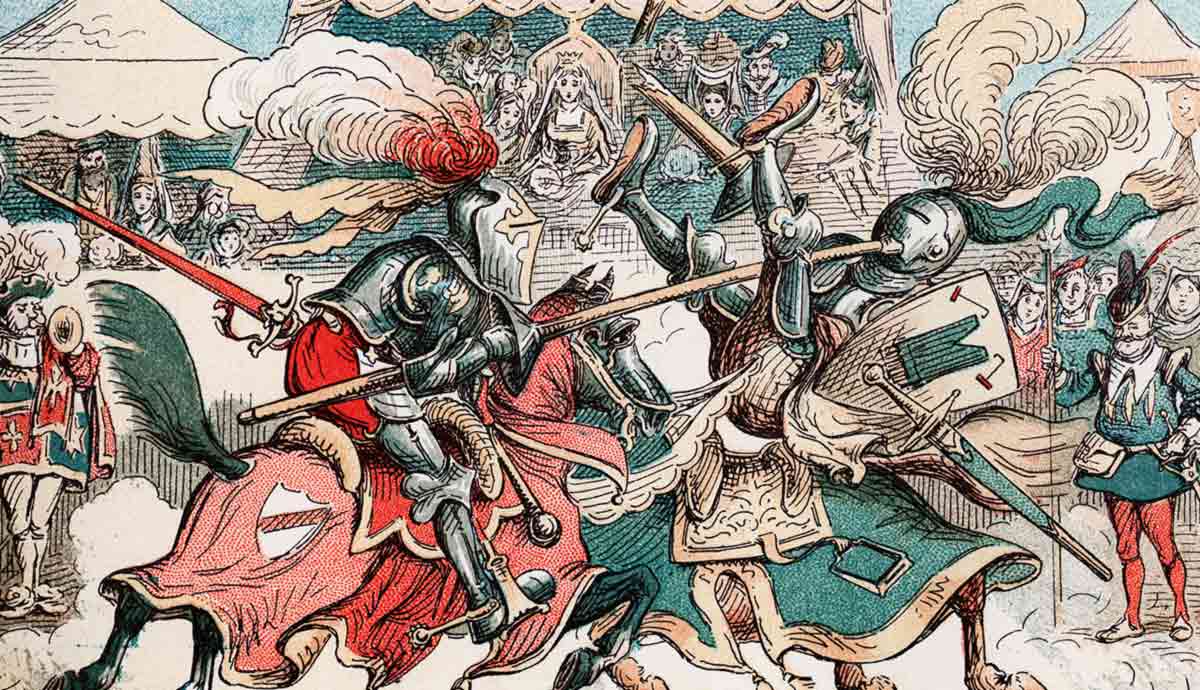
Medieval tournaments have long captured the imaginations of writers, both contemporary and modern. The art of chivalry, jousting, ladies in waiting, and fair maidens alongside brave knights and burly soldiers have been portrayed across the silver screen numerous times. But was there any of this glitz and glamor at a real medieval tournament, or has it simply all been exaggerated? Find out below.Origins of the Medieval TournamentAlbum of Tournaments and Parades in Nuremberg, late 16thmid-17th century. Source: The Met, New YorkWhile the classic knight in shining armor jousting another knight for the arm of a fair maiden might seem a bit far-fetched when it comes to what actually happened at a medieval tournament, the idea had to originate somewhere, right?Horseback gatherings had been going on since mankind had tamed wild horses and there is some suggestion that the early medieval tournaments, or tourneys, were simply meetings that got larger and larger. However, tournaments tended to differ from gatherings due to the games that were involved.Of course, the Olympics were first held in ancient Greece, and the tradition of games such as chariot racing and wrestling had been continued long into the Roman Empire, but it was not until the dawn of the Carolingian Empire (800887) that the idea of a tournament was born.Games were not solely for sport and entertainment, but rather, tournament games such as jousting and mock sword fights could be used as a form of military training. Due to the sheer number of conflicts in the Middle Ages, military training was a large part of many young mens daily lives.Equestrian practiceor being able to ride on horseback, wield a weapon, and successfully fight an opponentwas also a huge part of military training, especially for knights or mounted cavalry. As such, the idea of a tournament where soldiers from different parts of the country could participate against each other was born.Of course, this idea would evolve into a political statement by the Early Modern Period (think Henry VIII and Francis I at the Field of the Cloth of Gold in 1520 as a prime example), but it is around the 9th century that we see the idea of the tournament first develop.Mele at Medieval TournamentsGerman depiction of a medieval tournament, c. 1305-50. Source: Heidelberg Digital University archivesMele, or mock combat fighting, was one of the key features of a medieval tournament. This generally took the form of swordfighting and was a good way for knights to test each others swordfighting abilities.However, it was rarely just one knight against another. At tournaments, the participants were split into two teams, sometimes as large as 50 men on each side, although generally it was teams of around 20-30 each. The purpose of the mele was to successfully clash into the enemys side without breaking rank or formation, and then force them around in a full circle (also known as a tourney, which also contributes to the tournaments name).This fighting could be done by men with swords, or by participants on horseback. Naturally, the weapons that were used were blunted to prevent serious injuries while participating.Occasionally, the fighting was done as a brawl, rather than a formation, essentially in a last-man-standing competition. The victor would then be rewarded by the overseeing nobles. The objective was to capture knights of the opposition and ransom them. This could become a highly profitable business for skilled knights, as William Marshal demonstrated during his tournament experiences in the 12th and 13th centuries.Jousting at Medieval TournamentsTwo teams ready to fight at a medieval tournament, c. 1450. Source: Galicia Digital Library archivesPerhaps jousting is the first event that comes to mind at a medieval tournament, but it was not until the 15th century that it seriously gained popularity.Jousting had been around as a tournament event as early as the 12th century, and was always seen as the evening prelude to a big day, before eventually becoming the highlight of the day.There are a few examples of when jousting was banned as it distracted knights from their mele training. One example includes when Count Philip of Flanders (114391) used to turn up armed with a full retinue, and refused to join the mele, only entering the jousting at the very end of the day when the knights were exhausted so he could easily sweep up the ransom payments, which was of course, seen as cheating.In England, tournaments declined throughout the 13th century, before being revived by King Edward I of England in the late 13th and early 14th centuries, and jousting was transformed into a pastime for the nobility and would remain this way until the eventual decline of the tournament in the Early Modern Period.The Revival of the TournamentA German depiction of jousting at a medieval tournament, c. 1480. Source: Wikimedia CommonsKing Edward I of England (r. 12721307) and his grandson, King Edward III of England (r. 132777), were both responsible for the revival of the tournament in medieval England.Both kings were huge fans of the Arthurian legend, and what was more Arthurian than a medieval tournament, featuring great banquets, mele, jousting, and huge audiences?It is from these Edwardian tournaments in the High Middle Ages that we take our most common view and understanding of what a tournament looked like. Huge crowds would turn up to watch some of the finest knights in the land, while sometimes the monarchs themselves would even get involved in the events, such as jousting, which by now was becoming a key feature for the royal family to get involved in.It was during the later years of the Edwardian era tournaments that they transformed into a form of art, in part thanks to the Arthurian legends becoming such an integral part of it.Medieval Tournaments as a Showcase of Spectacle and ArtThe Dukes of Brittany and Bourbon at a tournament, by Barthlemy dEyck, c. 1460. Source: BnFIt was no secret that King Edward III of England was obsessed with the tale of King Arthur, even founding the Order of the Garter and the Round Table during his reign.Costumes were often worn to tournaments, and numerous factions were invited (this idea soon spread throughout the rest of Europe in the 14th century onwards), and colors were used to represent different families or factions, so certain knights could be seen to either represent them, or support them if they were not a member of that particular faction.Colors could also be worn by ladies who were watching, and if a knight wore the same color ribbon or band as her, he could be interpreted as wanting to win over her favor, or simply supporting her family. It was a popular chance for young, unmarried noble women to find potential suitors, especially from the knights who won their respective games like the mele or the ultimate joust at the end of the tournament.As the idea of chivalry and courtly love became more popular in the High Middle Ages, knights were seen to be fighting for a ladys honor (which is where many filmmakers have gotten the idea that tournaments were solely held to impress medieval women), and part of this playacting role involved dressing up in Arthurian-style dresses and costumes.As such, medieval tournaments from the late-14th century onwards became a courtly spectacle and a showcase of art, passion, and chivalry, while swordsmanship fell in the rankings of importance.What Went on Behind the Scenes at a Medieval Tournament?Henry VIII tilting in front of Catherine of Aragon, by Thomas Wriothesley, from the Westminster Tournament Roll, 1511. Source: Wikimedia CommonsBy the Tudor Period, when Henry VIII put on tournaments, the idea of spectacle was the biggest priority. It took hundreds of people to put together a tournament in the 15th century, and they could last for weeks at a time.There needed to be suitable stables for the sheer number of horses, as well as provisions to not just feed the animals, but to feed the thousands of people who would be attending. Royal banquets were thrown, so that needed to be addressed, including huge numbers of livestock that would be used to feed tournament attendees.Clothes and costumes also needed to be made for tournaments, especially if certain colors were going to be represented. Weapons needed to be supplied in huge numbers, as well as armor, including lots of spares in case anything went wrong. This required the effort of multiple blacksmiths and tailors, as well as the organization to be able to change costumes quickly, as tournaments essentially became a stage show for political purposes in the Tudor age.The Decline of the Medieval TournamentA Renaissance-era depiction of jousting, by Paulus Hector Mair, c. 1540s. Source: Munich Digital LibraryAs the Middle Ages gave way to the Early Modern Period, advanced technologies put an end to medieval tournaments.However, it was not just because of technologythe way that tournaments had developed was one major reason why they were no longer feasible.Tournaments had gone from being a training exercise for soldiers and knights to a show of political power, wealth, theater, and more, with the fighting being a very minimal part of the entertainment.It went from a few knights training to thousands of spectators and thousands more people working tirelessly behind the scenes, from cooks to blacksmiths and everything in between. The tournament became associated with prestige and wealth, including events like the Field of the Cloth of Gold (1520), where Henry VIII of England and Francis I of France competed against each other to show they were two of the most powerful monarchs in Europe at the time.Naturally, all of the additional theatrics and sheer numbers of people attending these tournaments-turned-political rallies meant that the cost increased by thousands and thousands every time one was thrown, as each one had to be bigger and better than the last.In an era where wars were still being waged and taxes were already high, tournaments as political or theatrical statements were simply no longer feasible, and by the 17th century, they had all but died out across Europe.Medieval Tournaments: In ConclusionThe Field of the Cloth of Gold, by Hans Holbein the Younger, 1545. Source: Google Cultural InstituteThe medieval tournament as a whole is one of the first things that comes to mind when we think of the Middle Ages. Knights in shining armor, ladies in waiting, and the rest of it were key features of huge political pageants in the later Middle Ages, and while tournaments had been around for centuries before that, it is these types of tournaments that we associate with the medieval period.From starting out as a training exercise for soldiers to becoming huge acts of medieval theater, the tournament was a key part of medieval life and attracted thousands of people in its heyday. This offered a small release from everyday life for many medieval people, and for that reason alone, they are worth celebrating today.













 English
 Arabic
 French
 Spanish
 Portuguese
 Deutsch
 Dutch
Dutch
 Italiano
 Russian
 Romaian
 Portuguese (Brazil)
 Greek
Greek