Catherine of Braganza, the Queen Who Brought Tea to England
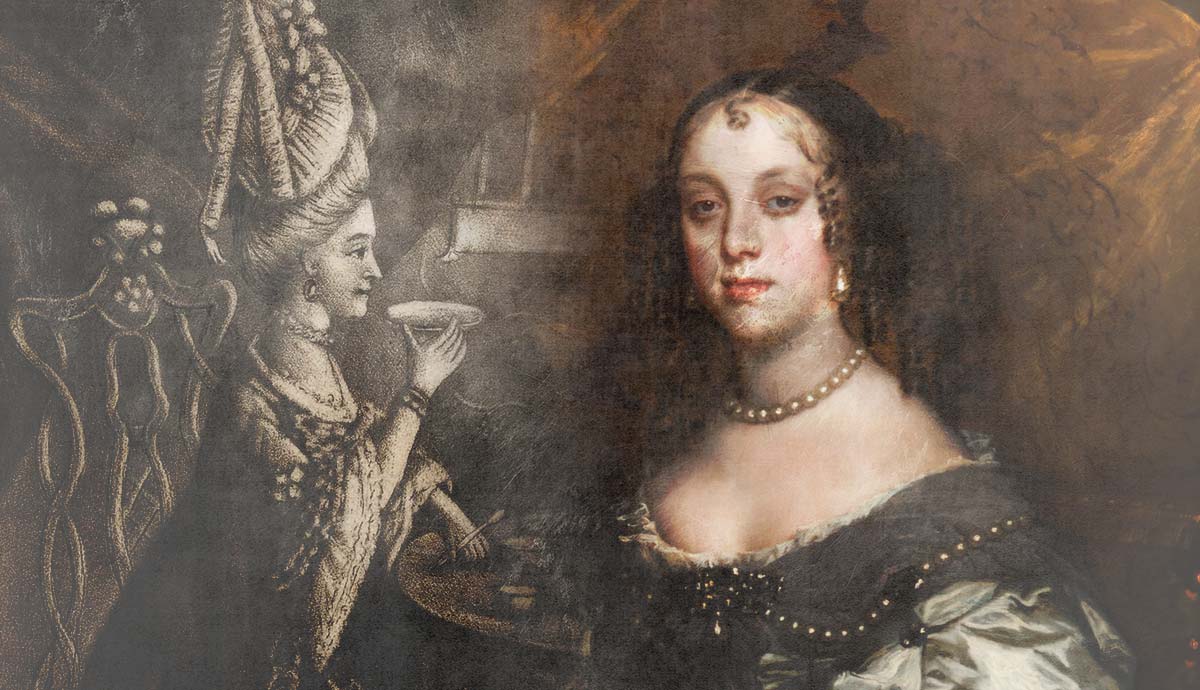
In 1662, Catherine of Braganza married King Charles II of England, renewing and cementing a deep connection between Portugal and England that has lasted to this day. The reason for this marriage was a high-stakes gamble of geopolitical and financial considerations. England needed gold and ports to rebuild its economy, while the Portuguese sought protection through Englands significant military.The political necessities of this union are no longer relevant today, but the legacies it left are apparent today. One of these legacies was in a small wooden boxCatherines personal supply of tea, or ch!Catherine of Braganza and Her Political DutyCatherine of Braganza by Peter Lely, ca. 1664. Source: The Royal Collection/Wikimedia CommonsCatherine was born in 1638 on the cusp of revolution, as Portugal threw off the yoke of the Iberian Union and sought to restore facets of independence it had lost to Spain. Her father became John IV of Portugal in 1640 and spent the rest of his life at war with Spain (he died in 1656, and the war lasted until 1668).Portugal was in need of allies, and Catherine was a powerful way to achieve this. Her mother, Luisa de Guzmn, was the main architect of securing an alliance with England through Catherine, and the marriage to Charles II took place in 1662. As part of the deal, England promised to support Portugals claim to independence, and in return, England gained Bombay and Tangiers as well as access to Brazil and the East Indies. Charles also received a large cash payment, although this was never paid in full.A Marital DisasterCatherine of Braganza and Charles II, by an unknown painter, ca. 1665. Source: Christies/Wikimedia CommonsFirst impressions in England were not good. Catherine was Catholic, a factor that had led to much opposition to the marriage. Because of her religion, she also could not be officially crowned in an Anglican ceremony.Like many women of noble birth in Portugal, Catherine was raised in a convent and spent much time secluded from the outside world. She grew to be pious, but with a gentle and trusting nature. Her fashion sense of dark clothes was in stark contrast to the flowing Parisienne styles that were popular in the English court, and her reserved nature did not seem at home amongst the more promiscuous sensibilities of the time. To add to this dynamic, she had taken ill and was consigned to her bed for the first week of her marriage. On the night of her wedding, the marriage was not consummated.As was common with arranged political marriages, neither party had much interest in the others views beforehand, and the marriage was not one where Catherine was given reason to warm to her husband (although there was a certain amount of love that seemed to develop over time). She held bitterness, later claiming she had been sold to England. Indeed, when she had arrived in England, Charles brother, James, Duke of York, had been the one to greet her, while Charles, stating he had had parliamentary duties, was likely enjoying his last unmarried moments with his pregnant mistress, Barbara Palmer.Barbara Palmer (ne Villiers) was a married woman, and despite officially separating from her in 1662, Roger Palmer was ridiculed as being Europes most famous cuckold.Barbara Palmer, ne Villiers, Duchess of Cleveland with her son, Charles Fitzroy, as Madonna and Child by Peter Lely, ca. 1664. Source: National Portrait Gallery/Wikimedia CommonsCatherine and Charles were civil towards each other at first, but what little attempt had been made to create a happy marriage during their honeymoon at Hampton Court Palace was intruded upon by Barbara Palmer, who insisted on being there for the birth of her son. The king allowed it. Not only was this an obvious affront to Catherine, but Palmer was made Lady of the Bedchamber, the new Queens personal attendant. When this was publicly announced, tears welled in Catherines eyes. She then suffered a nosebleed and promptly fainted.It can be stated in no uncertain terms that the Queens life was not a particularly happy one when it came to her relationship with Charles. And the king had made it abundantly clear that he preferred the company of Barbara Palmer to that of his wife. Catherine spent much time in her room, where she found solace in the contents of a box she had brought from Portugal. A box containing tea, an extremely valuable and rare commodity in Europe at the time.The Importance of TeaDried tea leaves. Source: Wikimedia CommonsCatherine was sidelined, and over the coming years, she had at least three miscarriages, bearing the king no children, while Charles acknowledged 12 (or 13, possibly even 14accounts vary) illegitimate children with his multiple mistresses, giving each of them land and a title. Palmer bore at least four children from their affair.Despite calls for divorce, Charles remained married, while Catherine remained humiliated. She did, however, entertain guests and introduced the ladies of the court to the habit of drinking tea.Markman Ellis, Richard Coulton and Matthew Mauger, in their book Empire of Tea: The Asian Leaf that Conquered the World, state that the popularity of tea in England was not due to a single source, but rather the convergence of virtuosi (scientists, doctors and philosophers), merchants, and elite female aristocrats, who provided a foundation for the tea market and the custom of tea drinking in England. The rise of tea, however, is a topic of considerable debate amongst scholars. It is also argued that tea only became popular with the introduction of sugar. Records mark the rise of tea, but the influences on its popularity continue to be discussed.Woman Drinking Tea by Bernard Lens II (1659-1725). Source: Yale Center for British Art/Wikimedia CommonsWhile tea was gaining a reputation as a medicinal drink, Catherine of Braganza was instrumental in popularizing it amongst aristocratic circles. Where the novelty of tea had been associated with medical purposes, Catherine introduced the custom of drinking it as a pleasant beverage. Drinking tea as a pastime became extremely popular amongst the ladies of the court, and as it was a commodity of great value, boxes of it were proudly displayed to impress guests. It offered a pleasant, non-alcoholic way to socialize.The popularity of this phenomenon was greatly aided by Edmund Waller, the court poet, who published the poem, Of Tea, Commended by Her Majesty, publicly endorsing the queen for introducing the best of herbs. Thus, tea went from one womans way to cope with a terrible set of affairs to being a significant public fashion.As tea-drinking spread throughout the kingdom, so too did the culture that surrounded it. Teapots, cups, and saucers found their way into English culture, and over the decades and centuries, became staple items in virtually every British home, while in the 18th century, chinoiserie, or Chinese-inspired European art, became popular. This was all triggered, in part, by Catherine of Braganza and her box of tea.A Respectable QueenCatherine of Braganzas coat of arms. Source: Wikimedia CommonsCatherine grew to have her own independence, which was not challenged by Charles II. She had a loyal household around her, and she lived with the security she needed, entertaining her own guests without the interference of her wayward husband, although his mistresses sometimes caused a bit of drama. Through those close to her, she accrued respect, affection, and dignity. She took to the duties, presiding over the queens circle, a daily gathering in the royal court, which became a most popular and well-attended event. She was praised for her good nature and her morality.Charles II by John Michael Wright, ca. early 1660s. Source: National Portrait Gallery/Wikimedia CommonsCatherine and Charles, however, did not hate each other. In February 1685, Charles lay dying from an apoplectic fit brought on by kidney dysfunction, possibly the result of mercury poisoning (he had a laboratory where he experimented with the substance). The man was subsequently subjected to torturous treatments that may have exacerbated his condition. Upon visiting her husband on his deathbed, Catherine found his suffering to be difficult to bear. She supposedly rubbed his feet (although this cannot be verified with any certainty), attempting to warm them, before being helped out of the room in great distress. Upon not being able to be by his side for grief, and with his death imminent, she sent him a message asking for his forgiveness if she had offended him in all her life. Charles responded, Alas poor woman! she asks for my pardon? I beg hers with all my heart; take her back that answer.Moments before his death, he is said to have converted to Catholicism, a move that was likely to have given Catherine at least some sense of ease in her difficult position.Despite his obvious sexual liaisons, the king had respect for his wife in a certain way and refused to divorce or separate from her, maintaining that she could not do anything wicked and that abandonment would be a horrible thing to do to her. He defended her in public and took little interest in listening to lies spread about her supposed efforts to poison hima notorious lie which was part of a plot to kill the king, which would have resulted in a restoration of a Catholic monarchy. The chief fabricator, Titus Oates, was arrested and indicted.The Last YearsStatue of Catherine of Braganza in Lisbon. Source: Wikimedia CommonsIn the aftermath of Charles death, Catherine became a dowager queen and had to remain in England. As a Catholic in a Protestant court, she felt increasingly isolated and longed to return to Portugal. Meanwhile, Charles IIs brother, James, had ascended the throne and was a harsh ruler and widely unpopular. Catherine eventually returned to Portugal in 1692, where her brother, Pedro II, was king.In 1704, Pedro made Catherine regent. She died from an attack of colic on December 31, 1705, at the age of 67. She was entombed in the Jeronimite Church in Lisbon, and later, her remains were moved to the Church of Saint Vincent of Fora, where they rest in the pantheon of the House of Braganza.Catherines LegacyA cup of tea (prepared in the British manner). Source: Wikimedia CommonsIn Britain, the impartation of terrible news is generally followed by the listener saying, Ill put the kettle on. Thus, it is certainly fitting that this comforting gesture can be associated with Catherine of Braganza.Her marriage was a political purchase that benefited both Portugal and England when both countries were in dire need of what the other could offer, and her life thereafter was full of disappointment and sadness. Her most enduring legacy, however, was not in geopolitical gains (or losses), but in the culture of England, which owes a considerable debt to her tea-drinking habits. Catherine played a significant part in shaping English society, as a catalyst for a 400-year-old tradition of relaxing with a cuppa.










 English
 Arabic
 French
 Spanish
 Portuguese
 Deutsch
 Turkish
 Dutch
Dutch
 Italiano
 Romaian
 Portuguese (Brazil)
 Greek
Greek