



ALLTHATSINTERESTING.COM
Inside The Tunguska Event, The Astronomical Explosion That Rocked Russia In 1908
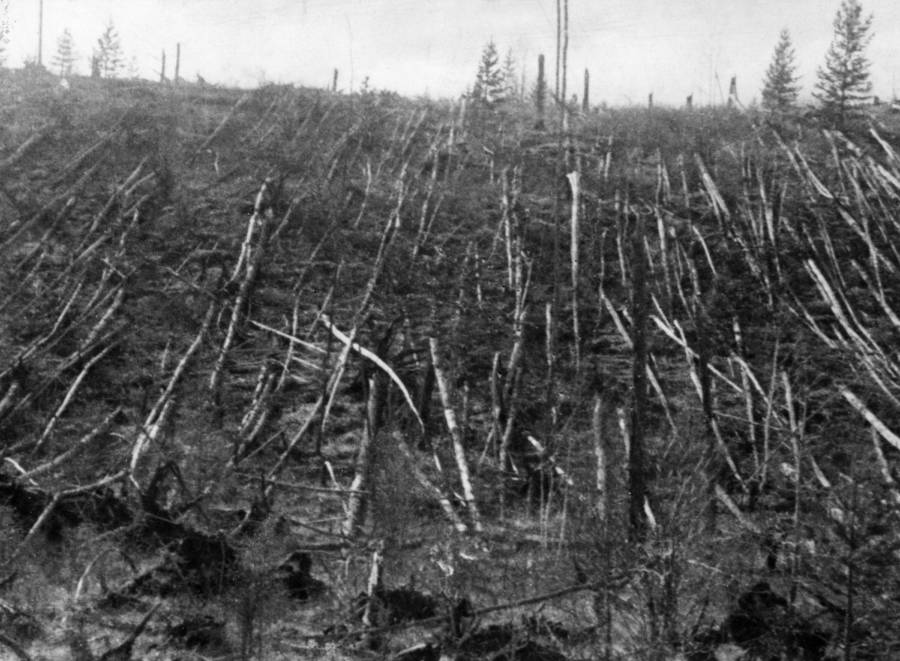
Sovfoto/UIG/Getty ImagesA Siberian forest that was flattened during the Tunguska event.On June 30, 1908, a massive explosion estimated to be up to 1,000 times more powerful than the atomic bomb dropped on Hiroshima unfolded in the remote Siberian wilderness of Russia. Shattering the calm of the landscape, the explosion burned hundreds of square miles of forest and flattened approximately 80 million trees in the area.Now known as the Tunguska event, since it occurred near the Podkamennaya Tunguska River, the explosion is considered the largest impact event in Earths recorded history, and one that was long shrouded in mystery. Many scientists now believe it was caused by an asteroid that approached Earths atmosphere and then exploded over Siberia, but several other theories have been floated throughout the years.This is the true story of the Tunguska explosion, the impact event that caused a split in the sky but left no impact crater behind.What Happened During The Tunguska Event?Bettmann/Getty ImagesDamaged trees at the site of the Tunguska event.At around 7:17 a.m. local time on June 30, 1908, Siberian villagers near the Podkamennaya Tunguska River basin were startled by a bright blue light that moved across the sky. Then, they heard a devastating boom.A powerful shockwave traveled across the area, shattering numerous windows and knocking some people right off their feet.S.B. Semenov, a peasant who was living in the area at the time, described the incident, saying, Over Onkouls Tunguska Road, the sky split in two and fire appeared high and wide over the forest. The split in the sky grew larger, and the entire northern side was covered with fire.Semenov continued, At that moment I became so hot that I couldnt bear it, as if my shirt was on fire; from the northern side, where the fire was, came strong heat. I wanted to tear off my shirt and throw it down, but then the sky shut closed, and a strong thump sounded, and I was thrown a few meters.Meanwhile, the owners of two gold mines in the area called one another on early telephones to accuse each other of blasting in the area.Due to the remote nature of this region in Siberia, only three people were reported to have died. But many more animals met terrible demises, according to an eyewitness account from Luchetkan, a member of the Indigenous Tungus people of the region.Luchetkans relative had been herding reindeer in the area of the blast, and unfortunately, they were still there when the explosion unfolded.As Soviet mineralogist Leonid A. Kulik later recalled: Of some reindeer they found the charred carcasses; the others they did not find at all. Of the sheds nothing remained; everything was burned up and melted to pieces clothes, utensils, reindeer equipment, dishes, and samovarsDespite the devastation, the Tunguska event initially attracted little attention, even within Russia. But that would eventually change, especially as experts searched for an explanation for the sudden explosion.What Caused The Tunguska Explosion?Sovfoto/UIG/Getty ImagesIt took decades before a patchy new forest began to regrow on the site of the Tunguska event.In 1927, the first scientific expedition reached the area of the Tunguska explosion, nearly two decades after the blast occurred. The long delay was due to the remote location of the site, as well as more pressing historical events like World War I and the Russian Revolution.Soviet mineralogist Leonid A. Kulik, who led early expeditions to the site, eventually uncovered a butterfly-shaped area of destruction. This devastation stretched about 830 square miles, and approximately 80 million trees had been knocked over. Chillingly, some trees remained standing, but had broken branches that had been stripped of their bark.Though early researchers quickly suspected that the explosion had an extraterrestrial origin, based on their observations and witness testimony, they werent able to confirm whether it was an asteroid or a comet. Curiously, they were also unable to find any actual physical evidence of a celestial object. In addition, they couldnt find any crater at the epicenter of the blast, probably because the explosion had occurred too high above Earths surface to create one. Though remnants of the mysterious astronomical object were eventually found in the area, these fragments were remarkably tiny in size and difficult to study in detail.The head-scratching nature of the crash site led to the rise of alternative theories about the Tunguska event as the decades went on.Google Earth/Adler PlanetariumThe site of the Tunguska explosion, as depicted on Google Earth.Some of these theories were more eyebrow-raising than others. For instance, in 1973, a team of physicists based at the University of Texas suggested that the Tunguska event could have been caused by a primordial black hole passing through the Earth. According to the physicists, this would explain the lack of an impact crater left behind. It could have also possibly explained the bright blue light that was seen by Siberian villagers.Most of the radiation from the shock front would be in the vacuum ultraviolet and would be absorbed and reradiated at longer wavelengths, the team explained. There would be little hard X radiation and the accompanying plasma column would appear deep blue. Decades later, astrophysicist Wolfgang Kundt at the University of Bonn in Germany offered yet another alternative theory about the Tunguska explosion. He said that instead of looking to space for an explanation, perhaps we should look inside the Earth itself. As he put it, an eruption of natural gas from kimberlite, a type of volcanic rock, may have been the real cause.It would have come from the molten Earth, some 3,000 kilometers deep (1,864 miles deep), Kundt explained. The natural gas would be stored as a fluid that deep, and when it reaches the surface it would become a gas and expand by a factor of thousand in volume, for a huge explosion.Some other strange theories include an annihilation of a chunk of antimatter, a UFO crash, and even a disastrous test of Nikola Teslas alleged death ray. By 2013, however, a team of researchers published a new study in Nature that seemed to confirm that an asteroid-turned-meteorite had been behind the Tunguska explosion, as was long suspected.The researchers came to this conclusion by reexamining tiny rocks that had been collected at the Tunguska site back in the 1970s. The detailed analysis indicated that the fragments, which each measured less than one millimeter wide, originated from an iron-rich meteor that apparently caused the explosion. Transmission electron microscopy showed that the rocks featured known meteorite mineral concentrations, like troilite and schreibersite.So does this mean the mystery was solved once and for all? While many experts seem to accept the asteroid theory, others believe an icy comet was more likely to cause that type of destruction than a rocky asteroid. And yet others have stubbornly held on to other theories, perhaps captivated by the remote landscape of the site and the eerie signs of destruction left behind.Now that youve read about the Tunguska event, go inside the chilling story of the Dyatlov Pass Incident. Next, learn about the mysterious disappearance of the Anjikuni people.The post Inside The Tunguska Event, The Astronomical Explosion That Rocked Russia In 1908 appeared first on All That's Interesting.
0 Комментарии
0 Поделились
3 Просмотры









 English
 Arabic
 French
 Spanish
 Portuguese
 Deutsch
 Turkish
 Dutch
Dutch
 Italiano
 Romaian
 Portuguese (Brazil)
 Greek
Greek