How the Battle of Dunkirk Saved 300,000 Allied Soldiers Who Lived to Fight Another Day
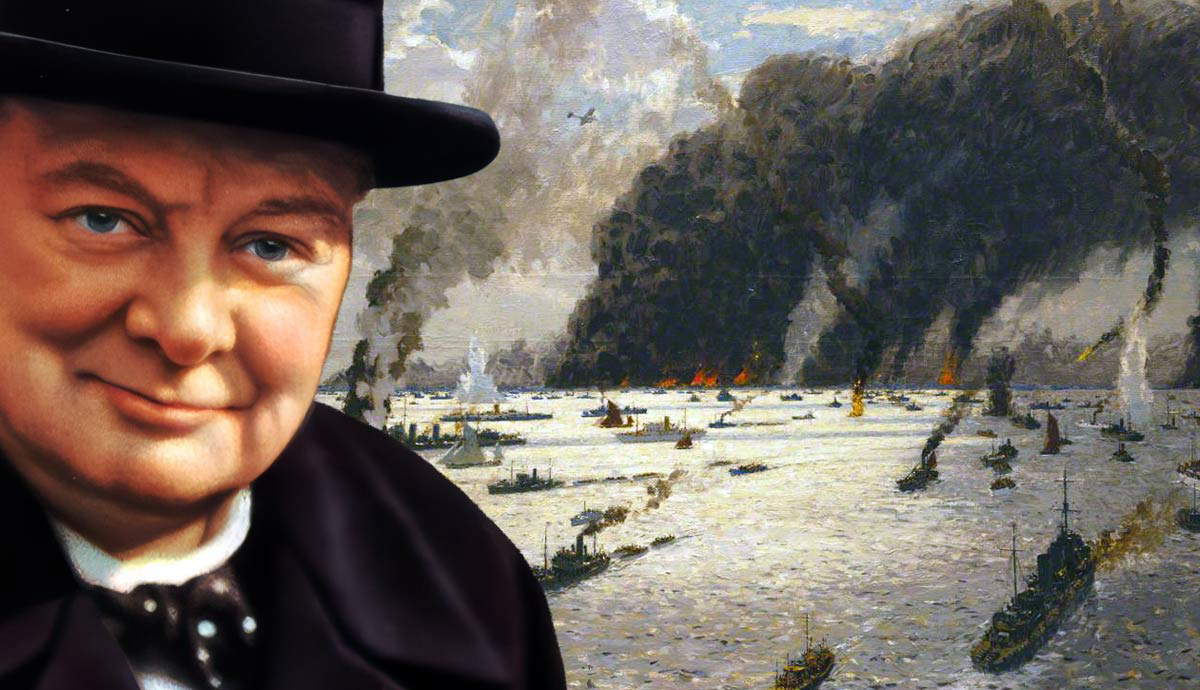
It is often said that the key to a successful offense is good defense. This mantra certainly applied to Allied forces during the first year of World War II. Following a hasty German advance across Europe during the invasion of France, hundreds of thousands of British, French, and Belgian troops found themselves pinned against the English Channel with nowhere to retreat in late May 1940. Aided by the Royal Air Force and a collection of hastily assembled merchant, fishing, and civilian vessels, the Royal Navy evacuated over 300,000 men to Britain.German Advance and the Fall of FranceAnti-aircraft gunners defending the British coastline, 1939-1945. Source: Smithsonian InstitutionOn September 1, 1939, the German Wehrmacht officially started the Second World War by its invasion of its eastern neighbor, Poland, leading Allied nations of Britain and France to declare war on Germany just two days later. Utilizing Blitzkrieg or Lightning War tactics, the Germans rapidly overwhelmed desired targets by concentrating infantry, tanks, artillery, and aircraft to break through enemy defenses. Several months later, the Wehrmacht turned its attention westwards.After occupying Denmark and Norway in April 1940, in May Germany launched an offensive towards Luxembourg, Belgium, and the Netherlands to circumvent the heavily fortified Maginot Line along the Franco-German border. Designed in the 1930s to deter a direct German assault by installing an extensive network of concrete bunkers, observation posts, and machine gun nests, the defensive boundary ultimately created a false sense of security in France, proving futile in preventing Germanys takeover.One of the most significant causes of unexpected isolation at Dunkirk was Germanys ability to bypass the Ardennes Forest. Many political and military leaders of the mid-20th century believed that the dense woods were impassable for an invading army. This notion was quickly proven a fallacy when the Germans launched a fierce offensive in northern France. By late May, the 390,000 men of the British Expeditionary Force that had been deployed in northern France risked being cut off and were forced to withdraw towards the port of Dunkirk. With Frances military defeat seemingly inevitable, the British decided that it was best to evacuate as many British and French soldiers as possible to fight another day before they were annihilated by German forces.Allied Encirclement at DunkirkBritish military propaganda poster, 1939-1945. Source: Smithsonian InstitutionAlthough the loss of the British Expeditionary Force would have left Britain virtually defenseless in the event of a German amphibious invasion, the situation was not entirely bleak. Strategically, the port of Dunkirk was in an advantageous position for retreat to England. The citys location on the English Channel meant that it was only 40 miles away from Dover. If Allied leaders could get hold of ships to transport the men, the evacuation was feasible.In the meantime, the Allies created a defensive perimeter around Dunkirk. Stretching over twenty-five miles long and eight miles deep, the line of brave Allied soldiers fought to hold off the German advance for as long as possible. The British 1st, 2nd, and 3rd Divisions, in combination with Frances 12th Motorized Infantry Division and 68th Infantry Division, built trenches and barricades to resist the German advance. Although Belgium surrendered in late May 1940, its troops in the region supported British and French efforts near the outskirts of Dunkirk.The Allied rearguard knew that the longer they held on, the greater the chances that their comrades could be rescued. They also recognized that they could not resist overwhelming German numbers indefinitely. Allied troops executed bold hit-and-run tactics to delay the Axis advance, but in many cases, the rearguard at Dunkirk fought to defend key positions to the last man to win as much time as possible for the evacuation. The defensive line was vulnerable to heavy coordinated assaults from German forces, and soon, weak points along its perimeter inevitably gave way as the battle ensued. Desperate to find any available help, British Prime Minister Winston Churchill weighed his options.Political ResponsesPoster of Winston Churchill, 1939-1945. Source: Smithsonian InstitutionAllied leaders were not only stranded militarily, but the desired evacuation at Dunkirk left Britain, France, and Belgium also isolated politically. Churchill knew that Britain could not win the war without assistance from the United States of America, but at this stage of the war, President Franklin D. Roosevelt was only prepared to offer limited financial and logistical aid. In any case, American ships were too far from northern France to offer any material assistance to evacuation efforts.Closer to home, Churchills options were also limited. Ireland and Spain remained stubbornly neutral and refused to offer assistance for evacuation efforts at Dunkirk. Ultimately, the responsibility of organizing the evacuation fell directly on those countries with troops trapped at Dunkirk. Considering Germanys occupation of Denmark and Luxembourg, Belgiums recent surrender, and the ongoing Battle of France, Britain was largely alone in planning and executing the evacuation. Seeing no way out other than an all-hands approach, Churchill called upon both military and civilian vessels to head towards Dunkirk in a risky attempt to save the Allied war effort before it crumbled.The Evacuation: Operation DynamoThe Little Ships at Dunkirk by Norman Wilkinson. Source: Imperial War Museum, LondonPlanned and executed by Admiral Sir Bertram Ramsey of the Royal Navy, the evacuation of Dunkirk, codenamed Operation Dynamo, began on May 26, 1940. Nearly 400,000 Allied troops were trapped by the advancing German offensive, demanding widespread participation from conventional and unconventional parties. While the Royal Navy was mainly responsible for the evacuation efforts across the English Channel, civilian involvement was critical for the operations success.Facing limited resources, hazardous waters, ground attacks, and air raids, moving hundreds of thousands of soldiers safely proved an immense challenge. Fortunately, over 800 privately owned fishing boats, yachts, and other small craft, charmingly labelled the little ships of Dunkirk, helped transform an Allied catastrophe into a story of resilience. Combined with over 200 British warships and smaller groups of Belgian, Canadian, and French vessels, the Allies worked around the clock over nine days to liberate its forces, and by June 4 some 338,000 Allied troops had been successfully evacuated. Meanwhile, a further 200,000 Allied soldiers were evacuated from other French ports. Tragically, nearly 70,000 Allied soldiers were killed, captured, or wounded while defending Dunkirk, while a further 40,000 Frenchmen were taken prisoner.Immediately following the evacuation, Winston Churchill delivered one of his most iconic speeches to the British House of Commons on June 4, 1940. Known as the We Shall Fight on the Beaches speech, the Prime Minister exploited the success of Operation Dynamo to not only acknowledge the strategic failures that caused the encirclement but to also inspire the country to resist an anticipated Nazi invasion of Britain through unity and strength.The Role of the Royal Air ForceRoyal Air Force flying suit, 1940. Source: Smithsonian InstitutionThe successful evacuation from Dunkirk owed much to air support from the Royal Air Force. While infantry, tanks, and artillery prevented Germany from infiltrating the beaches and port of Dunkirk, pilots patrolled the skies and provided air cover for the ships bringing troops across the English Channel. The transport ships provided a large target for Luftwaffe bombings and strafing runs, but talented Royal Air Force fighter pilots did their utmost to prevent the Luftwaffe from targeting the ships at close quarters.Outside of direct support to the evacuation efforts, the Royal Air Force fulfilled behind-the-scenes missions that enabled the successful operation. Reconnaissance aircraft gathered critical tactical and strategic intelligence surrounding German troop movements to inform Admiral Ramseys planning of Operation Dynamo. This surveillance proved vital in filling gaps in the defensive perimeter around Dunkirk and in coordinating the routes and timing of the hundreds of evacuation vessels at sea.After witnessing much of Europe falling to Germanys Blitzkrieg operations, the fate of Britains military was fragile, and the Royal Air Force was instrumental in providing hope during an otherwise bleak scenario. If Allied planes flew overhead, soldiers evacuating the port and their civilian and naval escorts knew there was a chance of survival. In all, 56 Royal Air Force pilots were killed in action while supporting the Dunkirk evacuation. Without their courage, it is unlikely that Operation Dynamo would have evacuated as many men as it did.Aftermath and ImpactThe British Navy guards the freedom of us all poster, date unknown. Source: Smithsonian InstitutionThe aftermath of Dunkirk is best categorized as one of cautious optimism. While the Allies celebrated their symbolic victory, the Battle of France had been a major setback for the Allied cause. Nevertheless, the public saw Operation Dynamo as a victory rather than a disaster, fostering national unity in the uncertain months that lay ahead.One positive outcome of the Miracle of Dunkirk was increased international support for Allied causes. While the United States was not yet involved in World War II, for example, the urgency of Dunkirk and Churchills resulting assertions resonated with the American public and national decision-makers, marking a tangible shift towards accepting inevitable inclusion in the conflict. While the United States did not formally enter the conflict until the Pearl Harbor attacks surprised Americas Pacific Fleet, softer involvement via initiatives like the Lend-Lease Program and rearmament efforts increased American aid to the Allies in the year following Operation Dynamo.By the time the United States joined the war, relations between political and military leaders in Britain and the United States were already well established. The entry of the United States into the war in December 1941, coupled with Hitlers invasion of the Soviet Union in June 1941, gave Britain hope that the war could be won. The Western Allies began turning the tide of World War II by defeating Axis forces in North Africa in 1942, facilitating the Allied invasion of Sicily and Naples the following year. By enabling the survival of the British war effort, the evacuation of Dunkirk was a necessary condition for ultimate Allied victory in the Second World War.











 English
 Arabic
 French
 Spanish
 Portuguese
 Deutsch
 Turkish
 Dutch
Dutch
 Italiano
 Romaian
 Portuguese (Brazil)
 Greek
Greek