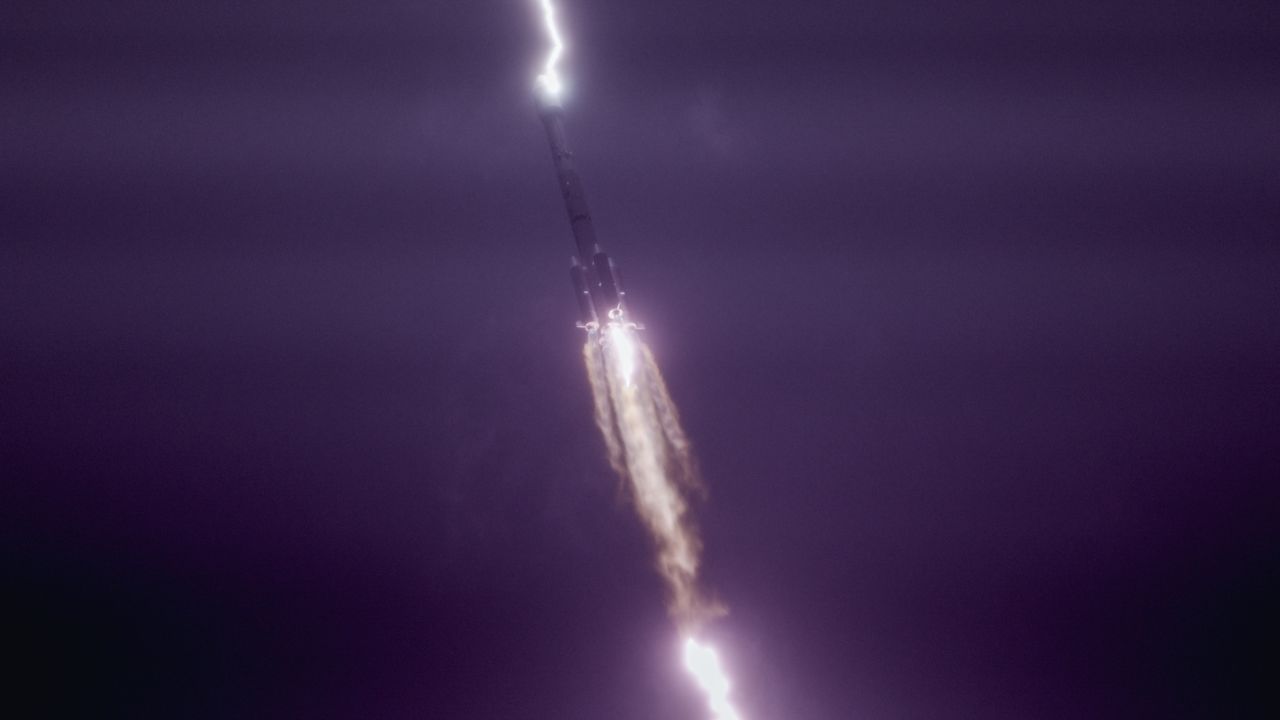
Chinese rocket hit by rare midair lightning strike moments after launch as onlookers gasp in horror (video)
Hundreds of spectators who attended the recent launch of a Chinese rocket witnessed a truly shocking sight when a bolt of lightning struck the ascending vehicle in midair. Stunning photos show the exact moment the zigzagging beam of electricity surged around the rocket's fuselage and through its exhaust plume before shooting down toward Earth's surface. Despite being hit with at least 100 million volts of electricity, the uncrewed rocket safely reached space and successfully deployed its payload in orbit. The stricken spacecraft, a Long March 3B rocket, lifted off from Xichang Satellite Launch Center in southwest China on July 23 at around 8 p.m. local time, Live Science's sister site Space.com reported. But around 30 seconds after leaving the ground, the rocket was suddenly hit by lightning, which illuminated the sky in the blink of an eye.Video footage from the launch (see below) shows a large crowd of people with raincoats and umbrellas collectively gasping as lightning hits the rocket and then loudly cheering as the spacecraft continues its climb, unimpeded by the electrical discharge.A translated statement from the state-owned China Aerospace Science and Technology Corp. released later the same day said the mission was a "complete success" and that the Long March 3B correctly deployed its payload, the Tianlian-2 (06) satellite, a geostationary relay satellite that will help support China's Tiangong space station. However, the statement did not mention the lightning strike. Modern spacecraft are designed to have highly conductive shells that divert massive electrical charges around their exteriors without impacting critical interior infrastructure or any crew they might be carrying. This works similarly to a Faraday cage, a protective enclosure that prevents certain types of electromagnetic radiation from entering or exiting. Similar designs are also used in commercial planes, which are struck by lightning at least once per year, on average, according to the National Weather Service. The Long March 3B is one of China's largest rockets and has been used in more than 100 missions since it first launched in 1996. This photo shows a launch on Dec. 9, 2025. (Image credit: VCG/VCG via Getty Images)Despite this, rockets normally launch only in good weather to minimize the risk. Previous incidentsIt is unclear exactly how many rockets have been struck by lightning throughout the history of spaceflight, but there have been several notable examples.Perhaps the most famous incident was during NASA's Apollo 12 mission, which successfully landed a trio of astronauts Charles Conrad, Alan Bean and Richard Gordon on the lunar surface in November 1969. Shortly after liftoff, the Saturn V rocket carrying the astronauts was struck by lightning twice as it climbed into the atmosphere. Some nonessential instruments and sensors experienced "permanent effects" from the strikes, according to one recently released report. However, these issues did not stop the spacecraft from safely ferrying the astronauts to the moon and back.The rocket used in NASA's Artemis I mission was struck by lightning on the launchpad during a "wet dress rehearsal," several months before it launched into space. (Image credit: NASA)Most recently, in 2019, a Russian Soyuz rocket was struck by lightning while carrying a communications satellite into low Earth orbit, Ars Technica reported. RELATED STORIESAstronaut snaps giant red 'jellyfish' sprite over North America during upward-shooting lightning eventRare colorful lightning caught on camera by ISS astronaut. 'OK, this is kind of out there'Spectacular photo taken from ISS shows 'gigantic jet' of upward-shooting lightning towering 50 miles over New OrleansLightning can also hit rockets on the launchpad, which is what happened in the lead-up to the Artemis I mission in 2022. The uncrewed Space Launch System rocket, which launched NASA's first moon mission in 50 years, was struck by lightning during a "wet dress rehearsal" around seven months before launch. However, strikes like these are exceedingly rare nowadays, as most launchpads are surrounded by towers designed to attract lightning away from standing rockets, according to The Institution of Engineering and Technology. Although these spacecraft remained relatively unscathed, the same cannot be said for an Atlas-Centaur rocket (dubbed AC-67) that was destroyed in 1987 after being struck by lightning 48 seconds after lifting off from Cape Canaveral, Florida. A NASA report later revealed that the electrical discharge had triggered a "single-word memory alteration" in the rocket's navigational computer, which caused it to veer sideways and completely break apart.




 English
 Arabic
 French
 Spanish
 Portuguese
 Deutsch
 Dutch
Dutch
 Italiano
 Russian
 Romaian
 Portuguese (Brazil)
 Greek
Greek