


WWW.LIVESCIENCE.COM
'Demon cavefish' discovered under WWII chemical weapons facility in Alabama
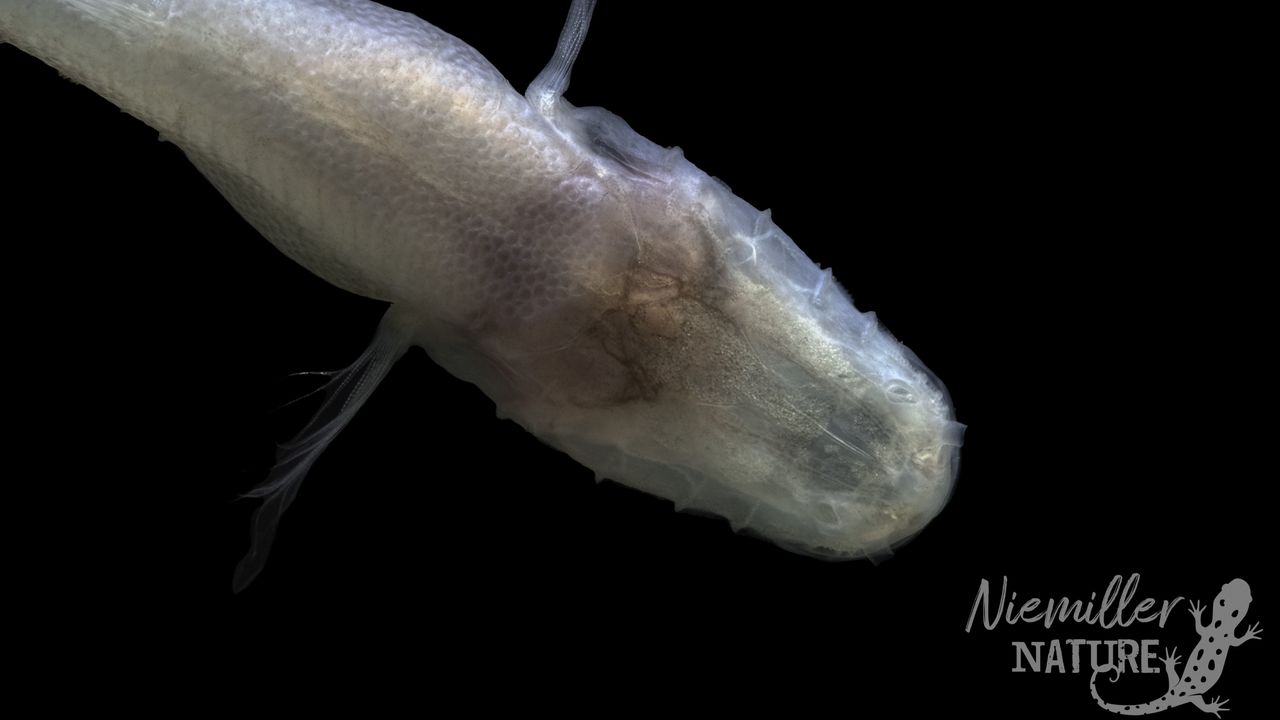
"Demon cavefish" have been discovered lurking in caverns beneath a contaminated U.S. Army base in Alabama, a new study has found. Biologists have named the pale, eyeless creatures Demogorgonichthys arcanus, after the monstrous Demogorgons from Netflix's "Stranger Things" and the underworld demon of Greek mythology from which the Demogorgon name derives. They are likely among the rarest fishes in the world. The find came as a shock to scientists because the cavefish's home, Bobcat Cave, has been extensively studied in recent decades. The subterranean system is part of U.S. Army site Redstone Arsenal, which was historically a center for chemical weapons production. Bobcat Cave is regularly subject to water quality monitoring and part of efforts to save endangered Alabama Cave Shrimp (Palaemonias alabamae), which also call the cave home.In a new study, published July 6 in the journal Scientific Reports, researchers described the cavefish find as a "discovery in plain sight." Study lead author Matthew Niemiller, who directs the cave biology lab at The University of Alabama in Huntsville, encountered the cavefish by chance during a routine survey of Bobcat Cave's largest chamber, known as the Shrimp Room, in early 2025. "I slipped in the mud at the back of the Shrimp Room and fell into a deeper pool," Niemiller told Live Science in an email. "During my graceful plummet, I disturbed a cavefish and crayfish underneath a rock ledge." Niemiller quickly snapped photos of the animals using an underwater camera before silt clouded his view of them. It wasn't until several days later, when he checked the photos, that he noticed the cavefish looked different from southern cavefish (Typhlichthys subterraneus), a known species within the cave. "The new cavefish had a pronounced hump behind the head, a longer, flatter snout, and unbranched fin rays," Niemiller said. "We returned a few days later, before a storm system forecasted to dump several inches of rain moved into the area. On the next trip, we confirmed that nearly half of the cavefish we observed were this new species."Niemiller studied the cavefish with colleagues at Auburn University, The University of Alabama and Mississippi State University, with students performing much of the lab work. Genetic analysis revealed that demon cavefish didn't fit within any known cavefish group. Notably, demon cavefish carry unique disabling mutations for rhodopsin, a light-sensitive protein that would otherwise support dim light vision. Niemiller noted that this mattered for two reasons."First, it's a great example of 'use it or lose it' at the molecular level," he said. "In total darkness, vision is useless, so natural selection stops maintaining the gene, and mutations simply accumulate. Second, and more importantly, the specific way this fish's rhodopsin is broken is different from how it's broken in the related cavefish it lives alongside. That's strong evidence they lost their vision independently."Demon cavefish and southern cavefish seemingly losing the ability to see independently is an example of how evolution can lead different species to converge on the same physical characteristics when they're suitable for an environment. Demon cavefish have a combination of physical traits that set them apart from other cavefish, including a long and flat snout. (Image credit: Matthew L. Niemiller, Niemiller Nature LLC.)The conditions in Bobcat Cave have likely been influenced by the history of the military base above it. Redstone Arsenal made various chemical weapons during World War II. At the end of the war, vast quantities of chemical munitions were buried at the site, along with chemical weapons from overseas, like British mustard gas and nerve agents and other toxic weapons recovered from Nazi Germany. The site is the subject of ongoing investigations, clean-ups and storage. Researchers have found that the cave contains elevated levels of trace metals compared to what would normally be found in such a habitat. However, Niemiller noted that the restricted-access status of the military installation does limit disturbance in the cave. A bigger concern for the demon cavefish is that surface water connects to the cave's groundwater, so the life in the cave is also exposed to runoff, sediment and contaminants linked to the nearby city of Huntsville. As demon cavefish are, as far as we know, restricted to a single cave, they are very vulnerable to extinction. The researchers concluded that demon cavefish would meet the criteria for becoming a "critically endangered" species, under the International Union for Conservation of Nature (IUCN) Red List a framework for determining a species' conservation status. It's unknown how many demon cavefish live within the cave, and it's likely that many of them will be in places that are inaccessible to researchers. RELATED STORIESNever-before-seen adorable pink bumpy snailfish with funny little beard filmed in deep canyon off California coast'I never thought we'd see one alive': Elusive goblin shark captured on camera for the first timeGolden scaleless cave fish discovered in China shows evolution in action"Like other cavefish, these animals probably spend much of their lives down in the water-filled aquifer below the cave, beyond where we can observe them, so any single survey is a snapshot, not a census," Niemiller said. "What we can say with some confidence is that it's known from just one cave system, it's rarely encountered, and by every measure we use, it qualifies as critically imperiled."Fortunately for the cavefish, Bobcat Cave is already known for being a home for endangered Alabama Cave Shrimp. Since 1990, the cave has been a focus for water quality monitoring, shrimp surveys, and other biological investigations that should also help the newfound species. "What protects the shrimp's water protects the fish's water too," Niemiller said.
0 Commentarii
0 Distribuiri
18 Views

 English
 Arabic
 French
 Spanish
 Portuguese
 Deutsch
 Turkish
 Dutch
Dutch
 Italiano
 Russian
 Portuguese (Brazil)
 Greek
Greek