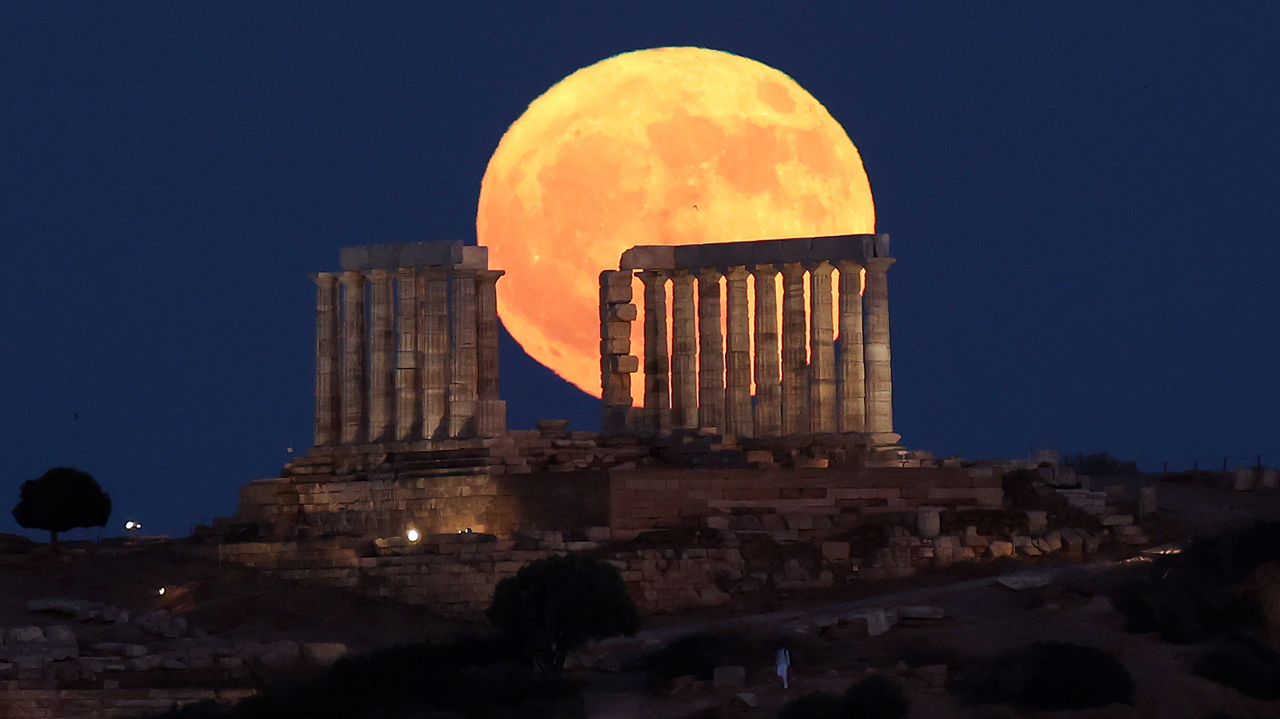
Catch an orange 'Buck Moon' rise tonight before a month of solar and lunar eclipses
Julys full Buck Moon, the second full moon of summer in the Northern Hemisphere, will turn full on Wednesday (July 29). It will be the final full moon before a flurry of solar and lunar activity notably, a total solar eclipse caused by the new moon on August 12, and a partial lunar eclipse during the following full moon on August 28.Named for the new antlers that emerge from male deer during summer, Julys full moon is also known as the Thunder Moon and Hay Moon, according to Time and Date. The Anishinaabeg people call it Miin Giizis, or Berry Moon, according to the Center for Native American Studies.The Buck Moon will be at its fullest at 10:37 a.m. EDT on Wednesday however, it will also look bright and full on Tuesday and Thursday night. From North America, the best time to see it will be at moonrise in the southeast during dusk on Wednesday evening. The exact time of moonrise will depend on your location. A full moon looks most dramatic as it first appears above the eastern horizon shortly after sunset, with Rayleigh scattering making it loom orange the same light-scattering phenomenon that makes the sky blue and sunsets red.July's full moon is one of the lowest full moons of the year as seen from the Northern Hemisphere because it occurs relatively soon after the June solstice. A full moon always sits opposite the sun, so the path of July's full moon mirrors the sun's path in February.You can easily enjoy the full moon with the naked eye, but a good backyard telescope or pair of stargazing binoculars can help you zoom in on famous structures, such as craters and Apollo landing sites. And if you want to take stunning photos of the moon, heres everything you need to know.Two weeks after theBuck Moon, the new moon will slide directly between Earth and the sun, causing a total solar eclipse. Observers along a narrow path of totality in eastern Greenland, western Iceland and northern Spain will see the moon block the sun for a few minutes, revealing the solar corona. A deep partial solar eclipse will be visible across Europe, with a small partial solar eclipse observed over Canada and the northeastern U.S.. The largest eclipse in Canada will be 93% in northeastern Nunavut, while northeastern Maine in the U.S. will see 29% of the sun covered by the moon. Solar eclipse glasses must be worn at all times to safely view the partial phases.The next full moon, the Sturgeon Moon, will rise on August 27 and be partially eclipsed by Earth overnight. More than 96% of the moon will pass into Earth's shadow as seen from Europe, Africa, North America and South America. How much do you know about the moon? Test your lunar smarts with our moon quiz!




 English
 Arabic
 French
 Spanish
 Portuguese
 Deutsch
 Turkish
 Dutch
Dutch
 Russian
 Romaian
 Portuguese (Brazil)
 Greek
Greek