


WWW.LIVESCIENCE.COM
America's gun violence epidemic, through the eyes of a Chicago trauma surgeon
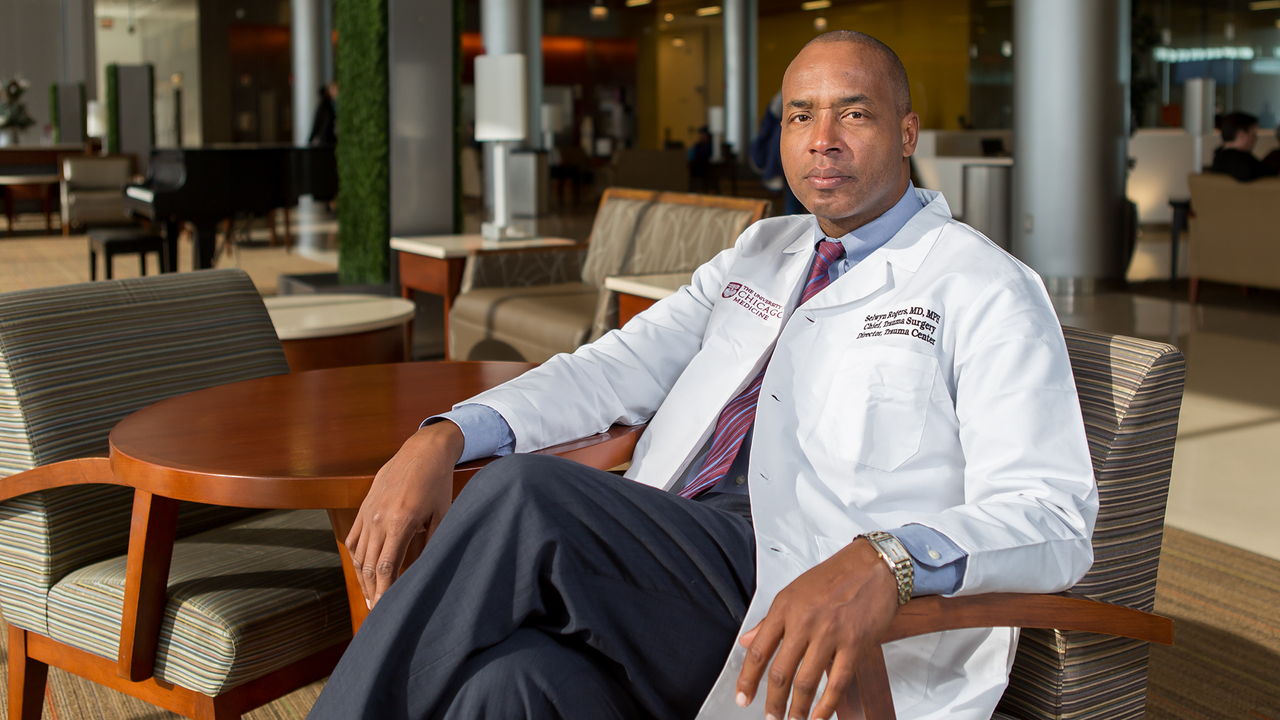
Gun violence is a uniquely American epidemic, according to Dr. Selwyn Rogers Jr., the founding director of the University of Chicago Medicine Trauma Center. Rogers helped found the trauma center in 2018 on Chicago's South Side, which had lacked a local adult trauma center since 1991. For nearly 30 years, people injured on the South Side had to endure long ambulance rides to access care elsewhere in the city, and lives were lost as a result.Since founding the new trauma center, Rogers has cared for many victims of gun violence. In a new book "Healing the Gun Violence Epidemic: Ending Violence, Rebuilding Communities, and a Trauma Surgeon's Vision for Restoring Hope" (North Atlantic Books, 2026) he tells their stories, along with those of advocates and organizations working to confront the underlying factors that drive gun violence in the first place. The book unpacks how we got here, and what we must do next, drawing on Rogers' experience as a witness to gun violence's toll.Live Science spoke to Rogers about his work, new book and vision for how Americans should tackle this epidemic.Nicoletta Lanese: In the book, you trace this trajectory of how we arrived here and what the future could look like, when it seems that strong gun legislation is unlikely. To put it plainly, what gives you hope for the future as a person who sees the impacts of gun violence daily?Dr. Selwyn Rogers Jr.: I'll start off by saying, I'm pathologically optimistic. Otherwise I couldn't do what I do as a trauma surgeon, where I see some of the worst things. What makes me hopeful, despite the current political headwinds, are people. When I see a mother who is grieving her son, who just died from gun violence, who says to me, "I have to keep going for my other kids." That gives me hope. When I see someone who acknowledges that they used to hurt others with a firearm, who now is passionate about prevention of other people getting hurt. That brings me hope. When I see the bugged out eyes of a five-year-old Black boy looking at me in my white coat, going, "Are you a doctor?" I say, yes, I am. That brings me hope. There are all of these moments of human connection. If we just look for them, they're all around us. That brings me hope every time.NL: The book draws on your experience as a trauma surgeon and also highlights societal factors driving gun violence. When did you begin thinking about treatment that goes beyond the operating room?SR: I trained in Boston at the time of the crack epidemic in the early 1990s, and Boston, like many cities in the United States, had a fair bit of penetrating trauma. (We separate trauma into "blunt" and "penetrating": "blunt" meaning events where there's no penetration of the skin by a missile or a projectile, and "penetrating" where there is some projectile that violates the skin and causes internal damage.) During that time, I was particularly struck that those who suffered penetrating trauma disproportionately look like me. I happen to be African-American, they happened to be mostly African-American or Hispanic. They happened to be mostly male. Something about that connected with me as I wanted to be part of helping to solve that problem over the course of my career.That brought me to Vanderbilt and Meharry Medical College in Nashville, which is where I took my first job. I earned a Master's in Public Health at Vanderbilt School of Medicine, and as part of that experience, I had to do a practicum that involved real-life work trying to understand healthcare outcome differences across a two-mile difference in space: I was at Vanderbilt, a traditional academic medical center, and Meharry Medical College's county hospital, Nashville General Hospital. Two people could have the same exact diagnosis and have very disparate outcomes, and trying to understand those differences and how you can make a difference in that space was very informative.ResourcesDirectory of Crime Victim ServicesTrauma Survivors NetworkNational Child Traumatic Stress NetworkSurvivors EmpoweredThe Rebels ProjectNL: How do you think about those social drivers of health in relation to trauma surgery?SR: When I was in training early on, as well as when I was a junior faculty, it was really striking to me that there were some patients who would come back again and again after traumatic injury. Thinking about how we treat other conditions that are not trauma for example, heart disease if I had a heart attack, blockage of my coronary blood vessels supplying my heart, I would today get a stent and get antithrombotic, antiplatelet therapy to reopen my heart. But if at the same time it was discovered that I had high cholesterol, I was overweight, I had a sedentary lifestyle, I smoked, those risk factors would also be addressed as part of my holistic recovery. For trauma, we don't treat it that way; for the most part, we treat it as an event. Something happened, and we will take care of you. But we don't look at all the other factors that put you at risk in the first place. And because we often don't do that, when people leave the hospital, the four walls of the emergency department or the trauma center, their risk factors haven't changed. Why would we think that they're not going to be re-injured again? So bringing that framing has been a very fundamental part of my both professional journey and my academic journey.NL: And those paired interests eventually brought you to your role in Chicago?SR: In many ways, I've been preparing my entire career to be in Chicago. My current role combines both my technical interest in helping people using my skills and training as a surgeon, but also the social drivers of health and healthcare disparities. All of those things culminated in a knock on the door where the chair of the Department of Surgery at University of Chicago, said, "Hey, we have an opportunity to open a brand-new adult trauma center on the South Side of Chicago." Before that call in 2016, I did not know that there was no adult trauma center on the South Side of Chicago since 1991. I've been here nine years now, and I love the city of Chicago. I love what I do; I love the patients I take care of; I love the community. I can't imagine doing anything else.NL: Can you clarify what services a trauma center offers, as opposed to an emergency room?SR: The distinction is that the emergency room, emergency ward, emergency department is a place. It's a place where people who are the most severely ill go to seek care. Now, in our healthcare system, people also seek care in the emergency department because they don't know where else to go. They may not have a primary care doctor, they may not have health insurance, so the ED becomes a place where they go. Trauma centers offer a comprehensive system of care that can't necessarily be delivered by an emergency room alone. (Image credit: Douglas Sacha via Getty Images)A trauma center is not that. A trauma center is a system of care incorporating operating rooms, interventional radiology, social workers, anesthesiologists, trauma surgeons, orthopedic basically a whole team of people that surround the individual and their injuries and try to restore them to health. For traumatically injured patients, time is critical and minutes mean life or loss of function. Let's say you fell off your bicycle and you lacerated, or cut, your brachial artery, the artery that supplies your arm. If you don't go to a trauma center within a short period of time minutes, maybe an hour max you will likely die from that relatively straightforward injury. The two things that trauma centers are very good at is stopping bleeding that will lead to death, and controlling complications of trauma. Those require a coordinated set of team members to do all those things in a short period of time. In 1991, when there was no adult trauma center on the South Side, people who were injured on the South Side of Chicago would go to other adult trauma centers throughout the city. Chicago, as you know, is a pretty big city. You can drive for an hour and still be in Chicago. It's hard for me to calculate the number of lives lost [because of the time it took to reach a trauma center].That's exactly what happened to a kid by the name of Damien Turner. He was an 18-year-old community activist advocating for rent control and other social issues on the South Side, and unfortunately, he was shot on August 15, 2010, literally four blocks from the University of Chicago. He was transported to Northwestern, where he arrived dead. His mother said that, "If the South Side had an adult trauma center, my son would still be alive." You can debate whether or not that may be true, but it's hard to debate the reality that time matters if you're shot and actively bleeding to death. Because Damien Turner led a youth group called Fearless Leading by the Youth, in his honor, that organization mobilized around a simple slogan: Trauma center now.This problem of gun violence in America is not unsolvable, it's not intractable. NL: What do you think people often get wrong about gun violence in Chicago?SR: Chicago has an outsized influence in this country, for better or for worse, right? It's in the middle of the Midwest. It has very high visibility as the third largest city. We've had mayors and governors and presidential candidates and presidents of the United States. All those things have put a lot of spotlight on Chicago. With this framing that Chicago has all this violence, this is all a Democratic city problem urban blight became synonymous with Chicago, which is far from the truth. One of the things that made me write the book is to dispel those myths. But also to bring the stories to change the narrative that this problem of gun violence in America is not unsolvable, it's not intractable. If we bring a public health lens, we can solve this problem, just like we've solved so many others. NL: What would it mean to bring a public health lens?SR: Going back to 2005, when I was in training in Boston, I was very struck by people who came back over and over again, injured. So we developed a violence recovery program that was hospital-based. The number of these programs have grown over the past 20 years to basically embed people with lived experiences some of whom have been shot themselves, some of whom have been justice-involved as credible messengers to help connect people with services, provide psychological support, and change the arc or trajectory of people's lives. That's what I would call secondary prevention. Something has already happened; how can we lower the risk? It's no different than someone who has an opiate addiction, and we make sure that they have access to naloxone so that they don't overdose and die. That's a public health risk mitigation strategy. Having a team of credible, trusted messengers to help transition that person from injured to recovered is something that every hospital should invest in.Ideally, we would also invest in programs to prevent people from being injured in the first place. Those are harder because they're not constrained within the four walls of an emergency department or the many, many walls of a health system. They're, if you will, societal. I think that there is an important opportunity for surgeons in particular, plus emergency medicine, physicians, nurses, and other healthcare providers, to bring voice to the voiceless. Oftentimes, people who are injured who come into our emergency departments, they don't have the agency that a physician or nurse or other healthcare provider has. How can we bring their voice to the forefront, often realizing that people who are the closest to the problem can often be the source of some of those solutions?Our opportunity for primary prevention that I see is that we could approach gun violence not as a criminal problem, but as a public health one, for which we need to determine risk factors, protective factors, mitigation factors to lower people's risk. NL: What do secondary prevention programs look like for the patients?SR: There are probably 80 or so hospital-based violence intervention programs across the country with a blueprint that's been coordinated by a nonprofit called the Health Alliance for Violence Intervention. It hires individuals who are not necessarily social workers or pastoral care (though they can be), but often people with lived experience from the community that can relate to and can connect with the person because they've either been in the situation themselves, or they're from the neighborhood, from the community. That's the first thing, to create that trusted relationship. The next thing that happens is you're getting out of the hospital. What's your life look like afterwards? If you were on the margin and living paycheck to paycheck, and now you're not working, now you can't pay your rent. Where's the next meal gonna come from?Turns out there's a whole host of community-based organizations that are doing great secondary prevention work. Our violence recovery team can be the connector. We could approach gun violence not as a criminal problem, but as a public health one.It's not like we're creating new services; there is the Supplemental Nutrition Assistance Program, there is the Victims of Crime Act, which is a fund, but people don't know about it and don't know how to access it. A violence recovery team serves as a connective tissue or bridge to those services to get people access to things that they need to keep on progressing and recovering. There are also a number of more established secondary prevention efforts. Oftentimes, street outreach organizations like Institute for Nonviolence Chicago have credibility to interrupt those cycles of violence. And there are others, like Cure Violence, that take people with lived experience, who are justice-involved, have spent time in prison or jail, and want to do something positive. Those people are incredibly strong proponents; they don't want their son, their brother to be injured like they were injured. Those people can be important interrupters to the cycle of violence. They know many of the people in the community that are involved, and sometimes, it's literally a conversation to prevent a retaliatory shooting. With that framing, you take folks who have been injured, shot themselves or [who have] shot others, and you wrap around a set of services to take them from the illegal economy into the legal economy. That might involve trauma-informed care, cognitive behavioral therapy, and skills development. I think those are all things that have evolved very intentionally in the city of Chicago over the past decade. Related storiesHere's what scientists know about mass school shootings'Tour de force' study may explain why trauma can lead to PTSD'Racism is a global public health crisis': Author Layal Liverpool says racist ideas still pervade medicine, and that hurts all of usNL: We're currently seeing social support being weakened at the federal level. Do you see that as a place for cities to step up in new ways?SR: In Chicago, I'll give a specific example for the community violence intervention ecosystem. The civic business community have put their money where their mouth is. They've put in $100 million over the past several years; that's new funding that wasn't there before. Holistically, no matter what's going on at the federal, state, municipal, local level, at the end of the day, it is about the human connection, right? It's about what we do for the person next to us. It's what we do for our neighbor. If your neighbor is sick and shut in, do we actually show up for our neighbor and say, "Hey, can I bring you a cup of soup?" How much does that really cost? You don't need the federal government to do that.This interview has been condensed and edited lightly for clarity. "Healing the Gun Violence Epidemic" "Healing the Gun Violence Epidemic" shares the stories of gun violence victims that Dr. Selwyn Rogers Jr. has met through his work as a trauma surgeon, as well as the lessons he's taken from bearing witness to that multifaceted trauma. Rogers explores underlying factors driving gun violence and shares insights into which policies have failed and which solutions have succeeded not just in his home of Chicago, but across the United States.
0 Commentarios
0 Acciones
15 Views

 English
 Arabic
 French
 Portuguese
 Deutsch
 Turkish
 Dutch
Dutch
 Italiano
 Russian
 Romaian
 Portuguese (Brazil)
 Greek
Greek