'Much more violent than predicted': A chunk of the universe's missing matter was powerfully hurled out of galaxies
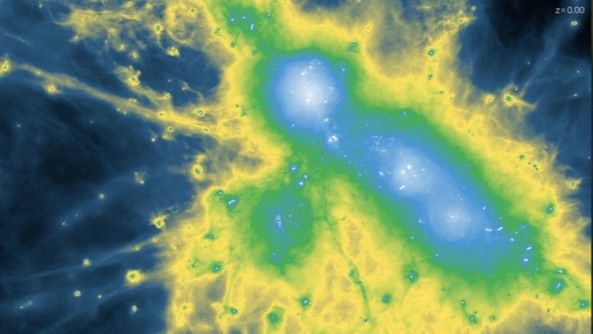
Scientists have found previously missing galactic matter lurking in the huge voids of space between galaxies.For decades, scientists have been unable to solve the long-standing puzzle of why we see far less normal matter in galaxies than we should. Now, a team of scientists in the CHIME/FRB Collaboration, led by researchers at MIT, has developed a novel method to spot this missing galactic matter by combining detections of fast radio bursts (FRBs) with measurements of galaxies' locations.This method, published July 21 in the journal Physical Review Letters, has exposed vast amounts of previously unseen matter in the space between galaxies, which originated from within the galaxies themselves. It has also unveiled the causes of the galactic matter's expulsion: violent astrophysical phenomena within galaxies, such as black hole jets and exploding stars. This finding, in turn, hints that these phenomena are much more energetic than previously thought.Just after the Big Bang, physicists estimate that roughly 17% of the universe was made from "ordinary" matter the observable matter that we, the planets, the stars, and galaxies are made of with the other 83% being dark matter, a mysterious component of the universe that exerts a gravitational influence on objects around it but does not interact with light, leaving it poorly understood. Scientists therefore expect to see a similar proportion of ordinary matter in the observable universe today. However, the total amount of ordinary matter within galaxies adds up to roughly one-tenth of what's expected in the universe. It has long been theorized that if the missing matter is really present in the universe, it is likely hiding in the vast space between galaxies. However, if this were true, the missing matter would be spread so thinly across empty space that it would be extremely difficult to detect.Now, the CHIME/FRB team has pioneered searching for the missing matter by studying FRBs. Discovered in 2007, FRBs are incredibly bright, millisecond-long flashes of radio waves thought to be produced by some of the most energetic phenomena in the universe. They arrive at Earth from distant galaxies billions of light-years away and contain imprints of the matter they pass through to get here acting like cosmic X-ray scans."What makes FRBs good to probe missing matter is that they have a special property," co-author Haochen Wang, a graduate student in MITs Kavli Institute for Astrophysics and Space Research, said in a statement. "They start out as a very quick flash, and as they pass through matter, they smear out in time. And we can measure that smearing very precisely, which is directly proportional to how much missing matter the FRB passed through."Smeared signalsBy combining data from both the Canadian Hydrogen Intensity Mapping Experiment (CHIME) and the Dark Energy Spectroscopic Instrument (DESI), the team cross-correlated the degree of smearing from thousands of measured FRB signals with the locations of millions of galaxies across the universe. This enabled the scientists to determine whether the FRBs were smeared by matter inside galaxies on their journey to Earth, or whether their path was through space between galaxies, meaning any smearing was due to matter residing there.The results showed that previously undetected matter was indeed located outside of galaxies and that it formed widely spread clouds that extend farther out than previously predicted. These findings support hypotheses that highly energetic processes, such as black hole jets and exploding stars within galaxies, push matter beyond galactic boundaries, but also suggest that the energies of these violent events must be higher than originally thought to throw them out so far.RELATED STORIESScientists may have finally found where the 'missing half' of the universe's matter is hiding Strange 'heartbeat' signal spotted coming from deep space Largest-ever 3D map of the universe shows 47 million galaxies, from the Milky Way to 'cosmic noon' "A galaxy is maybe a few 100,000 light-years across, and we found missing matter out to about 4 million light years," study co-author Kiyoshi Masui, associate professor of physics at MIT, said in the statement. "Thats further than the simulations predict, by quite a bit." "These measurements indicate that star activity, and activity from black holes, is stronger and much more violent than predicted," he added.Now that these results have verified that FRBs can indeed be used to search for missing matter, the team expects its method and results to improve in the future, particularly given that CHIME is continuing to detect more FRBs."We got it to work for the first time," Masui said, "and will get it to work even more precisely as data gets better."




 Arabic
 French
 Spanish
 Portuguese
 Deutsch
 Turkish
 Dutch
Dutch
 Italiano
 Russian
 Romaian
 Portuguese (Brazil)
 Greek
Greek