


WWW.LIVESCIENCE.COM
'It was unlike anything I'd witnessed before': Orcas seen headbutting a sunfish so hard that it exploded
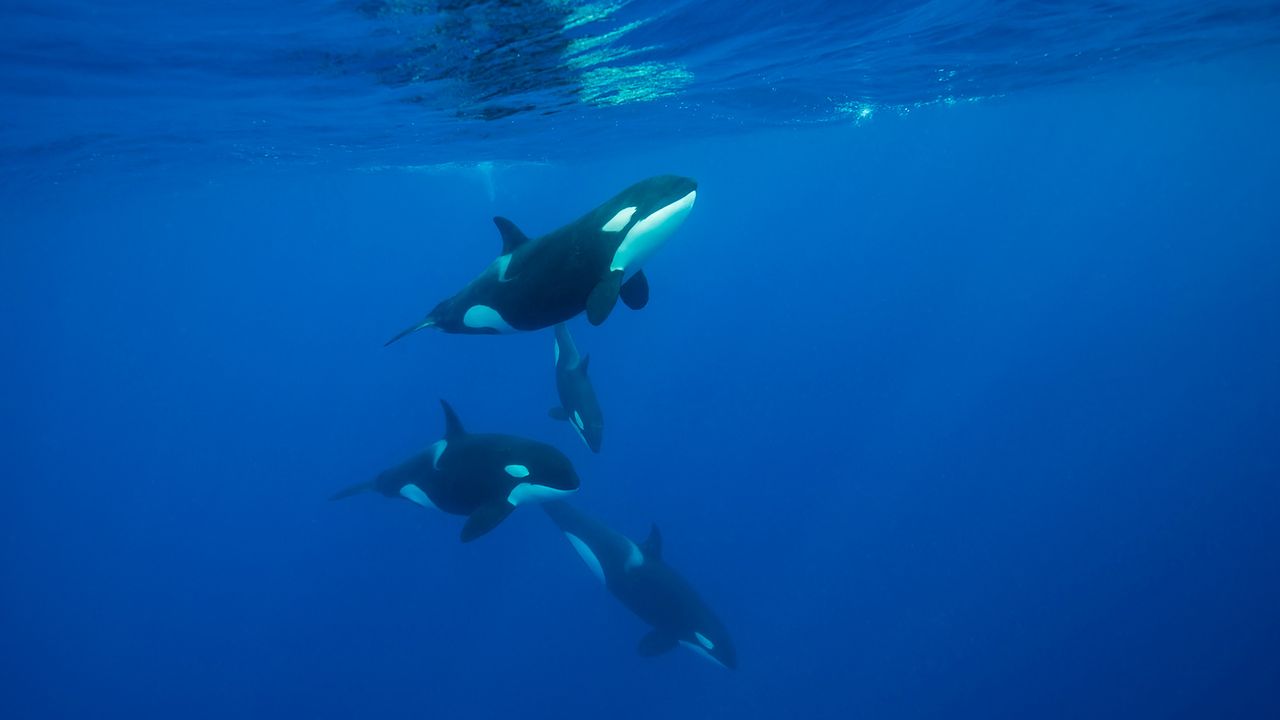
One of the ocean's most intelligent and aggressive predators has once again surprised scientists with a curious new behavior. In the Gulf of California, researchers witnessed orcas working together to smash dead sunfish into bits a suspected food processing technique that makes it easier for younger whales to feed on the enormous bony fish that weigh up to 4,400 pounds (2,000 kilograms). In two separate encounters, one orca gripped a sharp-tail sunfish (Masturus lanceolatus) while another orca charged toward the fish. The first whale released the carcass just before impact, allowing its companion to slam into the fish at high speed and scatter fragments of fish flesh throughout the water. "It was unlike anything I'd witnessed before," Kathryn Ayres, a scientist at the conservation nonprofit Beneath the Waves told Live Science in an email. "As a scientist, moments like this are incredibly exciting because you realize you're observing something that may never have been documented in detail before as you can tell in the video!" Ayres and her colleagues dubbed the behavior "ram-to-fragment." Their observations, published July 23 in the journal Frontiers in Ethology, suggest the killer whales were not trying to kill the sunfish, which were already dead and appeared to have been disembowelled. Instead, the orcas may have been breaking down the bulky carcasses so members of the group, particularly younger animals, could feed more easily.Hunting in actionThe first encounter Ayres observed took place in July 2024 near an offshore seamount off Baja California Sur, Mexico. An adult female orca held a sharp-tail sunfish by its tail-like clavus, or rudder, while an adult male orca accelerated toward it, belly-up. The female released the fish an instant before the male struck. The collision produced a loud noise and caused the sunfish's tissue to disintegrate. In the video, Ayres' shock is evident as she can be heard exclaiming, "Oh my god!" A juvenile orca then swam into the cloud of suspended flesh and ate the smaller pieces, while the adults fed on what remained of the main carcass. A second encounter, which the researchers credited diver Hctor Franz for filming in September 2025, followed much of the same sequence. One adult orca stabilized the sunfish, another rammed it and a calf later pulled tissue from the broken carcass. Ayres had previously watched orcas hunt ocean sunfish (Mola mola), but this was different. "I had also seen orcas ram their prey previously, but I had never witnessed an impact powerful enough to completely fragment the tissue like this," Ayres said. "That was what made this observation so remarkable." The maneuver resembled coordinated attacks Ayres and her team had previously documented, in which orcas confronted whale sharks (Rhincodon typus) the largest living fish in the Gulf of California. In those hunts, some orcas took turns ramming it. Previous footage from diver Kelsey Williamson shows orcas flipping a whale shark upside down to have an easier time preying on it. (Image credit: Kelsey Williamson)Why make fish confetti? Ramming is not a new killer whale hunting technique, said Matt Hansen, a postdoctoral researcher at the Leibniz Institute of Freshwater Ecology and Inland Fisheries who was not involved in the study. However, the hold-and-release sequences and shattering of carcasses may be new, Hansen told Live Science in an email. The researchers proposed several possible explanations for the behavior. The predominant assumption is that the adults were processing food for younger whales. Orcas frequently tear apart prey and share portions with calves and juveniles, and in both newly described encounters, young killer whales were present. But two observations are not enough to show that the adults were deliberately feeding or teaching the youngsters, Heather Hill, a professor and chair of psychology at St. Mary's University in Texas who was not involved in the research, told Live Science in an email. "Whether or not it represents parental investment, observational learning, or distribution of resources remains circumstantial in my opinion," she said. The researchers also suggested that the behavior could have been playful. Orcas are highly intelligent and social, and they sometimes manipulate, toss or strike prey without immediately eating it. However, Hill said that the two encounters appeared more practical than playful. Related storiesIncredible, first-of-their-kind images show an orca being born in Norway and the rest of its pod forming a protective circleChewed-up orca fins on Russian beach point to cannibalism, and scientists say it may explain why some pods are so tight-knitOrcas are adopting terrifying new behaviors. Are they getting smarter?"If it was for fun, I would have expected multiple attempts made with variations in speed, point of contact, force of impact, and initiators because the point of playing is to try different things and not destroy the toy too soon," she said. "Since it appears that these events were 'one and done' so to speak, probably less playful and more functional to eat the fish and maybe to model a foraging technique and possibly to share resources with the younger animal." The study authors also raise a more speculative possibility that dispersing the sunfish's microbe-rich skin and gelatinous tissue could somehow affect the surrounding water or expose the orcas to potentially beneficial microbes. But what that benefit might be is unclear."I don't see how dispersing the skin into the water column would have a different effect from eating it," Hansen said. "Unless the authors are suggesting [the orcas] are using it like a lotion on their own skin? Who knows, the world is weird and wonderful." Orca quiz: Will you sink or swim?
0 Commenti
0 condivisioni
20 Views

 English
 Arabic
 French
 Spanish
 Portuguese
 Deutsch
 Turkish
 Dutch
Dutch
 Russian
 Romaian
 Portuguese (Brazil)
 Greek
Greek