


WWW.LIVESCIENCE.COM
Mice on 'godforsaken' frozen volcanoes eat toxic plants to survive conditions 'not remotely compatible with long-term human survival'
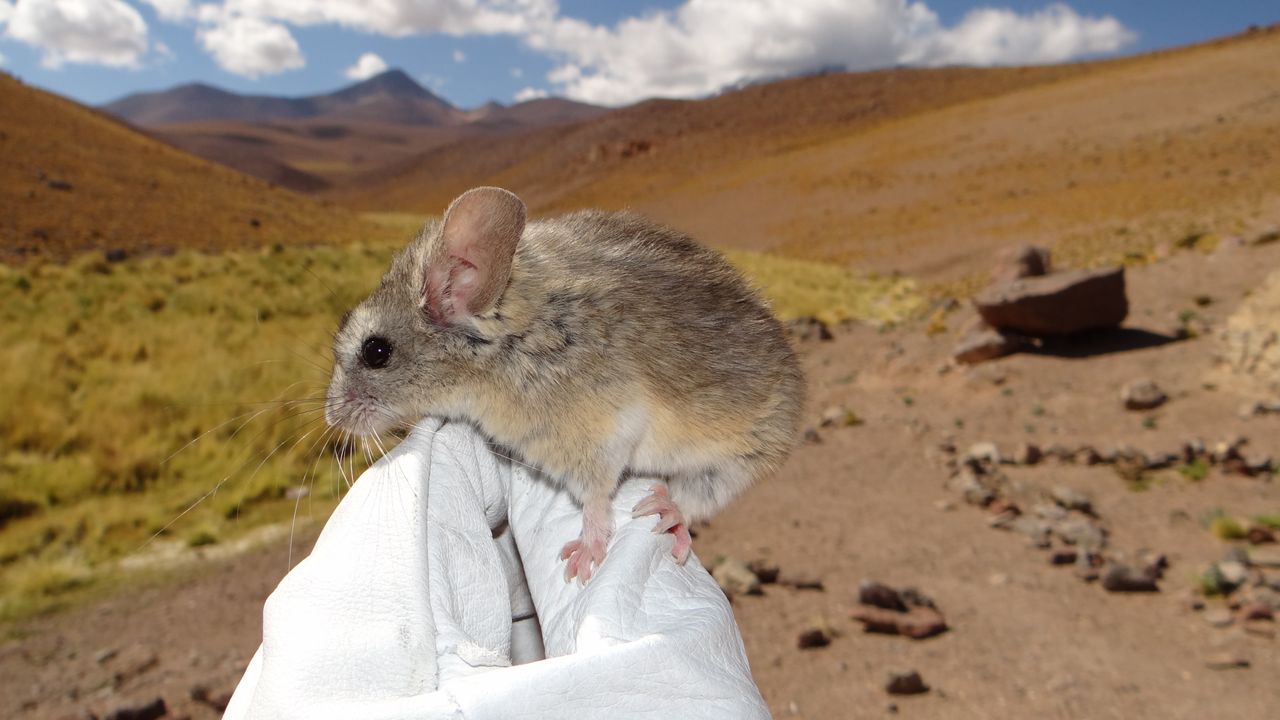
Scientists have discovered how mice survive at extreme altitudes on the tips of icy dormant volcanoes in the Andes. The area where the mice call home extends more than 1 mile (1.6 kilometers) above the world's highest human settlement. The air is thin, temperatures are blisteringly cold, and a desert ecosystem ensures water and vegetation are extremely scarce. "As a mountain climber standing on the summit of these peaks, the idea that there could be animals living in these barren godforsaken environments is just really mind-boggling," Jay Storz, a professor of biological sciences at the University of NebraskaLincoln, told Live Science.In 2020, Storz led a team of mountaineering scientists who recorded Andean leaf-eared mice (Phyllotis vaccarum) at a record-breaking altitude of 22,110 feet (6,739 meters). The mice were living on the summit of Llullaillaco, the world's highest historically active now dormant volcano, located on the border between Argentina and Chile. Now, in a new study published July 9 in the journal Science, Storz and his colleagues have revealed the biological mechanisms behind the mice's extreme survival. It turns out that the species has evolved a variety of adaptations to survive at such high altitudes, including the ability to eat plants that would normally be toxic. Before the discovery of the high-altitude mice, researchers had assumed that mammals could only survive up to around 18,000 feet (5,500 m) above sea level. But these hardy animals smashed that record, while also thriving at lower altitudes."One of the really notable things about this particular species is that it has such a broad elevational range, from sea level along the desert coastline of northern Chile, all the way up to the summits of some of the highest peaks in the Andes," Storz said. To better understand these remarkable mice, the researchers studied members of the species at low, middle and high altitudes between 2020 and 2023. The work mixed mountain climbing and animal surveying techniques, with Storz and his team ascending the mountains and setting traps to catch and record the mice. Storz said that a well-acclimatized mountain climber can tolerate these high elevations for a very short period, but that the conditions are "not remotely compatible with long-term human survival." The expeditions can be dangerous even for experienced climbers: one of Storz's colleagues was evacuated during a separate expedition in Peru after they developed high-altitude pulmonary edema a life-threatening form of altitude sickness that causes fluid to build up in a climber's lungs. Storz surveyed the mice with other experienced mountain climbers. Here he is pictured with Mario Prez Mamani and Franz Checca on the summit of Hualca Hualca in Peru. (Image credit: Jay Storz)The researchers sent some of their specimens to labs in Chile for further analysis. This included putting the mice into small chambers and measuring how they adapted to extreme cold and oxygen deprivation. The team also sequenced the Andean leaf-eared mouse genome, which revealed a variety of local adaptations to different altitudes. For example, the mice living at high elevations were better at maintaining their body heat and oxygen levels than those taken from lower altitudes, according to a statement released by the University of Nebraska-Lincoln. Another change in the high-altitude mice's genes enabled them to digest food and detoxify plants that would otherwise be harmful to them, according to a statement released by McMaster University in Canada. This special adaptation helps the mice get enough food on the sparsely vegetated volcanoes. The researchers also revealed that the high-altitude mice were much more active in the daytime, perhaps due to a lack of predators and warmer temperatures during those hours. However, despite local adaptations, the mice were still extremely similar genetically across their elevation range. All of the mouse populations overlapped, which prevented high-altitude individuals from becoming isolated or especially distinct from their low-altitude kin. Not all of the mice survived the researchers' study. To fully understand the biology of the mice, researchers needed to euthanize them and study their tissues. They also wanted to preserve "voucher" specimens to act as permanent representatives of the species in museums, which researchers can keep returning to for further study. According to the study, the team collected 167 of these voucher specimens.Storz noted that it's very valuable to have a biological record of specimens archived in museum collections for future generations. He added that their work was not having any impact on the viability of the mice populations, and that the animals were killed humanely, although he did not disclose any details. "King of the mountains"Study co-author Graham Scott, a professor of biology at McMaster University in Canada, said that the take-home message of the new research was how life can overcome such extreme environments, and not just survive but thrive. In this case, the mice did this by developing solutions for the cold, oxygen deprivation and food scarcity. "It just shows the complex ways that evolution has made these animals the king of the mountains," Scott said. RELATED STORIESMystery creature found in 'forbidden cloud forest' of Peru is new species of marsupial33-inch-long 'woolly' mountain rat caught on camera for first time everElusive dwarf fox, feared extinct, photographed for the first time on island off YucatnEnduring harsh conditions high in the Andes likely comes with some benefits. Scott said that competition is probably the biggest reason for the mice living at such high elevations. The mice are also pretty much left to their own devices, and thus likely have less to fear from predators. But this begs the question: Are there any animals living higher than the mice?"Birds are always a bit hard to nail down because, of course, they can fly and there's certainly records of birds flying at higher elevations than that," Scott said. "But we think this is probably the highest-dwelling animal."
0 Commentarii
0 Distribuiri
18 Views

 English
 Arabic
 French
 Spanish
 Portuguese
 Deutsch
 Turkish
 Dutch
Dutch
 Italiano
 Russian
 Portuguese (Brazil)
 Greek
Greek