


WWW.LIVESCIENCE.COM
Did ancient Egyptian princesses use weapons? Controversial study claims they hunted or trained with the military, but not all experts agree.
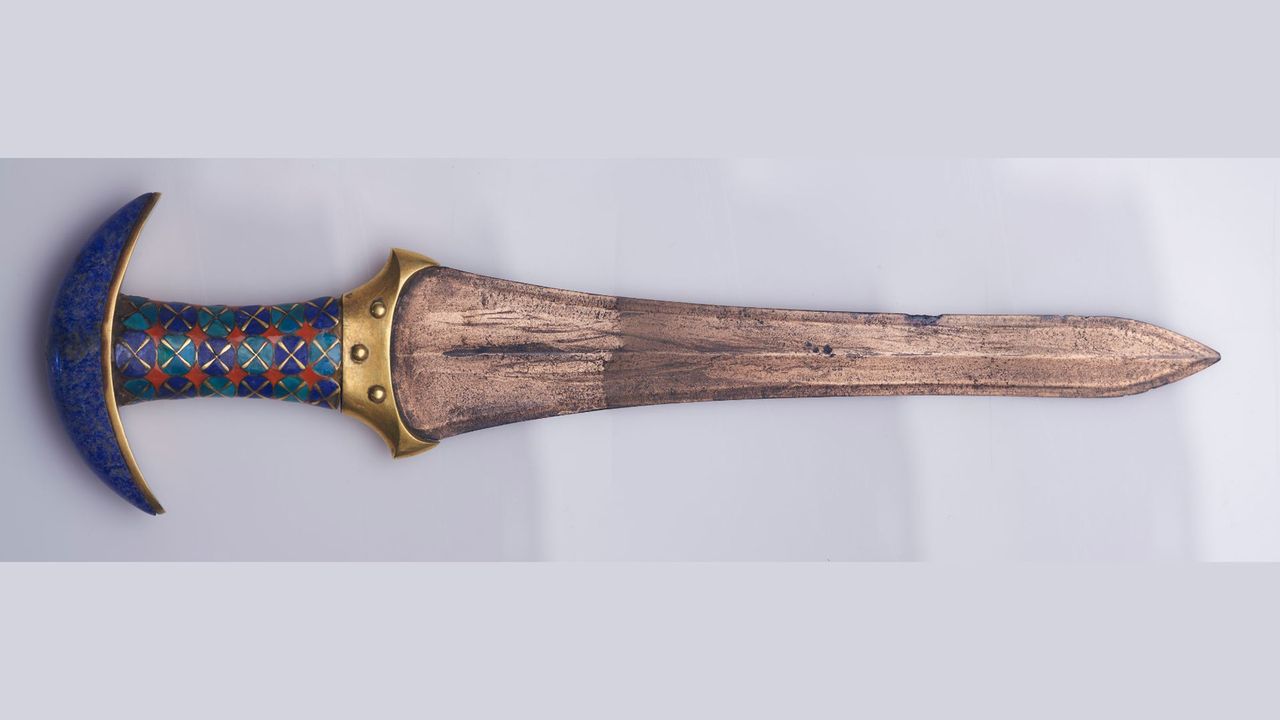
Several ancient Egyptian princesses buried with bows, arrows and a dagger may have trained with those weapons during their lives, possibly using them while hunting or practicing archery, a controversial new study suggests. Researchers examined the remains of six royal individuals who lived during Egypt's Middle Kingdom nearly 4,000 years ago. After analyzing the muscle-attachment sites on these bones, the researchers suggested that certain pronounced areas might be linked to repeated activities such as archery and weapon handling. "Members of the royal family, especially the women, were active participants in skilled, physically demanding activities such as archery and hunting," study first author Zeinab Hashesh, an archaeologist at Beni-Suef University in Egypt, said in a statement. The finding, published Friday (July 17) in the journal Frontiers in Environmental Archaeology, challenges the assumption that weapons placed in the women's tombs were largely ceremonial. It may also provide new information about the health and physical activities of royal women. However, bioarchaeologists who were not involved in the study told Live Science that skeletal changes cannot reliably indicate a specific activity. Age, body size, genetics and other repetitive movements can produce similar results, they said. Royals rediscovered in a museum basementIn the 1890s, French archaeologist Jacques de Morgan excavated a site near the tomb of pharaohs Amenemhat II and Amenemhat III. From these excavations, de Morgan found various royal individuals, whose partial remains were later stored at the Egyptian Museum in Cairo. The French archaeologist Jacques de Morgan found the royal burials in the 1890s. (Image credit: Gallica Digital Library via Wikimedia Commons)For decades, the remains were forgotten about. But in 2020, museum workers rediscovered the bones during a museum curation project. The collection included King Hor, Princess Ita, Khenmet, Itaweret and Noub-Hotep, as well as an unidentified woman who may have been Princess Sathathormeryt (also spelled Sithathoriunet). Four of the women are believed to have been daughters of the pharaoh Amenemhat II. However, the skeletons' identities depend heavily on those 19th-century labels, which "means that we cannot be certain how reliable they really are," Sonia Zakrzewski, a bioarchaeologist at the University of Southampton in the U.K. who was not involved in the research, told Live Science in an email. Most of the individuals' skulls were missing, and only around 22% to 58% of each skeleton survived. Their soft tissues had largely decayed into powder, but the remaining bones allowed the team to estimate the sex and age and look for injuries, diseases and signs of physical activity. Signs of weapons training?Using X-ray scans and specialized infrared spectroscopy, which can help identify different materials, the researchers examined the entheses, the places where muscles, tendons and ligaments attach to bones. Repeated muscle use can contribute to enlarged or pronounced attachment sites, although several other processes can also create this result. Princess Ita, who died between the ages of 28 and 34, had pronounced attachment sites on parts of her right shoulder, arm and hand. The team suggested that these changes could reflect repeated gripping and weapon handling, possibly involving the ornate dagger found in her tomb. Princess Noub-Hotep, who died in her early 40s, had strongly developed attachment sites in her forearms and right hand. De Morgan had discovered "arrows with their barbs in an astonishing state of preservation" in the princess's tomb, according to an 1896 issue of the journal American Anthropologist. Similarly, Princess Itaweret showed robust attachment sites around her shoulder and chest, while Khenmet had pronounced features on her arms and shoulders. King Hor also displayed differences between muscle attachments on the left and right sides of his body. The authors argued that these patterns fit actions involved in drawing back a bowstring a process that can create muscular asymmetry between the left and right upper body. They also posited that these muscular patterns could be from gripping objects like daggers or maces and suggested the weapons buried with the royals weren't just symbolic. Experts remain doubtfulDespite the pronounced attachment sites on these individuals' bones, Zakrzewski said it's unknown if the royals got buff through archery or some other activity. The sites on the bones show that "certain muscles appear to have been repeatedly used, but the actual cause of that use is uncertain," she said. "We cannot say therefore that these skeletal changes necessarily are associated with the use of weaponry," especially since the researchers didn't look at comparison groups from the Nile Valley or elsewhere. Zakrzewski added that it's unknown why artifacts like arrows were included in the tombs. Perhaps they were meant to be "used by individuals associated with the deceased," she said.Scott Haddow, a bioarchaeologist at the University of Turin in Italy who was not involved in the study, noted that some of the skeletal changes were present on both sides of the remains. "Archery is a highly asymmetrical activity; finding generalized, bilateral robusticity in some bones (with some asymmetry observed in other bones) does not make a particularly strong case for these individuals practicing archery," he told Live Science via email. The individuals' ages at death could also explain the differences. Khenmet was between 35 and 45 when she died, while Noub-Hotep was approximately 40 to 44. Muscle-attachment sites are influenced by aging, as well as by body size and genetics, Haddow said. An old photo of Dashur Pyramid, where the royal individuals were found. (Image credit: Rijksmuseum via Wikimedia Commons)Princess versus pauperOne of the study's largest caveats was the absence of a comparative group, which would have shown how unusual the changes were compared with other Egyptians from the same period. "It would be very useful to know how much such side differences exist in contemporaneous Egyptians, whether royal or not," Zakrzewski said. Besides missing a comparison with a "control" group, other experts believe that the researchers are reading too much into the weapons being buried with the royals. Related stories18 ancient Egyptian tombs with dozens of gold 'tongues' discovered along the Mediterranean coastArchaeologists discover perfectly circular ancient Egyptian temple that may have been used for sacred water ritualsWe finally know why Queen Hatshepsut's statues were destroyed in ancient Egypt"Although the presence of funerary artifacts (e.g., arrows, daggers) makes the princesses' involvement in such activities plausible, the authors provide limited biomechanical or biomedical evidence to substantiate this claim," Sbastien Villotte, an anthropologist at the French National Center for Scientific Research, told Live Science via email. He added that "a more robust approach would involve comparing these individuals to non-elite contemporaries from the same region and period. This would help determine whether such degenerative changes (at these locations) were common in the general population (who were unlikely to engage in the same activities) or truly indicative of elite-specific behaviors." Although the study has a number of uncertainties, Zakrzewski said they shouldn't diminish the value of examining the remains. "It allows us to sort of put flesh on the bones and understand more about their lives," she said. Can you identify these historical objects of war? Test your smarts with our weapons of the world quiz!
0 Comentários
0 Compartilhamentos
11 Visualizações

 English
 Arabic
 French
 Spanish
 Portuguese
 Deutsch
 Turkish
 Dutch
Dutch
 Italiano
 Russian
 Romaian
 Greek
Greek