Robot dog can climb stairs, navigate a forest and bound over logs thanks to new, rapid AI training technique
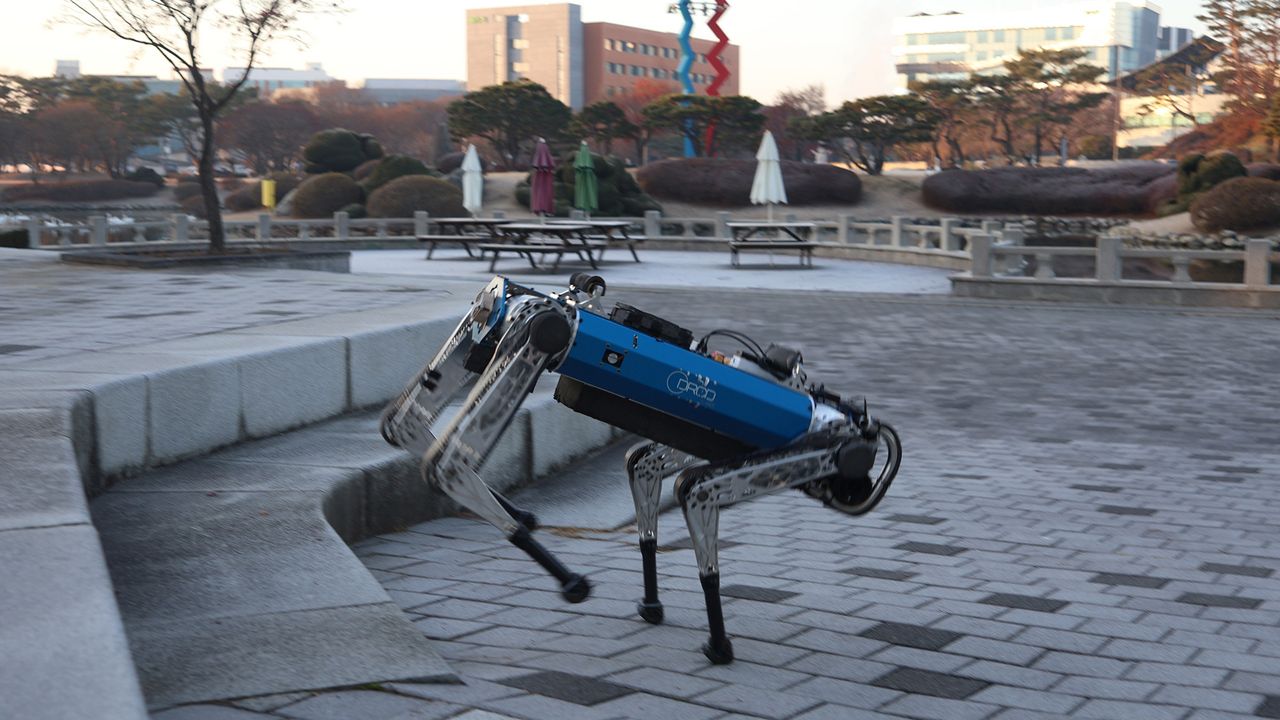
A four-legged robot has learned to change the way it runs while navigating forests, staircases and obstacle courses. seamlessly switching between a steady trot and a faster bounding gait without instructions from a human operator. The 100-pound (45 kilograms) robot, called KAIST HOUND, uses cameras and lidar to scan the ground ahead, then selects an appropriate gait and adjusts its movements in real time. In outdoor tests, it crossed a 0.7-mile (1.1- kilometers) university campus route and a 0.2-mile (0.3 km) forest trail strewn with roots, logs and slippery leaves.The researchers described the robotic framework on July 15 in the journal Science Robotics. Changing gaitAnimals naturally change their gait depending on their speed and surroundings. A dog might trot carefully across uneven ground, for example, before bounding over a fallen branch. Reproducing this adaptability in robots is tricky because different movements are often controlled by separate, highly specialized coding systems, and transitions between them can cause a lag that drives the robot to stumble. To overcome this issue, researchers developed a special training framework called action pretrained transformerbased reinforcement learning (APT-RL). This is an artificial intelligence (AI) training system that first studies many examples of actions, uses a transformer to understand patterns across those actions, and then improves through rewards and penalties. The training began with a simple, two-dimensional computer model of the robot. Using trajectory optimization a technique that calculates physically workable movements for the robot the team generated 180,000 short trotting and bounding sequences, including the joint forces the robot's legs need to perform. The dataset represented about 15.5 hours of movement but took only around eight minutes to produce. During reinforcement learning a machine learning technique where AI learns to make the best decisions by engaging with a particular environment through trial and error an AI system then learned how to select and modify those skills while negotiating simulated stairs, stepping stones, hurdles, gaps and rough ground. In digital simulations, the robot dog was not limited to copying its prerecorded movements. It could also make corrections for three-dimensional terrain and unexpected situations, such as jumping over a log a behavior that wasn't included in the original, flat-ground training data. The KAIST HOUND quadrupedal robot navigates a forested terrain (Image credit: Jun-Gill Kang, Jaehyun Park)Related storiesScientists found the optimal robot body, and it has 20 legs watch it scale walls and move through treesThis humanoid robot does all your housework for you and its makers say it's ready for your homeAI compressed billions of years of evolution into seconds to create 'Lego-like robots' that can recover even when they lose limbsFinally, the researchers configured the system to include the robot's depth camera and lidar scanner in the simulation. In one indoor test, HOUND bounded across an obstacle 2 feet (60 centimeters) high while briefly achieving 9.5 mph (15 km/h). It also jumped down a three-step staircase. The robot generally chose trotting at lower speeds on irregular ground, while bounding became more common at higher speeds or when it encountered larger steps, hurdles or gaps. The AI system that could select either gait performed more consistently across the different simulated environments than the version restricted to trotting or bounding alone. The researchers suggest the technology could eventually help robots navigate disaster zones or other places inaccessible for wheeled machines. However, the current framework only allows two gait choices and mainly handles forward movement. Rapid turning, sideways motion and other behaviors like crawling remain future goals for the research team.




 Arabic
 French
 Spanish
 Portuguese
 Deutsch
 Turkish
 Dutch
Dutch
 Italiano
 Russian
 Romaian
 Portuguese (Brazil)
 Greek
Greek