


WWW.LIVESCIENCE.COM
18 ancient Egyptian tombs with dozens of gold 'tongues' discovered along the Mediterranean coast
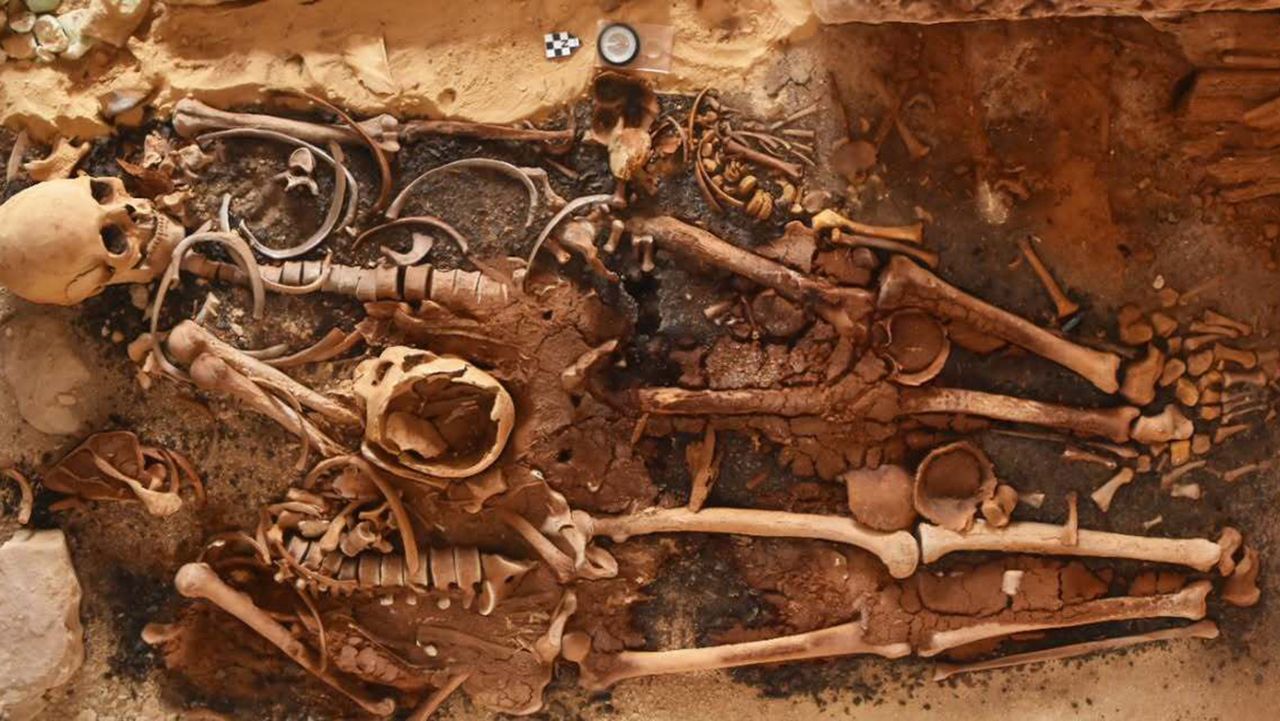
Archaeologists have discovered 18 ancient tombs in an Egyptian town along the Mediterranean Sea.The tombs which were unearthed in Marina el-Alamein (also spelled Alamin), about 60 miles (100 kilometers) west of Alexandria date to the Ptolemaic (322 to 30 B.C.) or Roman (30 B.C. to A.D. 395) period, the Egyptian Ministry of Tourism and Antiquities said in a translated statement announcing the find. During the Ptolemaic period, Egypt was ruled by the descendants of one of Alexander the Great's generals, while the Roman period started with the death of Cleopatra VII, when Egypt became incorporated into the Roman Empire as a province.The team noted that 11 of the tombs had been carved deep into the ground, while the seven others were located closer to the ground's surface. The tombs held many artifacts most notably, 24 "gold tongues" that were likely put into the mouths of mummies, and an offering altar with a base designed to look like a false door.An entrance to one of the tombs in Marina el-Alamein (also spelled Alamin). (Image credit: Courtesy of the Egyptian Ministry of Tourism and Antiquities)"The false door is one of the oldest and most recognizable elements of ancient Egyptian funerary architecture. In traditional Egyptian belief, it symbolized the interface between the worlds of the living and the dead, through which the deceased could spiritually receive offerings presented by the living," Hesham Hussein, the undersecretary for Lower Egypt and Sinai archaeology at Egypt's Ministry of Tourism and Antiquities, told Live Science in an email. The fact that the design of a false door was carved into the altar "suggests that the symbolic meaning of the false door remained important even as its architectural function evolved," Hussein added.Some of the gold tongues discovered inside the tombs. The ancient Egyptians believed these tongues could help the deceased communicate in the afterlife. (Image credit: Courtesy of the Egyptian Ministry of Tourism and Antiquities)Gold tongues from ancient EgyptGold tongues have been found in mummies at a number of ancient Egyptian sites. The ancient Egyptians considered gold to be the flesh of the gods, and they believed gold tongues could help the deceased communicate with them in the afterlife."Gold tongues are a well-documented feature of some burials dating to the Ptolemaic and Roman periods in Egypt," Hussein said. "They are generally interpreted as symbolic funerary amulets intended to enable the deceased to speak in the afterlife, particularly during the judgment before Osiris, or more broadly to communicate and recite sacred formulas in the next world." Interestingly, one of the newly found gold tongues is shaped like the "Eye of Horus." Horus was a falcon-headed god associated with the sky and warfare. Artifacts shaped like his eye are often found in Egypt and were used to ward off evil, according to the statement. However, it's unclear if some of these artifacts are actually gold tongues, Attilio Mastrocinque, a retired archaeology professor formerly at the University of Verona in Italy, told Live Science. Mastrocinque has written extensively about Greek and Roman religion but was not involved in this excavation. After looking at the photos posted by the ministry, he noted that one appears to show a wheat ear. Wheat ears were associated with fertility and images of them were popular in the ancient world. The newfound artifact looks similar to silver wheat ears that have been found in Roman sanctuaries in Europe, Mastrocinque added.An offering altar with a base that resembles a false door. (Image credit: Courtesy of the Egyptian Ministry of Tourism and Antiquities)Altar with a false door?False doors are commonly found in ancient Egyptian tombs and offering altars are often near these doors. In this case, the base of an offering altar resembles a false door. Krzysztof Jakubiak, an archaeology professor at the University of Warsaw who has excavated at Marina el-Alamein in the past but was not involved in the recent excavation, noted that this find likely needs additional analysis. "I would exercise caution in asserting a direct comparison between the iconographic motifs visible on the discovered altar and those of the false door iconography," Jakubiak told Live Science in an email. He said it's possible that the altar was not finished and its existing appearance simply resembles a false door. Hala Mostafa, an archaeology professor at Ain Shams University said in an email that he thought the altar may depict the hieroglyphic sign for "offering" rather than a false door. An unfinished statue of the goddess Aphrodite, who was associated with love and beauty. (Image credit: Courtesy of the Egyptian Ministry of Tourism and Antiquities)Goddess statue and other findsOne of the tombs contained an 8.2-foot-long (2.5 meters) granite coffin whose lid was still on when the tomb was discovered. The team is currently examining the skeletal remains found inside.Related storiesTomb of ancient Egyptian prince discovered at Saqqara and it has a giant 'false' pink door7 famous mummies and secrets they've revealed about the ancient world13 ancient Egyptian mummies found with gold tongues to help them talk in the afterlifeOther finds included an incomplete statue of Aphrodite, a Greek goddess associated with love and beauty. During ancient Egypt's Ptolemaic dynasty, Greek culture and religion became increasingly popular in Egypt. Mastrocinque said it will be interesting to see if there is a structure for Aphrodite near the statue"It is important to know where this statue has been found," Mastrocinque told Live Science in an email. "Was there a little cultic place of Aphrodite within this funerary complex?" Dorota Dzierzbicka, director of the Polish-Egyptian Archaeological Mission to Marina el-Alamein, said that the new finds, along with finds made at the site in the past, reveal that the town was "a culturally diverse community in which Egyptian and Graeco-Roman traditions coexisted and blended in everyday life and funerary practices." She noted that the new discoveries were made by Egyptian archaeologists who work at the site. See how much you know about mummies with our mummy quiz!
0 Comments
0 Shares
1 Views

 Arabic
 French
 Spanish
 Portuguese
 Deutsch
 Turkish
 Dutch
Dutch
 Italiano
 Russian
 Romaian
 Portuguese (Brazil)
 Greek
Greek