Scientists build tiny 'diving suit' for cockroaches, turning them into search-and rescue cyborgs
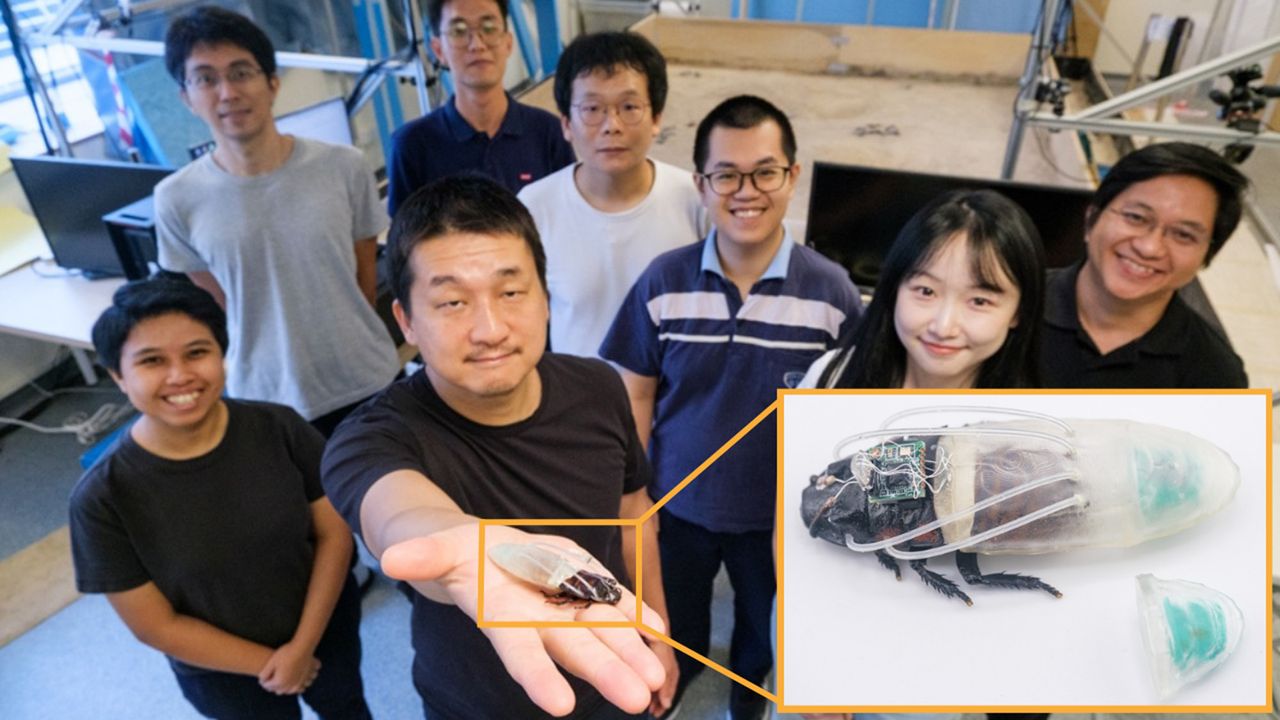
Engineers have designed a waterproof "diving suit" for cyborg cockroaches that enables the hybrid insects to survive and roam underwater for up to three hours. This function expands the capabilities of cyborg insects and could one day be deployed in disaster zones, according to the team.A built-in oxygen generator and silicone tubes deliver the gas directly to a cockroach's breathing holes, known as spiracles. The design is adapted for use in low-oxygen conditions as well as submerged environments, the researchers said in a new study published June 29 in the journal Nature Communications."Our approach combines a soft waterproof shell with a simple yet reliable chemical oxygen generator," study co-author Shinjiro Umezu, a professor in the School of Creative Science and Engineering at Waseda University in Japan, said in a statement. "This allows the insect to retain its natural mobility while being protected from an environment that it cannot normally survive in."Cyborg insects are living insects that have been fitted with electronic controllers that guide their movements. Researchers have previously used them in search-and-rescue operations to access and investigate hard-to-reach areas; for example, they were used in rescue efforts after the devastating magnitude 7.7 earthquake in Myanmar in March 2025 that killed at least 3,700 people and injured 4,800 more. The advantage of cyborg insects over tiny robots is that the former employ insects' muscles to move, whereas the latter rely on high-power batteries that consume energy and can run out of steam.The cyborg insects deployed in Myanmar were developed in the laboratory of Hirotaka Sato, senior author of the new study and a professor in the School of Mechanical and Aerospace Engineering at Singapore's Nanyang Technological University.Sato has spent more than a decade pioneering cyborg insect technology. He and colleagues hope the new diving suit will extend cyborg insects' operational range to include flooded and partially submerged areas in disaster zones.The suit consists of a flexible shell, four silicone tubes that attach to the spiracles and a transparent, 3D-printed oxygen tank. To make the tank produce oxygen, the researchers sprinkled manganese dioxide onto a highly absorbent sponge inside the tank. They then injected a small amount of diluted hydrogen peroxide, which breaks down slowly in the presence of manganese dioxide to produce oxygen. Finally, the team sealed the tank with ultraviolet adhesive to prevent leaks."The key engineering challenge was to build a system that was small, light and flexible enough for the insect to wear, while still producing enough oxygen for long-duration underwater movement," Umezu said.The silicone tubes send oxygen straight into the thoracic spiracles, while the abdominal spiracles, which are lower down the insects' bodies, take in the oxygen contained in the suit."Our new insect diving suit works like the oxygen tank used by human divers," Sato said in the statement. The silicone tubes can be attached and removed without pain or harm to the insect, the researchers added.RELATED STORIESScientists found the optimal robot body, and it has 20 legs watch it scale walls and move through treesMIT builds swarms of tiny robotic insect drones that can fly 100 times longer than previous designsAI compressed billions of years of evolution into seconds to create 'Lego-like robots' that can recover even when they lose limbsThe researchers tested the suit on a cyborg Madagascar hissing cockroach (Gromphadorhina portentosa), which they placed in a water tank and later sent into a plastic tube that simulated submerged and low-oxygen environments.The suit enabled the cockroaches to roam underwater for up to three hours, raising the prospect that cyborg insects, including locusts and beetles, could one day be used to inspect flooded pipes, drains, tunnels and other hard-to-access places.Next steps include improving the diving suit to potentially include sensors and a navigation system; and testing the design in simulated disaster environments, according to the statement.




 English
 Arabic
 French
 Portuguese
 Deutsch
 Turkish
 Dutch
Dutch
 Italiano
 Russian
 Romaian
 Portuguese (Brazil)
 Greek
Greek