


WWW.LIVESCIENCE.COM
'Astronomers have to revise estimates': The Milky Way may be larger, heavier, and more lopsided than we realized
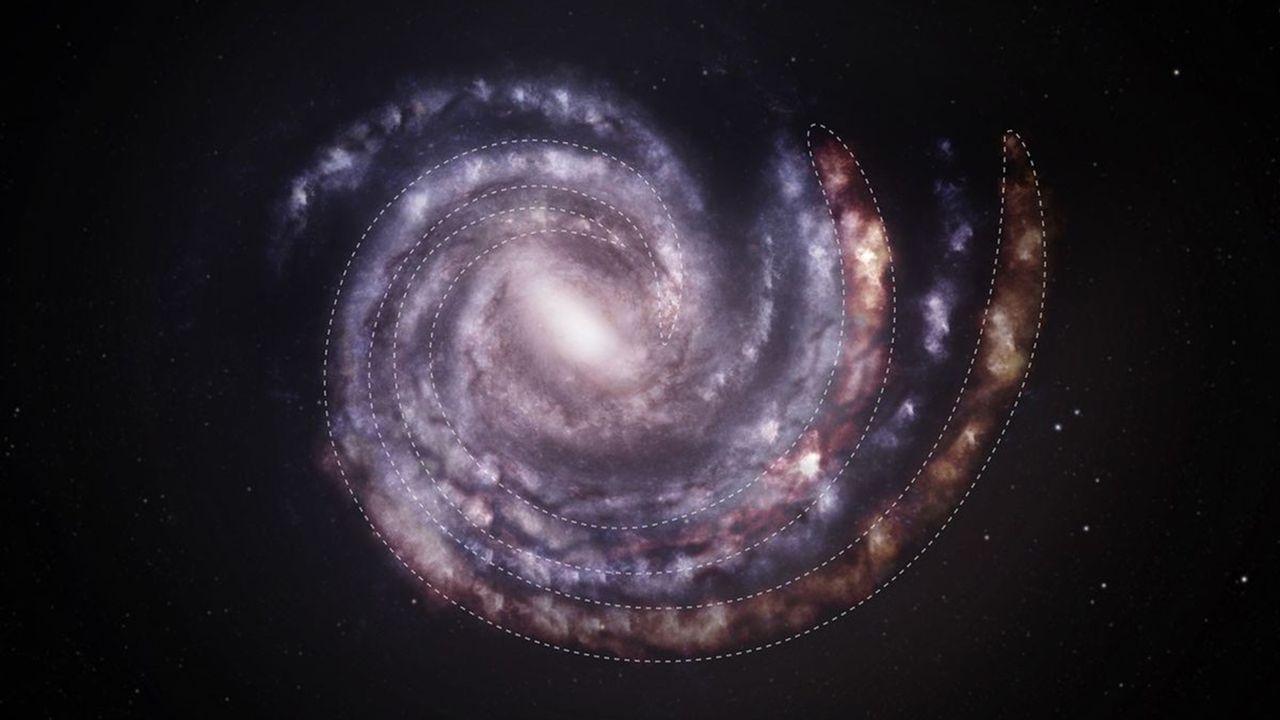
Two of the Milky Way's gigantic spiral arms appear to be much farther away than we realized, scientists have discovered after listening to the echoes of distant cosmic explosions. The findings could potentially force us to reconsider our galaxy's mass and maybe even its shape, researchers say. The Milky Way is a barred spiral galaxy made up of a dense central region containing a supermassive black hole (dubbed Sagittarius A*), orbited by four major arms the Sagitarrius arm, the Scutum-Centaurus arm, the Perseus arm and the Outer arm that curve and stretch outward like a giant pinwheel. Most of our galaxy's stars and gas are tightly packed together in these cosmic limbs, although some stars, including the sun, exist in the gaps between them or within other smaller structures.Until now, researchers have estimated the size of these arms based on the Milky Way's rotation rate, because it is impossible to see our galaxy's entirety from Earth's position inside the galaxy. This, in turn, has helped us estimate the galaxy's total size (around 100,000 light-years across) and its mass, which is equivalent to around 1.5 trillion suns, according to NASA. However, this way of measuring the massive structures is not foolproof and has led to several uncertainties about our galaxy since we first discovered its spiral shape around 175 years ago, Live Science's sister site Space.com reported."We usually model the Milky Way's outer arms indirectly based on what we know of how our galaxy rotates, but doing it this way leaves room for error," study first author Beatrice Vaia, a researcher at the Italian National Institute for Astrophysics who led the new study as part of her doctorate, said in a statement. The farther away from the galactic center, the more uncertain the measurements become, she added.In the new study, published June 19 in the journal Astronomy and Astrophysics, researchers came up with a new method of measuring the arms using the most powerful and luminous explosions in the universe, known as gamma-ray bursts (GRBs). As X-ray light from these cosmic outbursts passes through dense clouds of gas, like those within our galaxy's arms, it creates luminous rings, or echoes, whose size corresponds to their distance from Earth.Researchers studied echoes of X-ray light leftover from GRBs as the radiation from these powerful cosmic explosions passed through gas clouds in our galaxy's arms. (Image credit: X-ray: NASA/CXC/INAF/B. Vaia et al.; Optical: Pan-STARRS; Image processing: NASA/CXC/SAO/N.Wolk & P.Edmonds)The team used data from NASA's Chandra X-ray Observatory and the European Space Agency's XMM-Newton observatory (both of which orbit Earth) to analyze echoes from three different GRBs that shone through gas clouds in the Perseus, Outer and Scutum-Centaurus arms, respectively. This revealed that both the Outer and Scutum-Centaurus arms are likely around 10% farther from Earth than we thought. This may not sound like much, but it equates to several thousand light-years. The biggest potential implication of this discovery is that our galaxy is wider and, therefore, probably more massive than we realized, which could have major knock-on effects for our understanding of our cosmic neighborhood."The differences are small, but any revision of these distances is important because they are so fundamental for understanding our galaxy," study co-author Ilaria Fornasiero, an astronomer at the University of Bologna in Italy, said in a separate statement. "For example, this could mean that astronomers have to revise estimates of the mass of the galaxy, because that affects how wide the arms stretch."The new positions of the Outer and Scutum-Centaurus arms (shown in red) suggest that the Milky Way is not as perfectly symmetrical as we thought. (Image credit: NASA/CXC/SAO/M.Weiss)Animations released alongside the new paper show how the Milky Way might look based on the new data, revealing the Outer and Scutum-Centaurus arms extending farther into intergalactic space, making our galaxy look more like a lopsided snail's shell than a perfect spiral.These visualizations do not necessarily show the true shape of the galaxy, as the Sagitarrius arm and other minor galactic limbs have not been measured using the same methodology. However, the fact that the Perseus arm was not as distant as the other two GRB-illuminated limbs hints at a surprising asymmetry throughout our galaxy that cannot be easily explained. RELATED STORIESThe Milky Way ate a galaxy called Loki, and scientists think they found its bonesA 'mass migration' of stars from the Milky Way's center could explain why there's life in our solar system'Rare and enigmatic' structures found at the Milky Way's center in largest-ever map of its kindThe researchers are now on the hunt for more GRBs that can be used to map out the rest of our galaxy's shape and help us better understand what our cosmic neighborhood actually looks like. However, finding these cosmic explosions is easier said than done. "We're relying on the universe to provide us with these events, and so far, over 25 years, we've only found a handful that we can use," study co-author Andrea Tiengo, an astronomer at Scuola Universitaria Superiore Pavia in Italy, said in the statement. "That said, we will continue to be on the lookout for more."
0 Comments
0 Shares
1 Views

 Arabic
 French
 Spanish
 Portuguese
 Deutsch
 Turkish
 Dutch
Dutch
 Italiano
 Russian
 Romaian
 Portuguese (Brazil)
 Greek
Greek