2,500-year-old tomb of a 'warrior prince' with chariot and helmet discovered on Italy's Adriatic coast
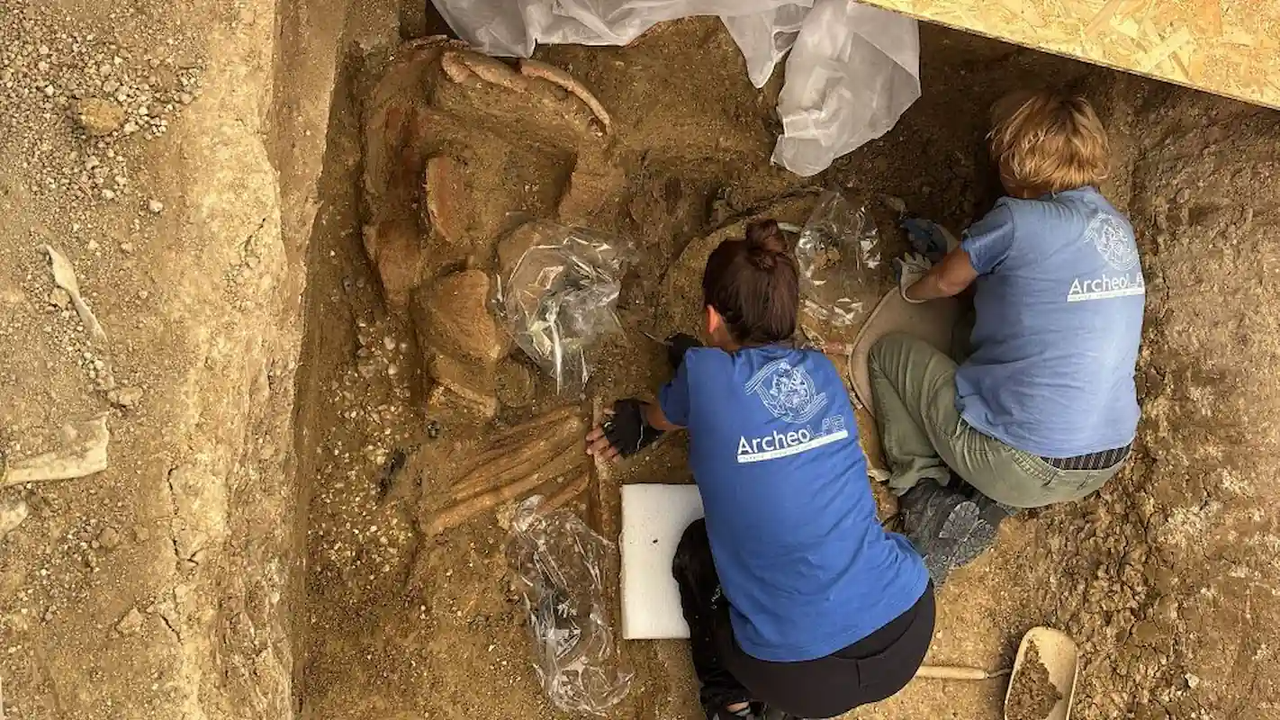
Archaeologists in Italy have unearthed the royal tomb of a pre-Roman "warrior-prince" along with the remains of his chariot and weapons. The tomb was just one part of an extensive sixth-century B.C. burial ground and reveals new information about the funerals of elite rulers from this mysterious civilization.The funerary complex was found in the municipality of Sirolo, a small town on the Adriatic Sea on Italy's east coast, according to a translated July 1 statement from the Superintendency of Archaeology, Fine Arts and Landscape for the Provinces of Ancona, Pesaro and Urbino. In the sixth century B.C., an Italic group called the Piceni or Picentes lived in the area, bordered to the north by the Etruscans. The Piceni left few written records, so much of what is known about the enigmatic group comes from archaeological excavations. In 2020, a "princely tomb" complete with an iron-wheeled chariot, a cache of weapons and a helmet was discovered in the Pini cemetery. Now, archaeologists have found a second one.At the center of a monumental circular palisade, researchers unearthed a large male burial with a wooden "currus" a two-wheeled chariot that had been buried intact with the nobleman around 2,500 years ago. The warrior prince was also buried with a helmet and an ax, as well as several bronze vessels sealed with ceramic lids and filled with organic remains, which may represent the traces of a funeral banquet or food offerings for the afterlife. Fragments of the two-wheeled chariot during excavation. (Image credit: Superintendency of Archaeology, Fine Arts and Landscape for the Provinces of Ancona, Pesaro and Urbino)Next to the warrior prince was the tomb of a woman who was buried with textiles, shoes and numerous "fibulae" ancient metal safety pins that likely fastened her clothing and burial shroud. An enormous fibula with a hunk of amber had been placed on or near her head, possibly as part of her hairstyle or a headdress. This burial is not far from the "Queen's Tomb" in the Pini necropolis, where, in 1989, archaeologists discovered a Piceni woman buried with two chariots, two mules and a large quantity of personal belongings.RELATED STORIESItalian teenagers discover 1,800-year-old Roman luxury house underneath their high school gymArchaeologists discovered a hidden chamber in Roman Emperor Nero's underground palaceFirst-century villa discovered near Mount Vesuvius may be where Pliny the Elder watched catastrophic eruptionWhile royal burials had been discovered in the Sirolo area for decades, the newly discovered cemetery surprised archaeologists because of its unprecedented shape. Previously discovered burial grounds in the territory of the Piceni were ringed with a ditch, symbolizing the separation of the dead from the living. But the newly discovered cemetery was ringed with a wooden palisade instead of a ditch, and it had been placed on a slight hill, possibly to emphasize its monumental character and symbolic value, according to the statement.This is the the first time that archaeologists have observed "an entire aristocratic nucleus" of the Piceni, and the discovery can provide "new perspectives on the structure of the elites that led to the great Piceni center," archaeologist Stefano Finocchi, the director of the new excavation, said in the statement. Although many of the artifacts are still being analyzed, the quantity and quality of the grave goods already recovered reveal that the "ruling groups integrated into a dense network of relationships connecting the central Adriatic with the principal centers of central Italy," Finocchi said.From Augustus to Nero, see how much you know about ancient Rome's famous leaders with our Roman emperor quiz!




 Arabic
 French
 Spanish
 Portuguese
 Deutsch
 Turkish
 Dutch
Dutch
 Italiano
 Russian
 Romaian
 Portuguese (Brazil)
 Greek
Greek