


WWW.LIVESCIENCE.COM
NASA launches bold mission to rescue a falling space telescope before it crashes to Earth
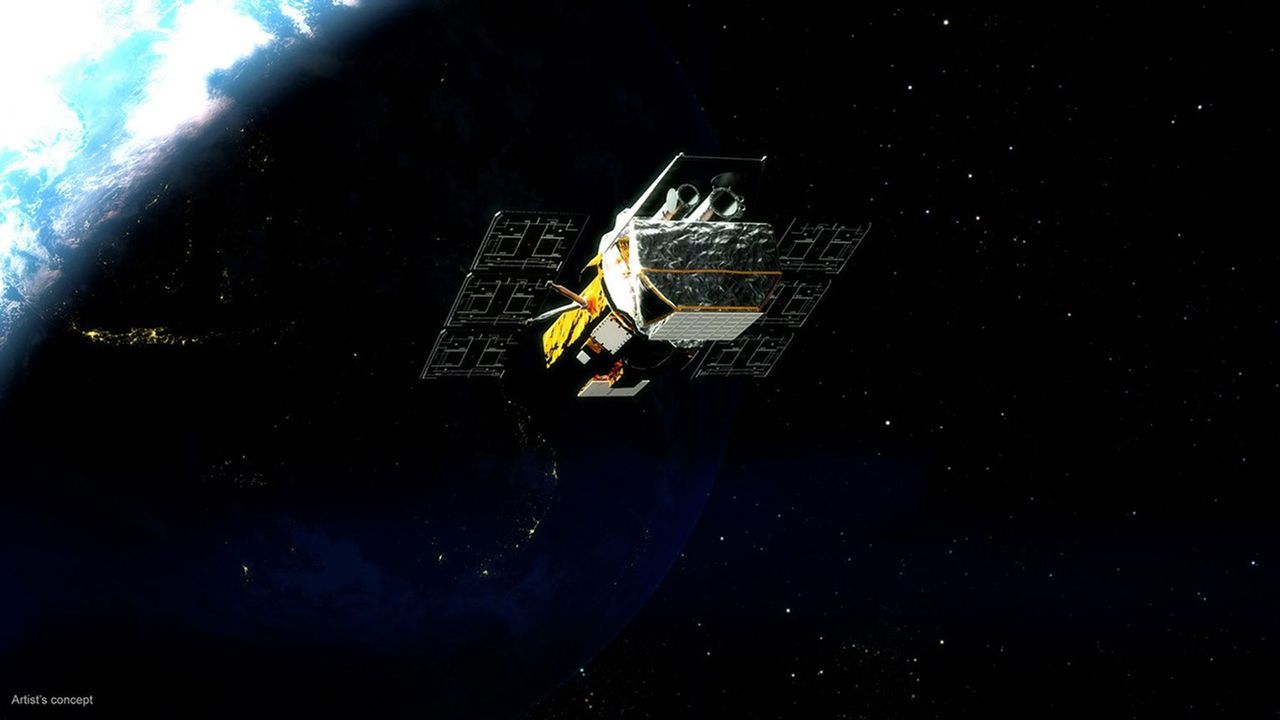
A rescue spacecraft is speeding toward a NASA telescope to prevent it from falling into Earth's atmosphere.The first-of-its-kind mission launched at 5:09 a.m. EDT (0909 GMT) Thursday (July 2) from the Marshall Islands, carrying a robot-arm spacecraft named Link into the sky aboard a modified Lockheed Martin L-1011 airliner. In midair, a Northrop Grumman Pegasus XL rocket launched Link into orbit, where it will eventually rendezvous with NASA's Neil Gehrels Swift Observatory, a gamma-ray telescope that has been slowly falling toward Earth and headed for an untimely demise. Link was developed by private company Katalyst Space for $30 million. Katalyst's goal is to meet up with the falling Swift Observatory, which launched in 2004, and pull it to a higher orbit, using Link's robotic arms and thrusters. Swift is still scientifically useful but is rapidly losing altitude due to the natural drag of Earth's atmosphere. Without help, Swift will likely meet its demise later this year, scientists say."This is a high-risk, high-reward mission," Shawn Domagal-Goldman, director of NASA's Astrophysics Division, said in a statement. "We have much to gain by attempting this boost, which is more affordable than trying to replace Swift's capabilities, and allows NASA to advance the nation's satellite servicing industry, for the benefit of all."Swift cost $250 million in 2004, which is roughly $450 million today when accounting for inflation a relatively cheap observatory compared with the $10 billion James Webb Space Telescope. The Swift mission was originally designed to study gamma-ray bursts cosmic explosions that occur when a massive, dying star collapses into a black hole. Swift has made many observations of these bursts in the past 20-plus years while also watching for other signs of stellar activity, like X-ray flares or supernova explosions, as well as transient objects, like comets and asteroids. In sum, Swift helps us see how the universe is changing over short periods. "Swift is NASA's multitool when it comes to studying the cosmos," S. Bradley Cenko, Swift's principal investigator and an astrophysicist at NASA's Goddard Space Flight Center, said in the statement. "It observes the sky using a wide range of light, and rapidly points at short-lived outbursts, alerting other facilities in space and on the ground to help coordinate follow-up observations."Katalyst engineers attach Link to a baseplate inside the Space Environment Simulator at NASA Goddard on April 28, 2026. The team practiced firing the satellites ion thrusters and operated one of the robotic arms while they cycled through space-like temperatures. (Image credit: NASA/Sophia Roberts)High-risk rescue missionThe rescue mission comes with several challenges. Swift was not designed to be serviced when it launched, making the logistics of the mission something of a puzzle. Moreover, NASA only gave the contract to Katalyst in September, after high solar activity in recent years ballooned Earth's atmosphere and unexpectedly accelerated the spacecraft's fall due to increased drag. This meant the mission had to be ready for space in less than a year after the usual punishing requirements of design, build and testing.Katalyst accepted the challenge because the company hopes to do this kind of work more often. "If we're going to build an enduring presence beyond Earth, we need the capability to manipulate our environment in space," Katalyst CEO Ghonhee Lee said in the statement. "That means deploying robotic spacecraft that can reposition, repair, refuel, and refit satellites after launch."Unless Swift altered its operations plan, however, the spacecraft would have been irrecoverable in July. So, to give Link as much time as possible to rescue Swift, the operations team at Penn State's Eberly College of Science made some changes.For example, Swift's science was minimized so that the spacecraft looks at targets only if the telescope is put in a "streamlined position" to minimize drag, NASA explained. Power consumption has also been slashed to let Swift's solar panels fly "in a more aerodynamic orientation," which also reduces the drag that is making the spacecraft fall into the atmosphere.Related storiesCan we refuel 'dead' satellites in space? Bold new missions aim to try.Falling metal space junk is changing Earth's upper atmosphere in ways we don't fully understandPaperclip-sized spacecraft could visit a nearby black hole in the next century, study claims These changes will allow Swift to stay above the minimum rescue altitude of 185 miles (298 kilometers) until autumn, agency models suggest. Katalyst will use that time to do the usual spacecraft "commissioning" on Link to make sure all systems are well. It will take Link about a month to rendezvous with Swift, according to NASA.Following those steps, Link will approach Swift for evaluation, and Katalyst will use Link's robotic arms to latch onto the NASA observatory. Link will then use its propulsion system to gradually bring Swift's orbit to about 370 miles (595 km) well above the pathway of the International Space Station, which orbits roughly 250 miles (400 km) over Earth.NASA did not say how much longerSwift would be able to keep observing, should it reach its new altitude safely. However, figures from the European Space Agency suggest that spacecraft at an altitude of 310 miles (500 km) reenter the atmosphere within about 25 years. This would suggest that as long as Swift's instruments hold out, scientists would have many years of observations to look forward to.
0 Reacties
0 aandelen
30 Views

 English
 Arabic
 French
 Spanish
 Portuguese
 Deutsch
 Turkish
 Italiano
 Russian
 Romaian
 Portuguese (Brazil)
 Greek
Greek