


WWW.LIVESCIENCE.COM
Scientists propose launching a giant 'airbag' into space to protect us from solar superstorms and experts say it's 'quite feasible'
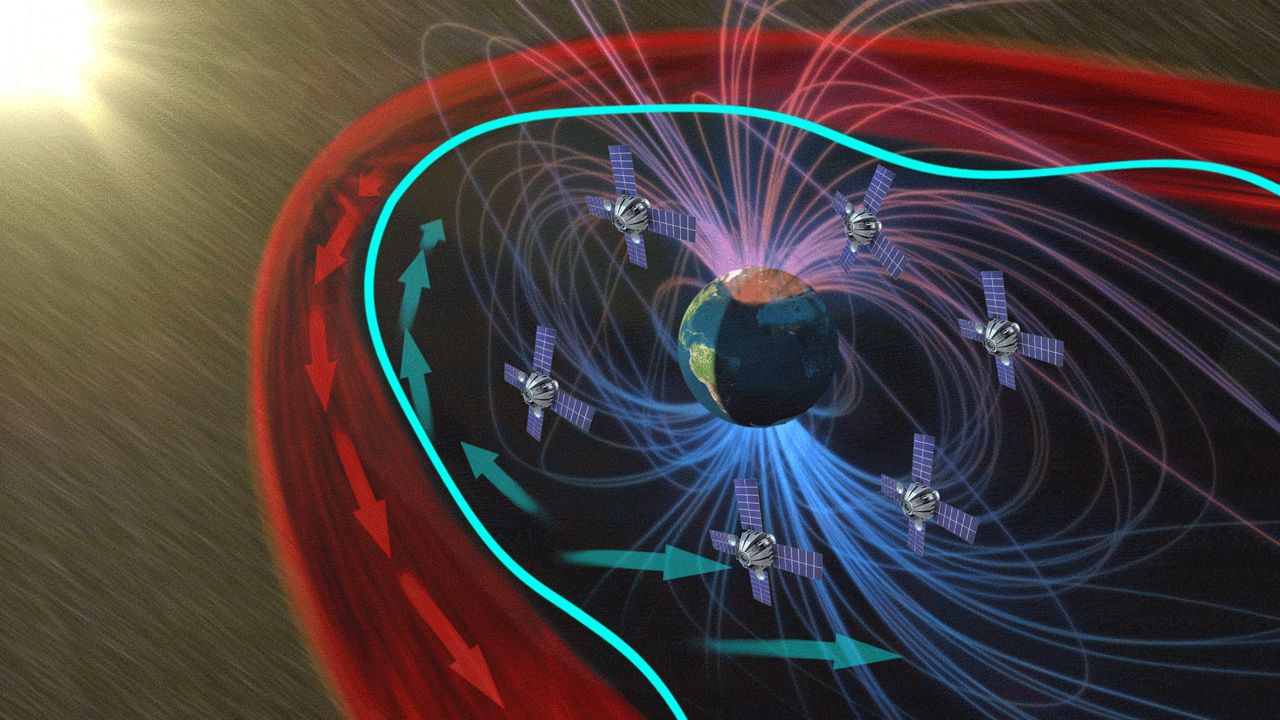
Researchers have proposed creating a novel satellite constellation, dubbed StormWall, that could shield Earth from the worst effects of solar "superstorms" that we are otherwise unable to mitigate. The innovative idea, which would essentially create a giant airbag in front of our planet, could prevent trillions of dollars in potential damage and is "quite feasible," experts say. Over the past few years, we have been bombarded by dozens of solar storms as the sun reached the most active phase of its roughly 11-year solar cycle, called solar maximum. These events are often triggered by large clouds of incoming plasma, or coronal mass ejections (CMEs), which often follow powerful explosions on the sun's surface known as solar flares. Such storms frequently paint vibrant auroras across our skies, but their effects are not always benign.Every century or so, the sun spits out a supercharged storm, such as the Carrington Event of 1859, that is several orders of magnitude stronger than a typical CME. If such a storm were to hit us today, it could wipe out every satellite orbiting Earth, dose astronauts with lethal levels of radiation, damage power grids and even knock out the internet. Currently, the only way we can prepare for the next superstorm is to get better at forecasting them and design our spacecraft and ground-based infrastructure to deal with their arrival as best as possible. However, a new study published June 2 in the journal Space Weather presents a more proactive approach. In the new paper, researchers propose launching six bus-sized satellites into a geosynchronous orbit, around 22,500 miles (36,000 kilometers) above Earth. At this altitude far above the International Space Station and most other satellites the mini spacecraft swarm would sit and wait for the next "big one." If and when such a storm were spotted, the satellites would empty giant canisters of gas around the edge of Earth's invisible magnetic shield, or magnetosphere, creating a giant wall of plasma that would cushion and divert an incoming CME.Earth-orbiting satellites can be knocked out of the sky during solar storms due to increased drag from our planet's inflated atmosphere. (Image credit: ESA/NASAT. Pesquet)The teams simulations show that this plasma wall could cut the intensity of a superstorm down by more than half. This would not completely shield us, but it could help avoid any worst-case scenarios, similar to having an airbag during a car crash, study co-author Daniel Welling, a space physicist at the University of Michigan, told Science magazine. "It's as if you could install an airbag in the magnetosphere," he said. Because we currently have no way to defend ourselves against these storms, the researchers argue that such a system is vital and should be constructed as soon as possible."It's like people in a village who see a river flooding maybe they can predict when that will happen, but probably what's even better is if they could build a storm wall. That's what we're proposing here," study first author Brian Walsh, a plasma physicist and space weather expert at Boston University, said in a statement. The only difference is that "it would help all people on the planet," he added.Protecting the planetStormWall was inspired by Earth's natural response to a solar storm. When CMEs impact our planet, they temporarily weaken the magnetosphere known as a geomagnetic disturbance allowing solar radiation to flood the upper atmosphere and trigger auroras. But this also causes oxygen ions to rise into the magnetosphere, where they accumulate on the sun-facing side of our planet, creating a bubble that helps shield us from incoming radiation while the magnetosphere is compromised.The idea of StormWall is to create this protective barrier before the storm arrives so that the geomagnetic disturbance is not as strong as it otherwise would be. To do this, the proposed satellites would dump around a dozen oil trucks' worth of a reactive gas such as barium, lithium, sodium or calcium into the magnetosphere. This gas would accumulate on the sun-facing edge of the magnetosphere and quickly become ionized by the sun, creating a massive plasma barrier that would not only push back against an incoming CME but also help divert it around our planet.The sun is constantly firing explosive solar flares into space and experts warn it is only a matter of time before the next "big one." (Image credit: Michael Jger)To demonstrate StormWall's potential effectiveness, the team simulated how the satellites would have impacted the May 2024 solar storm (also known as the Mother's Day storm), which occurred when a series of CMEs struck our planet in quick succession, triggering the most powerful geomagnetic disturbance since 2003. They found that the satellites could have reduced the intensity of the resulting geomagnetic disturbance by as much as 84%."When you apply some really serious physics to it, it does work," Walsh said. "And the amount of mass we need, the launch capacities it's all within our capabilities."One of the most surprising aspects of the new proposal is the amount of gas being released by the satellites: It equates to only around one-millionth the weight of a typical CME, yet this can cut a solar storm's power in half so the "scheme punches far above its weight," according to Spaceweather.com."I definitely would want this"Some concerns need to be addressed before StormWall could become a reality. For example, similar geoengineering projects most of which have been proposed to tackle the effects of human-caused climate change have been criticized for the inadvertent impacts they may have on our planet. However, while follow-up studies will be needed to make sure it is safe, the researchers are confident that the ionized gas would not affect Earth's magnetosphere or upper atmosphere in any way. Once deployed, the plasma wall would quickly dissipate and be blown clear of our planet by solar wind. Launching the StormWall satellites would require massive rockets like SpaceX's Starship. But researchers argue that the cost of such an endeavor would be well worth it in the long run. (Image credit: RONALDO SCHEMIDT/AFP via Getty Images)There is also the issue of money. The StormWall satellites, with their massive gas canisters, would be among the heaviest spacecraft ever launched and would likely require massive rockets, such as SpaceX's Starship, to put them into geosynchronous orbit. While a proper cost analysis has yet to be completed, this would likely cost billions of dollars.However, considering the potential damages from solar storms, the researchers argue that StormWall would be well worth the money. The May 2024 solar storm, for example, cost U.S. farmers around $500 million due to malfunctions with GPS equipment. And that's just a drop in the bucket compared with what a Carrington-level storm would cost; the study researchers estimate that such a superstorm could cause up to $3.4 trillion in damage.RELATED STORIESThe sun just experienced its first 'spotless days' in 4 years but we're not in the clear yetAstrophotographer snaps 'once-in-a-lifetime' shot of solar flare photobombing the ISS'The sun is slowly waking up': NASA warns that there may be more extreme space weather for decades to comeAnother issue is that StormWall is a one-and-done solution. Once the gas canisters are empty, they need to be refilled or completely replaced, which would create a substantial additional cost. But again, if the benefits significantly outweigh the cost, this would be a no-brainer. Even when taking all of these challenges into account, several experts believe StormWall is not only a good idea but also achievable on a relatively short timescale.The proposal is "highly innovative and appears to be quite feasible in the near term," Allison Jaynes, a space physicist at the University of Iowa who was not involved in the study, told Science magazine.And given that there are currently no viable alternatives, it would help put people at ease about the next superstorm."If I knew that a 100-year disturbance was coming and it would knock out power grids, I definitely would want this," David Sibeck, chief of heliophysics at NASA's Goddard Space Flight Center, told Science magazine.
0 Commenti
0 condivisioni
14 Views

 English
 Arabic
 French
 Spanish
 Portuguese
 Deutsch
 Turkish
 Dutch
Dutch
 Russian
 Romaian
 Portuguese (Brazil)
 Greek
Greek