66 billion trees have been planted in China's Great Green Wall and they appear to be growing faster than natural forests
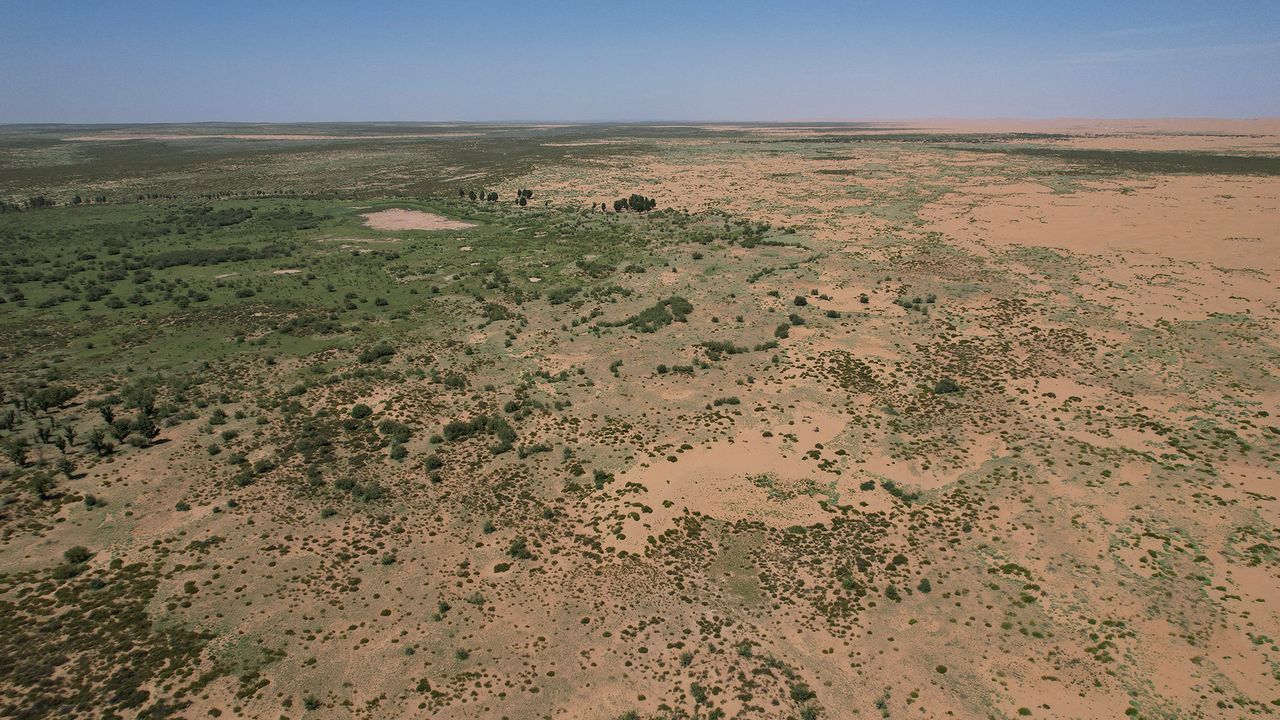
Trees in China that were planted as part of huge reforestation projects appear to grow faster than those in natural forests, a new study finds. This is possibly because the reforestation trees are responding more strongly to the rising atmospheric carbon dioxide, scientists say. China is quickly turning green. The country has planted 66 billion trees since 1978, with plans for 34 billion more by the middle of this century, as part of its "Great Green Wall" to slow the spread of the Gobi and Taklamakan deserts.These new forests absorb large amounts of CO2, but it is unclear exactly how they differ from natural ones, study first author Yuhang Luo, a landscape ecologist at Peking University in Shenzhen, China, told Live Science. Luo and his colleagues set out to study how differences between natural and planted forests, including species diversity, tree density and age, might affect how the forests respond to rising CO2 and climate change. "Planted forests are widely used in climate mitigation strategies, but most global ecosystem models do not distinguish between forest types or represent age-related dynamics adequately," Luo said. "So we felt it was important to clarify how these factors interact not just for scientific understanding, but also for improving the models and assumptions that underpin real-world forest policy and carbon accounting."Planted forests are those purposefully created by humans, such as those in the Great Green Wall. Natural forests, on the other hand, grow without human intervention. The researchers used satellite data to track leaf area index, a measure of canopy density and a key driver of carbon uptake, to determine how fast the different forest types grew, and found a striking difference: Planted forests increased their leaf area 66% faster than natural ones.Most of that difference was due to planted forests being, on average, much younger than the natural ones and young trees grow faster than old ones. But even when comparing forests of similar age and growing conditions, the planted ones still grew 4.6% faster, and the difference was even more pronounced in mixed and evergreen forests.A researcher working in the Great Green Wall in August 2025. So far, 66 million trees have been planted as part of the project. (Image credit: PEDRO PARDO via Getty Images)This is largely due to how planted forests are managed. They tend to feature fast-growing species like eucalyptus and poplar and are often actively managed, with people removing competing vegetation and even fertilizing them. These interventions reduce competition for light, water, and nutrients, amplifying the fertilization effect of rising atmospheric CO2.This discrepancy peaks in planted forests when trees are around 30 to 40 years old and then declines noticeably after age 40. In contrast, natural forests grow more slowly but steadily, so have an advantage over the long term."Planted forests can be a powerful short-term tool for carbon uptake, but this advantage is temporary," Luo said. "For long-term carbon storage and resilience, natural forests remain irreplaceable."Kevin Dsouza, who worked on reforestation models during his postdoctoral research at the University of Waterloo and was not involved in the new study, said the results make intuitive sense, as the sprawling leaves of young, fast-growing trees could lead to increased carbon take-up. But he is not sure that leaf area is the best measurement for tracking growth and carbon sequestration."It's not a bad proxy, but it doesn't give you the full picture," he said. "The canopy is just the top of the tree and the carbon is stored in all sorts of different places like wood, bark, roots and soil."Another study of Chinese forests found that natural forests actually accumulate more carbon above ground than planted ones in their early years, Dsouza pointed out, so these results should be considered carefully alongside other factors.Related storiesChina has planted so many trees it's changed the entire country's water distribution'River in the Sky': China's doomed plan to create a 'cloud seeding corridor' tells us how far the country will go to solve its climate crisisChina's Great Green Wall around the Taklamakan Desert has turned this 'biological void' into a carbon sinkLuo said the findings show that most global climate models are missing something when it comes to understanding how various forest types play a role in carbon sequestration and climate change."Land use management works in more subtle and specific ways than we had assumed," he said. "It is not just about planting more trees. It is also about when you plant them, what species you choose, and how you manage them over time."Luo hopes these findings will help guide reforestation efforts, to ensure we get the most benefit from planting new forests to help mitigate the effects of climate change."Our work offers a more practical guide for forest-based climate action: when to plant, what to plant, how long the benefits last, and what current models are getting wrong. We hope that helps people make better decisions," he said.




 English
 Arabic
 French
 Spanish
 Portuguese
 Deutsch
 Turkish
 Dutch
Dutch
 Italiano
 Romaian
 Portuguese (Brazil)
 Greek
Greek