NASA rover finds record-breaking trove of complex organic molecules on Mars
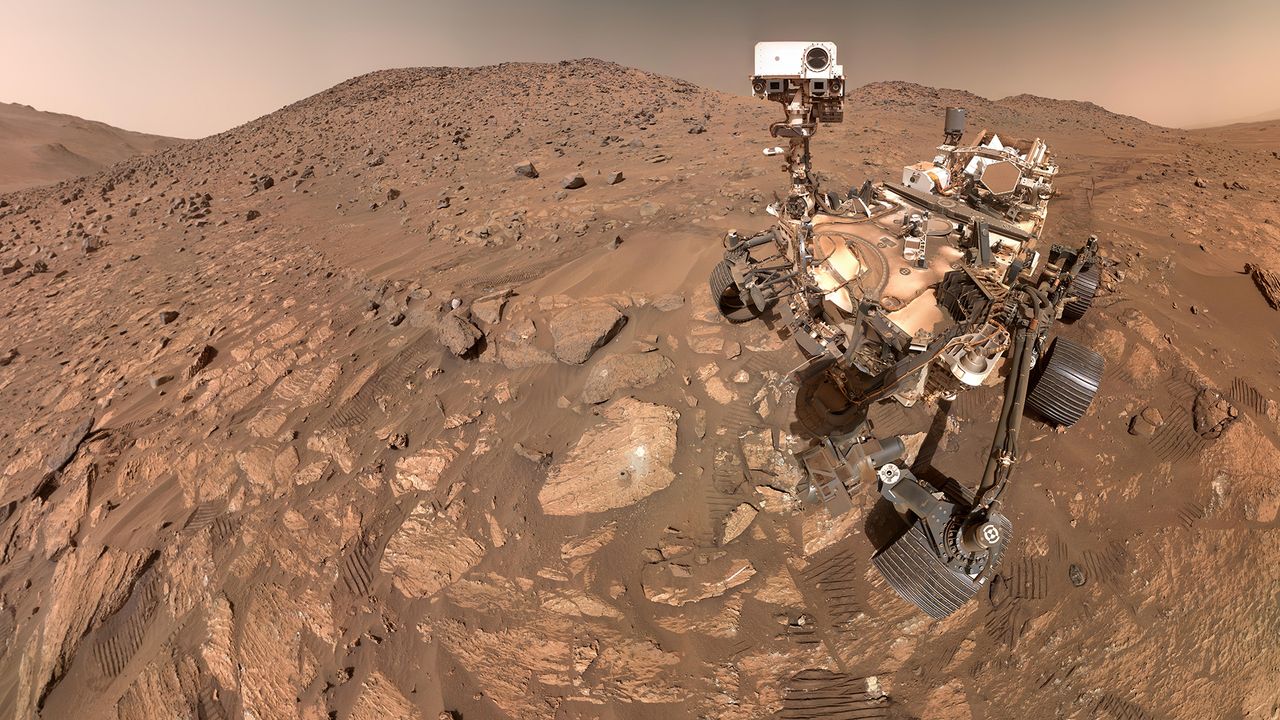
Researchers have found a new puzzle piece in Mars' geological history that hints that the Red Planet may have once harbored life. New data from NASA's Perseverance rover indicates that mudstones in Jezero crater contain a complex form of carbon, the chemical foundation of all known life. It's the highest concentration of organic molecules found on Mars to date. Although the mere presence of carbon isn't proof that life once evolved on Mars, the location of the discovery adds to the excitement. This "macromolecular carbon" was discovered near other potential signs of life, or biosignatures, touted by NASA with great fanfare in 2025. This geological context adds credence to the case that microbes may have once colonized the Martian surface. The results were published Wednesday (June 24) in the journal Science Advances.Perseverance landed in Jezero crater on Feb. 18, 2021. Since then, the site has emerged as one of the most geologically interesting places on Mars. "Jezero crater was once fed water and sediment from rivers, and, billions of years ago, it hosted a lake," Ashley Murphy, a researcher at the Planetary Science Institute and co-author of the new study, told Live Science in an email. It may have hosted more than that. A study published last year in the journal Nature found that some of the stones in an area of Jezero known as the Bright Angel outcropping contain clays and other minerals that are known to preserve fossils on Earth. One sample, in particular, raised eyebrows: a piece of a rock nicknamed Cheyava Falls, whose patterns resemble those left by terrestrial microbes. Although these patterns could have been created by nonliving sources, NASA officials proclaimed it one of the clearest signs yet of past microbial life on the Red Planet.The backbone of lifeThe new research builds on this work by confirming the widespread presence of complex carbon molecules in and around the Bright Angel outcrop. In the study, the researchers used the rover's Scanning Habitable Environments with Raman and Luminescence for Organics and Chemicals (SHERLOC) instrument to map the carbon distribution in these rocks and sediments. They compared them with carbon data from NASA's Curiosity rover taken at Gale crater some 2,300 miles (3,700 kilometers) away, a distribution that suggests water may have been widespread on Mars in the deep past. Murphy's team also determined that the carbon was not too weathered, indicating that it may have been exposed recently. However, its impossible to say whether the newly discovered carbon is related to life or not.The work is an important step in unraveling Mars' geological history, including the planet's potential habitability and how water shaped its surface. But Murphy cautioned that it is far from a definitive answer. "Macromolecular carbon on Mars does not prove the existence of life there," Murphy said. The molecules could indicate the presence of fossilized microbes, but they also could have formed through nonbiological means, like meteor strikes or running water. Leopard spots on the rock formation Cheyava Falls could be linked to microbial life on Mars. (Image credit: NASA/JPL-Caltech/MSSS)Related storiesNASA rover discovers out-of-place 'Skull' on Mars, and scientists are baffledGiant string of organic molecules on Mars may be one of the best signs of life yetA giant 'shadow' has been creeping across Mars for 50 years and scientists aren't sure whyUntil scientists get their hands on a sample directly, it will be hard to tell exactly how this complex carbon arose and whether it represents a true biosignature. But that research may now be decades away if it happens at all. The Cheyava Falls sample was originally supposed to be brought to Earth in the 2030s as part of NASA and the European Space Agency's joint Mars Sample Return program. However, in its 2026 budget proposal, the Trump administration deemed the mission "financially unsustainable" and proposed slashing the project. Currently, the project is considered dead. It may be China that gets the first shot at bringing Martian samples back to Earth for analysis. The country's Tianwen-3 sample-return mission will aim to collect several samples albeit in a more accessible but less-promising site than where Perseverance has looked for biosignatures in a mission due to launch no sooner than 2028.What do you know about the Red Planet? Test your knowledge with our Mars quiz!




 English
 Arabic
 Spanish
 Portuguese
 Deutsch
 Turkish
 Dutch
Dutch
 Italiano
 Russian
 Romaian
 Portuguese (Brazil)
 Greek
Greek