The Spice Islands and Their Surprising Connection to New York
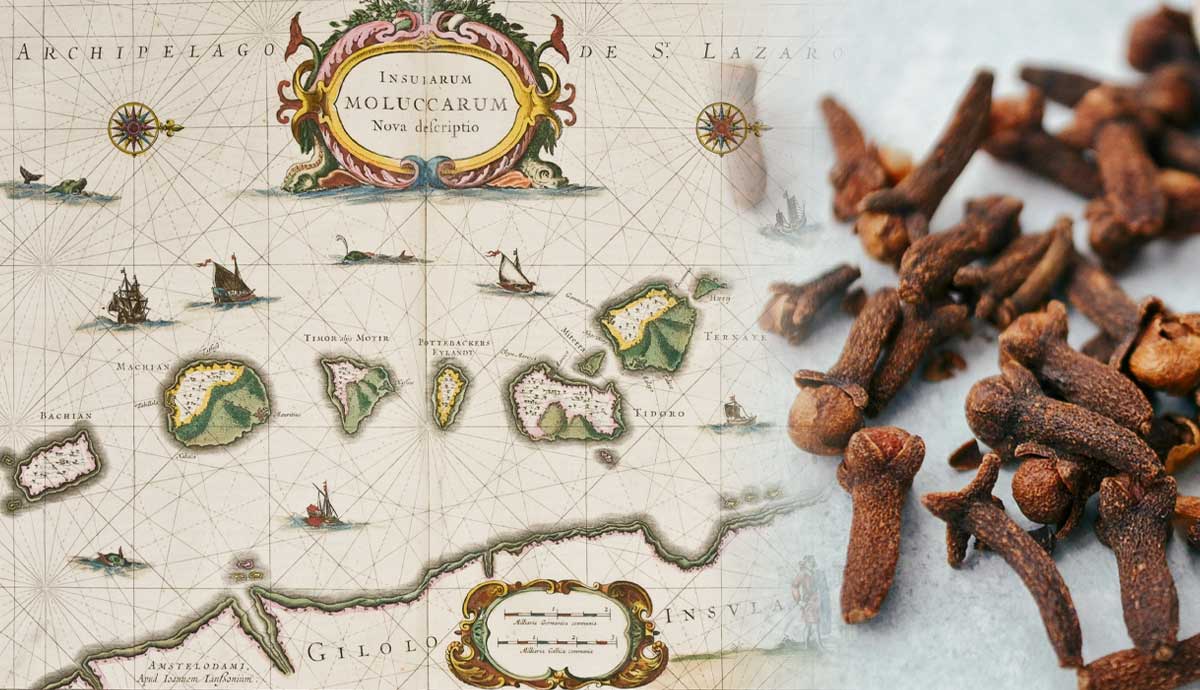
The Maluku Islands, alternatively known as the Moluccas or the Spice Islands, were significant historical agents as the planets only source of the holy trinity of spices: cloves, nutmeg, and mace. Maluku spices were widely adopted by various cultures as medicine, flavoring otherwise bland or tainted foods, and found a place within aromatics. Over time, the Spice Islands became a driving force behind European maritime expansion into Asia beginning in the 16th century, catalyzing the transition to the modern world.What Are the Maluku Islands?Ternate and Tidore Islands, Maluku. Source: Wikimedia CommonsThe Maluku Islands are part of the Ring of Fire, a chain of volcanoes tracing the eastern edge of Southeast and East Asia, the western face of the American continents, and New Zealand, creating a horseshoe shape around the Pacific Ocean.Millions of years ago, several tectonic plates in the Pacific collided, falling beneath one another. These subduction zones have become sites of marine trenches, active volcanoes, and earthquakes. Notably, around ninety percent of the worlds earthquakes take place in the Ring of Fire. This is why volcanoes are present throughout Peru, why California is prone to earthquakes, and why Mount Fuji is not only Japans tallest mountain, but also an active volcano.What does this have to do with the Moluccas? Emerging from a subduction zone in the Pacific Ocean, the Moluccas are volcanic islands that rose from the ocean floor, creating an archipelago abundant with evergreen landscapes nurtured by volcanic soil. It is this volcanic soil, rich in nutrients and optimally fertile, that created the circumstances for cloves, nutmeg, and mace to grow on these islands, and these islands only.Molucca Headdress (Wutulai), 18th-19th century, Yale University Art Gallery, New Haven. Source: Wikipedia CommonsThere have been various interpretations of the term Maluku by outsiders to the archipelago- Europeans believed Maluku meant head, implying someone who is in charge. This was based on the account of Francois Xavier, a 16th century Jesuit missionary, who was informed it meant the head of a bull (Andaya, p. 47). Islamic interpretations of Maluku tie this word to the Arabic malik, meaning king. However, Maluku is perhaps best understood not as a singular expression, but instead as a complex idea.The reason behind these various interpretations was that people from this archipelago were not so much concerned with the literal meaning of Maluku, but instead what it represented. Rather than being unified under a single ethnic group or political body, people living in this region were connected through a recognition of their place within the larger whole of Maluku (Andaya, p. 49). In essence, this created a family of different languages, people, and cultures beneath the larger umbrella of Maluku. Thus, Maluku refers to the symbolic unified world between the different islands and groups in the region with one another (Andaya, p. 47).The Holy Trinity of SpicesCloseup of cloves. Source: PexelsMaluku is split into North Maluku, which opens to the Pacific Ocean, and Maluku, the set of islands nestled between northern Sulawesi in Indonesia and western Papua New Guinea. Cloves were found only in North Maluku on five of its 400 islands: Bacan, Makian, Moti, Tidore, and Ternate. Ternate was the largest export island for cloves, followed by Tidore, which collectively formed the center of the Moluccas. Maluku is also home to the Banda Islands, an archipelago of five islands that were the sole source of nutmeg in the world. Mace, the third spice of the trinity, is the crimson red web that covers the shell of the nutmeg seed.Spices in Food15th Century Medieval Wine Conservation. Source: PicrylThe Moluccas held a significant role as the sole providers of flora that were important ingredients within food, medicines, and aromatics across the Asian, African, and European continents. In the Maluku Islands, cloves that were still green would be sugared into conserves or vinegared (Andaya, p. 1).The Anonymous Andalusian Cookbook, an Arabic cookbook combining recipes from the 13th and 15th centuries, details recipes for various syrups, cookies, savory dishes, cheese and sausages, many of which use cloves, nutmeg, or both. Al-Andalus refers to present-day Portugal, Spain, and parts of France that were under Muslim rule for several centuries beginning in the 8th century. Muslim merchants played an integral role in the trade networks bringing these spices to the Mediterranean.One recipe includes sweet breads stuffed with a mixture of almonds, cloves, camphor and drizzled with honey. A recipe for Mirkas with Fresh Cheese includes meat mixed with egg and cheese that is not too soft lest it fall apart. The sausage is then seasoned with cloves, coriander, pepper, and topped with mint and cilantro juice, turning it green. Spices were also a necessary part of European diets in helping mask the flavor of spoiled foods. Meat was usually salted and dried, but could still become rotten. Thus, spices like pepper, nutmeg, and clove would be used to disguise the smell and flavor (Pearson, xvi). The sour taste of spoiled wines would also be hidden with spices, prolonging its shelf life.Medicinal and Aromatic UsesA physician giving medicine to a sick man in bed, and a surgeon, supervised by a physician, amputating the leg of a seated patient, representing pharmacy and surgery respectively from De Efficaci Medicina by Marco Aurelio Severini, 1646. Source: Wellcome Collection via Wikimedia CommonsMaluku spices were also crucial ingredients in helping cure a wide range of ailments. In Europe, clove extract would be dropped into eyes in order to improve and strengthen eyesight (Andaya, p. 1). Clove powder would also be rubbed on the forehead to relieve head colds, and ingesting cloves was believed to increase appetite and smooth the digestion of food.The aforementioned Anonymous Andalusian Cookbook also provides recipes for various elixirs and medicines that include clove and nutmeg. Electuary of Cloves, made from cloves, sugar, and rosewater, dissolves phlegm, increases the force of coitus, and restrains the temperament. A recipe for The Great Drink of Roots combines cloves with fennel and other spices to open blockages of the liver and spleen [and] clean the stomach.Cloves would also be used as a breath freshener, such as in Han Dynasty China (206 BCE-220 CE). Allegedly, a Han emperor requested people in his court to have them in their mouths every time they spoke to him (Andaya, p. 2). One can only imagine the stench of breath during this time period that necessitated the use of a freshener.An Extensive Trading NetworkProto-historic and historic maritime trade network of the Austronesian peoples in the Indian Ocean. Source: Wikimedia CommonsBefore being incorporated into medicines, aromatics, and food throughout Asia and the Mediterranean, these spices first needed to reach these regions. Maluku was a part of a vast trade network extending from their location in present-day Indonesia all the way to West Asia, oftentimes referred to as the Near East. The earliest evidence of cloves outside of Maluku dates to 1700 BCE in Mesopotamia, where they were uncovered in the pantry of a middle-class home (Andaya, p. 2). This suggests cloves were not reserved only for elites, but were so widely available they trickled down to a wider section of society.The core of Indian Ocean trade was in commodities that were high value but small and light, perfect for transportation on ships (Lewis, p. 254). Thus, cloves, nutmeg, and mace were ideal for maritime trade. By the 2nd and 3rd century CE, spices from Maluku were part of a highly lucrative trade network connecting China and the Near East via the Malay Peninsula. Rather than sailing directly to the Moluccas, spices would be brought from Maluku to entrepots such as Koying, a 3rd century kingdom in the Indonesian island of Sumatra, or Melaka (Malacca) in present-day Malaysia.The Church of San Giorgio Maggiore in Venice by Johann Anton Eismann, 1698. Source: Wikimedia CommonsBy the 15th century, Maluku spices were brought mainly to the port of Melaka, at this time a bustling trade city where merchants from all over the Indian Ocean would buy and sell objects such as cloth, textiles, ceramics. The movement of these objects, including Maluku spices, from Melaka to West Asia was largely facilitated by merchants from Gujarat in western India. Gujaratis from Cambay (present-day Khambhat) were so interwoven into the trade markets of Melaka that Melaka couldnt have existed without Cambay, and vice versa (Pearson, xxii).From Melaka, spices would be carried by Gujaratis to Sri Lanka or Calicut (Kozhikode), thence to Gujarat or the Persian Gulf, then sometimes to Egypt then to Alexandria, where Venetians would bring it to mainland Europe. The Venetian merchants sold these spices at a price markup of 40 percent (Freedman, p. 1215). Thus, the Moluccas were an integral part of how Venice became one of the wealthiest states in Europe.Other European consumers of these spices, such as the Portuguese and Spanish, understood the spices themselves were cheap, but accumulated value through the long supply chain beginning in Southeast Asia and ending in Europe that was accompanied by customs duties, taxes, and changing hands. A desire to circumvent the middlemen and locate the source of the spices motivated European maritime expansion into Asia beginning in the late 16th century.The VOC and European ColonizationReproduction of Jorge de Aguiars Chart of the Mediterranean, Western Europe, and African Coast, 1492. Source: Wikimedia CommonsThe Portuguese were the first to reach Maluku in the 16th century shortly after conquering Melaka in 1511. They achieved this not through any navigational expertise or skill, but rather sheer luck. The Portuguese explorer Francisco Serro and his fleet were shipwrecked in the Banda Sea, and word spread to the Sultan of Ternate. The Sultan sent for Serro and his crew with hopes of establishing a trade relationship with the fabled merchants from the West. Although initially civil, this relationship soon turned sour, culminating in a war between the Sultan and Portugal.Although the Ternate-Portuguese war was one of the first successful triumphs of an indigenous power against Europeans, the people of Maluku would shortly face a more powerful, if not more violent, European powerthe Dutch.Dutch Map of the Banda Islands in the Moluccas, from the travelogue of the Second Voyage to the East Indies under Jacob Cornelisz. van Nes and Wijbrant van Warwyck in 1598-1600, 1599. Source: Wikimedia CommonsThe Maluku Islands motivated the establishment of the Vereenigde Oostindische Compagnie (VOC) or Dutch East India Company. The company was founded in 1602 and sought to obtain a monopoly of spices from these islands. Beginning in Sumatra, VOC control spread throughout Indonesia, by 1621, they became the first foreign power to conquer the Banda Islands. The colonial administration of what became the Dutch East Indies was quickly marked by violenceaccounts of massacres, rapid deforestation, and other acts of cruelty quickly became hallmarks of the VOCs presence in Maluku. The Dutch control of Maluku ended centuries of a long-standing, mostly peaceful, trade between the islands and the Indian Ocean world.Notably, the profit gained through the control of nutmeg, cloves, and mace was brought back to the Netherlands to fuel the Dutch Golden Age. This was an artistic, cultural, scientific, and economic movement characterized by invention, technological discovery, and new artistic styles, most notably by Rembrandt. However, the Dutch monopoly did not go unchallenged.Run for New YorkNew Amsterdam and its people; studies, social and topographical, of the town under Dutch and early English rule by J. H. (John H.) Innes, 1902. Source: GetArchiveIn 1616, the British, through their own East India Company, secured control of Run, a nutmeg island in the Banda archipelago. In 1664, during the Second Anglo-Dutch War, British ships targeted the Dutch colony of New Amsterdam in North America. After a surprise attack on the port city, the British were able to secure control over the region. New Amsterdam became New York, in honor of the Duke of York, later King James II, who organized the British attack.Under the terms of the Treaty of Breda which ended the Second Anglo-Dutch War, the British ceded Run to the Dutch in exchange for the official recognition of New York as British territory.The Linchpin of Cross-Cultural ExchangeNutmeg from Banda Islands. Source: FlickrThe Maluku Islands were an integral part of economic, medicinal, aromatic, and food history for cultures and societies across the Eurasian and African continents. As the singular provider of highly sought-after spices, Maluku was a linchpin of cross-cultural exchange that lasted for centuries.This factor would eventually make Maluku a target of European explorers, who sought not only to participate in the trade, but monopolize it entirely. The quest for the Spice Islands marked the beginning of European colonization in regions of Asia, paving the way for a global network that would connect both Atlantic and Pacific Oceans.SourcesAndaya, Leonard Y. The World of Maluku: Eastern Indonesia in the Early Modern Period. University of Hawaii Press, 2022.Freedman, Paul. Spices and Late-Medieval European Ideas of Scarcity and Value. Speculum, vol. 80, no. 4, 2005, pp. 120927.Lewis, Archibald. Maritime Skills in the Indian Ocean 1368-1500. Journal of the Economic and Social History of the Orient, vol. 16, no. 2/3, 1973, pp. 23864.Pearson, Michael N. Introduction. Spices in the Indian Ocean World: An Expanding World: The European Impact on World History, 1450-1800, vol. 11, Routledge, Abingdon, 1996, pp. xvxxxvii.









 English
 Arabic
 French
 Spanish
 Portuguese
 Deutsch
 Turkish
 Dutch
Dutch
 Russian
 Romaian
 Portuguese (Brazil)
 Greek
Greek