The Monroe Doctrine, a Cornerstone of American Foreign Policy
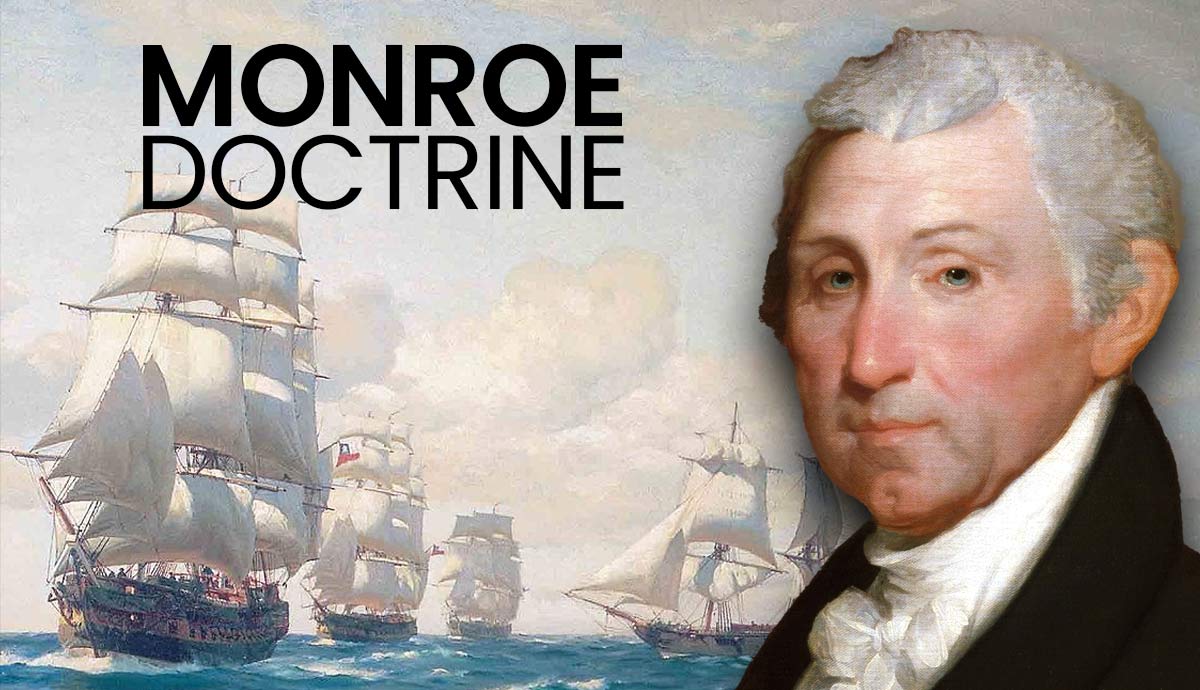
On December 2, 1823, US President James Monroe held his annual message to Congress. In his speech, he announced that the Western Hemisphere would be closed to further colonization by European powers. In exchange, the US would adopt a policy of non-intervention in the Old Worlds affairs. In the following decades, Monroes address became a cornerstone of American foreign policy, the so-called Monroe Doctrine. As the US became an international power, the Monroe Doctrine provided the ideological framework for US expansion, especially in Central and South America.The Origin of the Monroe DoctrineMap of the Spanish Nation in 1812. Source: Wikimedia CommonsThe Napoleonic Wars (1803-1815), a series of conflicts between France and various alliances of European powers, briefly redrew Europes geopolitical landscape, leading to French hegemony over most of the continent. While the United States tried to maintain a neutral position regarding Europes affairs, the Napoleonic Wars also affected the status quo of the Americas.When Napoleons Continental System and Great Britains counterblockade damaged the United States maritime trade and rights, President Madison declared war on Britain in 1812. Meanwhile, Napoleons military successes against Spain gave several Mexican and South American Spanish colonies the opportunity to declare their independence. Between 1810 and 1822, fifteen colonial territories established autonomous governments. By 1826, all former colonies had severed their ties with Spain. The United States recognized their independence, starting a profitable commercial relationship with the newly formed republics.After Napoleons first abdication in 1814, his adversaries met at the Congress of Vienna to redraw the map of Europe to avoid future upheavals and conflicts. To secure the new order, the leaders gathered in Vienna sought to restore the rulers overthrown by Napoleon to their thrones. The European powers also saw this measure as a means to counteract the republican and liberal movements born from the French Revolution.First Chilean Navy Squadron Chilean Fleet by Thomas Somerscales. Source: Wikimedia Commons/Armada de ChileIn 1820, the Congress of Troppau, a meeting of the conservative Holy Alliance powers, reiterated the Russian tsar and the restored rulers commitment to fight the spread of the liberal forces and their demands for constitutional reforms. Three years later, in 1823, France invoked the Troppau protocol to overthrow Spains constitutional government and return Ferdinand VII to the throne.Secretary of State John Quincy Adams was skeptical about the feasibility of Holy Alliances conservative program, believing that the United States had set a fundamental historical precedent. The influence of our example has unsettled all the ancient governments of Europe. I hold this revolution to be as infallible as the earth will perform a revolution around the sun in a year, wrote Adams.Despite the secretary of states confident words, Frances involvement in Spains affairs had alarmed the US government, raising the suspicion that Spain and other European powers might try to restore their colonial empires overseas. In 1821, for example, Tsar Alexander I of Russia stated his claim on the Pacific Northwest, prohibiting foreign vessels from navigating near the coast.An American Cause: Creating the Monroe DoctrinePortrait of James Monroe by Gilbert Stuart, ca. 1820-1822. Source: The Metropolitan Museum of Art, New YorkRussian expansionist ambitions on American territories had also alarmed Great Britain, whose government intended to prevent the Holy Alliance from re-colonizing Latin America, a move that would harm their trade interests.In 1823, British Foreign Minister George Canning approached his American counterpart to propose that the two chief commercial and maritime states of both worlds issue a joint statement prohibiting the European powers from colonizing Central and South America. At the same time, Canning requested that the US and Britain relinquish any future annexation in the same region.Before accepting Cannings proposal, James Monroe opted to seek advice from his cabinet as well as from former presidents Thomas Jefferson and James Madison. While Jefferson considered Cuba the most interesting addition which could ever be made to our system of States, he argued in favor of accepting the British governments offer, pointing out that it was an opportunity to bring her [Britain] mighty weight into the scale of free government, and emancipate a continent at one stroke. Madison similarly affirmed that the US would benefit from the proposed partnership with Britain.Portrait of John Quincy Adams by Gilbert Stuart, 1818. Source: The White House Historical AssociationState Secretary John Quincy Adams did not share the views of the two former presidents. During the cabinet meetings in the autumn of 1823, he strongly opposed Cannings plan, declaring that the British governments real goal was to prevent the US from expanding in Latin America. Adams also feared cooperating with a more powerful maritime country might ultimately weaken the US position on the international stage. It would be more candid as well as more dignified, to avow our principles explicitly to Russia and France, than to come in as a cock-boat in the wake of the British man-of-war, argued Adams.Rather than agreeing to a joint statement, according to the state secretary, the United States should seek a policy of non-intervention regarding the European countries affairs, focusing on mak[ing] an American cause, and adher[ing] inflexibly to that.The Monroe DoctrineThe text of Monroes message to Congress, Washington Republican Extra, 1823. Source: The Gilder Lehmanns Institute of American HistoryIn the end, Adams opinion prevailed. On December 2, 1823, James Monroe included a unilateral declaration of foreign policy in his annual speech to Congress. Citing the differences underlying the political systems of the Old World and the New World, the US president outlined the vision of a globe divided into two spheres of influence.In particular, Monroe announced that the American continents, by the free and independent condition which they have assumed and maintain, are henceforth not to be considered as subjects for future colonization by any European powers.After asserting the USs claims on the Western Hemisphere, the president warned the European powers that we should consider any attempt on their part to extend their system to any portion of this hemisphere, as dangerous to our peace and safety.In exchange, Monroe declared that the United States would not intervene in the affairs of the European countries and their colonies. It is only when our rights are invaded or seriously menaced that we resent injuries or make preparation for our defense, reiterated the president.In asserting the American governments neutrality toward European affairs, Monroe heeded George Washingtons warning to steer clear of permanent alliances with any portion of the foreign world.The Evolution of the Monroe DoctrineAmerican Progress by John Gast, 1872. Source: Wikimedia Commons/Autry Museum of the American WestWhen Monroe gave his speech, the United States lacked the military and naval power to enforce the newly announced policy throughout the Western Hemisphere. Indeed, in the following years, the US would largely rely on the powerful British navy to thwart the European countries forays into the New World. Thus, for much of the 19th century, the Monroe Doctrine mainly remained a patriotic message for the nation and a symbol of the US intention to eventually have a crucial role in the global arena.In 1833, for example, the American government did not implement Monroes threat of armed intervention when Britain asserted its claim on the Falkland Islands. Similarly, in 1845, the US did not react when France and Britain introduced a five-year naval blockade against Argentina.In the 1860s, the Civil War prevented the American government from effectively enforcing Monroes policy during the Second Franco-Mexican War. Only in 1867, after the end of the internal conflict, was Secretary of State William H. Steward able to invoke the Monroe Doctrine to secure Frances withdrawal from Mexico.A political cartoon depicting Uncle Sam standing between the European powers and Latin Americans, Victor Gillam, February 1896. Source: Wikimedia Commons/Library of Congress, Washington DCWhile the United States initially struggled to enforce Monroes principles in South America, the policy was successfully implemented in North America in the 1840s. Combined with Manifest Destiny, a belief that the US had the right to overspread the continent allotted by Providence for the free development of our yearly multiplying millions, the Monroe Doctrine became a powerful tool in the territorial expansions in North America.In 1845, for example, President James K. Polk directly referred to the principle avowed by Mr. Monroe to justify the United Statess claim over Mexico, Texas, the Yucatan Peninsula, and Oregon. No future European colony or dominion shall with our consent be planted or established on any part of the North American continent, declared Polk.Toward the end of the 19th century, as the United States became an international power, the Monroe Doctrine supported its involvement in Central and South America. In 1895, Secretary of State Richard Olney invoked Monroes policy to warn Britain against intervening in the dispute over Venezuela and British Guiana. The United States is practically sovereign on this continent, and its fiat is law upon the subjects to which it confines its interpositions, wrote the secretary of state.The Roosevelt CorollaryUS President Theodore Roosevelt. Source: The White HouseAfter the end of the Civil War, the United States began to grow exponentially. As coal and steel rails production rose by 800 percent and 523 percent, respectively, by 1885, the USs manufacturing output had surpassed Great Britain. Immigration doubled its population. In the 1880s, the United States also expanded its navy, aiming to no longer rely on British fleets to keep the European powers out of South America.By the turn of the century, the US sought to translate its economic growth into a predominant role in the international arena. As a result, the American government began to claim its right to extend its hegemony in Latin America. In 1901, for example, the Platt Amendment bound the US withdrawal from Cuba with the islands agreement to let America intervene in its internal affairs. Among the amendments supporters was Theodore Roosevelt, whose presidential term began in the same year.In 1904, in his annual address to Congress, President Roosevelt formulated the biggest expansion of the Monroe Doctrine: the Roosevelt Corollary. In his speech, Roosevelt declared that chronic wrongdoing in the Western Hemisphere may force the United States, however reluctantly to the exercise of an international police power.Roosevelts strengthening of Monroes principles was caused by tensions between several Latin American and European nations. In 1902, for example, Germany, Britain, and Italy enforced a blockade of Venezuelas ports when the Venezuelan government stopped paying its debts. The blatant disregard of the Monroe Doctrine alarmed the US, prompting the cabinet to reinforce its claim on the region.In the following years, Roosevelts interpretation of the Monroe Doctrine, along with his big stick policy, justified the US military intervention into numerous Latin American countries, including Santo Domingo, Nicaragua, and Haiti.A Cornerstone of US Foreign PolicyHis Foresight, a political cartoon of the Monroe Doctrine in Puck magazine. Source: Friends of the Lincoln Collection/Library of Congress, Washington DCIn 1823, President Monroe and Secretary of State Adams had formulated their principle to respond to a particular geopolitical order. Over the following decades, the Monroe Doctrine became a key tenet of US foreign policy, informing Americas role in international affairs.Originally aimed at ending the European powers colonial claims in the Western Hemisphere, the Monroe Doctrine and its later expansions paradoxically became the ideological basis for the United States interference in the affairs of Central and South America.Let Sam Do It, cover of the April 5, 1911 issue of Puck magazine. Source: Friends of the Lincoln Collection/Library of Congress, Washington DCAfter coming into office in 1913, President Franklin D. Roosevelt sought to thaw the effects of the Monroe Doctrine in Latin America, replacing the 1823 principle with the Good Neighbor policy, a strategy aimed at establishing cooperation with the Latin American countries. While the new policy reduced the United States intervention in Central and South America, the American government continued interfering in the affairs of its neighbors whenever deemed necessary.The Monroe Doctrine and its complicated legacy continued to affect the relationship between the United States and Latin America in the 21st century, when political leaders like Hugo Chvez and Nicolas Maduro won the support of their citizens by denouncing it as a tool of American imperialism.










 English
 Arabic
 French
 Spanish
 Portuguese
 Deutsch
 Turkish
 Dutch
Dutch
 Russian
 Romaian
 Portuguese (Brazil)
 Greek
Greek