0 Commentaires
0 Parts
17 Vue
Annuaire
Elevate your Sngine platform to new levels with plugins from YubNub Digital Media!
-
Connectez-vous pour aimer, partager et commenter!
-
YUBNUB.NEWSWV Lawmakers Launch Freedom Caucus To Take On Undocumented Democrats In The GOP[View Article at Source]'It's fitting that we are launching the West Virginia Freedom Caucus on the 250th anniversary [of our nation] to restore those same rights to West Virginia,' WVFC Chair Chris Anders0 Commentaires 0 Parts 11 Vue -
YUBNUB.NEWSDemocrats Openly Fantasize About Anti-White Revolution While GOP Grovels Over A Race Hoax[View Article at Source]If Democrats are this bold when their anti-white zeal can still jeopardize campaigns, what will happen when they no longer fear losing elections?0 Commentaires 0 Parts 10 Vue -
YUBNUB.NEWSWhite Liberals Think Black Voters, Married Women Are Too Stupid To Get Voter ID[View Article at Source]'Its infuriating. Its like they think a whole demographic of our country cant figure out how to get an ID,' said Wisconsin's Will Martin.0 Commentaires 0 Parts 11 Vue -
YUBNUB.NEWSColumbia Middle East Chair Finalist Faced Probation at Princeton for Anti-Israel EncampmentA finalist to lead Middle East studies at Columbia University was placed on probation by Princeton University after holding a class in the middle of an anti-Israel encampment on campus. The situation0 Commentaires 0 Parts 11 Vue -
YUBNUB.NEWSHouse GOP Faces Turmoil as Retirement Rumors and Exit Waves Shake ConferenceRumors of early retirement by a sitting Republican lawmaker are adding to political uncertainty inside the House GOP, compounding a broader wave of departures that threaten the partys slim majority.0 Commentaires 0 Parts 11 Vue -
YUBNUB.NEWSHouse Passes Voter ID, Citizenship Proof Rules with Only One Democrat Crossing AisleThe Republican-controlled U.S. House of Representatives narrowly approved the SAVE America Act, a bill requiring government-issued photo ID and proof of U.S. citizenship to register and vote in federal0 Commentaires 0 Parts 11 Vue -
WWW.LIVESCIENCE.COM'DNA origami' could be key for making an effective HIV vaccine, early study hintsA new vaccine design uses folded DNA to steer the immune system toward producing the rare immune cells needed to make protective antibodies against HIV.0 Commentaires 0 Parts 11 Vue -
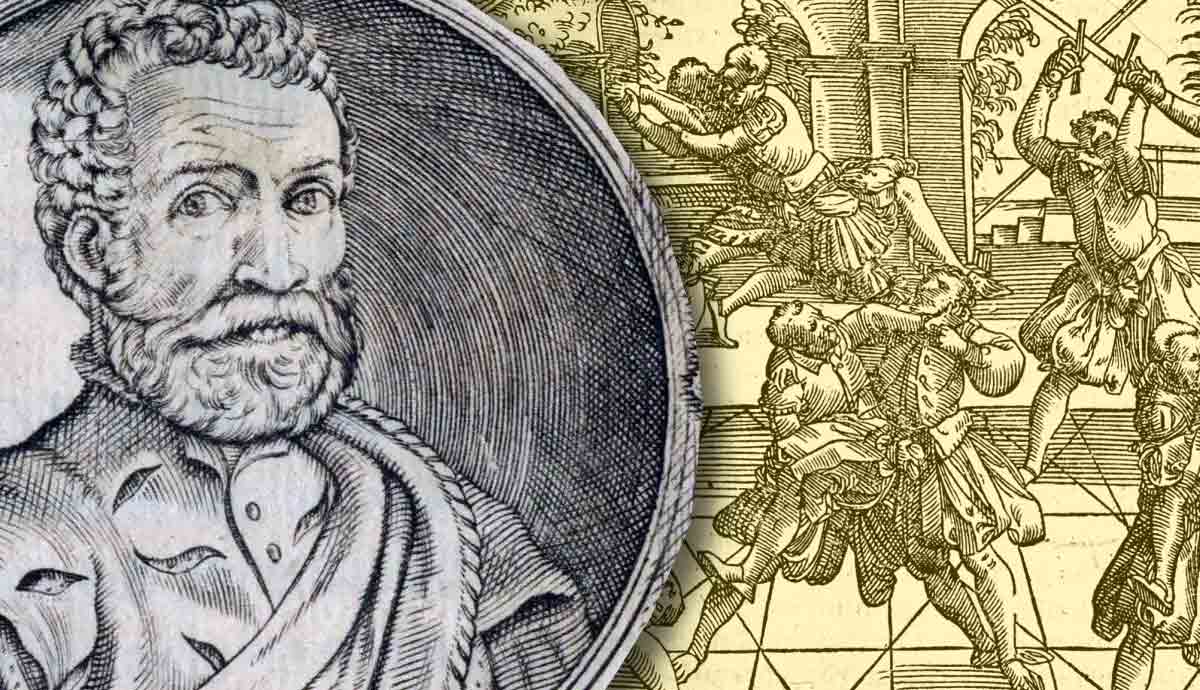
WWW.THECOLLECTOR.COM6 Famous Swordsmen of Medieval and Renaissance Europe Who Shaped the Art of FencingSwordsmanship in Europe developed over the course of hundreds of years in response to the shifting culture and the many innovations of weapons and armor. Famous swordsmen who trained others in the use of these weapons often came from wealthy backgrounds. It would have been unlikely for a commoner to own a sword, let alone train with it, at least during the Medieval Period. Leading into the Renaissance, the wearing of swords would have been more common, but extensive training took a lot of time. Those who were skilled in fencing could find work as masters-at-arms, private bodyguards, or mercenaries, or found their own school. Through this work, they gained experience that honed their knowledge further.1. Johannes LiechtenauerIllustration of Johannes Liechtenauer, from Cod. 44 A 8, Peter Von Danzig, 1452. Source: HROARR.comOne of the earliest widely known fencers was Johannes Liechtenauer, who lived sometime during the 14th century. His surname, Liechtenauer, indicates that he was likely from or associated with Liechtenau, Germany, in the region of Bavaria. Unlike many of the other swordsmen in our list, there is little that is known about Liechtenauers personal life, save that he traveled extensively and was possibly part of a mercenary group. He is instead known for his accomplishment and compilation of many of the fencing techniques that inspired many, particularly German nobles, to compile their own teachings or interpret Liechtenauers for easier consumption and understanding.Liechtenauer wrote his teachings down, or at least a distilled version, in a poem referred to as the Zettel, or Recital. The poem consists of a series of rhymed couplets, and upon initial reading, the Zettel is almost incomprehensible. This is intentional: Liechtenauer did not feel that his teachings of the longsword should be available freely, so it was written as a study guide or mnemonic device for use by swordsmen who already had some form of training in his system. The Zettel itself does not contain much nuts-and-bolts explanation of techniques. Later interpretations, on the other hand, go into more detail.2. Fiore Furlano dei LiberiPage from Fior di Battaglia depicting posta di donna, 14th century. Source: Aikido ItaliaFiore Furlano dei Liberi di Premariacco, born in the 14th century in the city of Friulano, was another noble: his familys title of Liberi possibly referred to their status of Imperial immediacy, as well as being free nobility rather than indentured. At the time, the Holy Roman Empire encompassed present-day Germany and the north of Italy, but Fiores family is thought to have answered directly to the throne rather than any intermediary.Being steeped in the lifestyle of nobility, Fiore had exposure to the martial arts from a young age and wrote that he was interested in learning and teaching. He spent many years learning fencing and battlefield techniques from both German and Italian masters, but only a few of them are named, such as Johane Suveno and Nicholai de Toblem. Many fighters wanting to make a name for themselves or doubting Fiores skill attempted to challenge him to duels when he would not train or fence with them.Fiore wrote his fighting manual, Fior di Battaglia (The Flower of Battle), over a six-month period in 1409, dedicating it to Niccolo III dEste, the Marquis of Ferrara, whom he had trained. Currently, only four known manuscripts of Fiores manual survive, and they are named after the libraries in which they reside. The most comprehensive version of the manual, commonly called the Getty Manuscript, covers unarmed, dagger, sword, and pole weapons extensively, and is structured from simple to complex concepts, with various plays, their counters, and the counters to those counters. Fiore wrote that trying to plan a fight beyond three layers of movement was unlikely to be successful, and even though his techniques were valid, he stated there was always a chance they would not work in a given situation.3. Camillo AgrippaCover of Agrippas manual, 1568. Source: Wikimedia CommonsNow we start moving beyond the transitional period and more into the Renaissance proper with an introduction to Camillo Agrippa, who, unlike many of the others we have listed here, was not a fencer by vocation. Rather, he was an architect and engineer who had a deep fascination with science and mathematics. As a whole, the Renaissance was defined by an increased interest in a more rationalist view of the world, though the Catholic Church still held sway.Sometime in the 1510s, Agrippa was born in Milan and moved to Rome during the 1530s, where he stayed for the rest of his life. He was affiliated with and worked in Rome, where he became acquainted with various famous figures, including Michelangelo. One of Agrippas most well-known architectural accomplishments was the 1570s creation of a hydraulic water system delivering water to the gardens of Villa Medici from the Roman aqueduct Acque Vergine.However, Agrippas most well-known accomplishment is his fencing treatise Trattato di Scientia dArme, written in 1553. During this time period, earlier cutting swords, such as the longsword or arming sword, had given way to the rapier, a thrust-centered weapon. He approached the study of swordplay as a geometric exercise. The illustrations of the figures in the book are used to demonstrate the idea of the point of the sword being in line with the opponent, as straight out as possible, and of moving based upon relative measurements of timing: mentions of half-time and double-time are made. A similar concept is expressed in Miyamoto Musashis work: Things seem slow or fast according to whether or not they are in rhythm.4. Salvator FabrisImage of Fabriss manual. Source: Camille Sourget LibrarySalvator Fabris, perhaps known best for being name-dropped in the novel The Princess Bride, was also a prolific author and fencer born and raised in Padua, Italy. He attended the University of Padua, which he would eventually return to, to teach his theory of fencing. At the time, swordplay was seen as a requirement for any young man of noble birth to learn. Having a good teacher was paramount to ones survival, let alone prosperity. Fabris traveled extensively through Germany, Denmark, and possibly Sweden.From 1601 to 1606, Fabris was the private fencing instructor to Christian IV, the king of Denmark. During this period, he wrote the fencing treatise Scienza e Prattica dArme and presented it to the king as a farewell gift upon leaving his service to return to Italy, where he took his teaching position at the University of Padua. Fabris simplified the Italian rapier system, bringing the number of guards down to four. They are still used in modern fencing.Fabris was so well-known that, according to rumor, Shakespeare requested his aid in choreographing the stage fighting in Hamlet.5. Joachim MeyerImage from the Meyer manual section on rapier. Source: HROARRWe return to Germany in the late 16th century to look at Joachim Meyer, one of the most notable authors who wrote about the longsword and other weapons. Meyer was born in 1537 in Basel, Switzerland, where he studied to become an apprentice cutler, or knifemaker. However, he developed an early interest in fencing before moving to Strasbourg in Germany in 1560. He became a Freifechter, or free fencer. In other words, he was allowed to study and teach swordplay without being tied to a guild. The predominant one was the Marxbruder Guild, but Meyer disliked what he felt was an excessive adherence to tradition. The idea of writing a comprehensive fencing manual for the masses ran contrary to their teaching methods. Eventually, Meyer became affiliated with the rival Federfechter Guild.Joachim Meyers 1570 fencing manual, commonly called The Art of Combat, was dedicated to Johann Casimir, Count Palatine of Simmern. Its basis is the longsword, but Meyer suggests that fencers extrapolate the concepts for use in other weapons and in unarmed combat. It draws much of its inspiration from the earlier manuals written by members of the so-called Society of Liechtenauer, but illustrated in a more sportive context. At the time, the longsword in particular had fallen out of fashion as an everyday carry weapon and in war, partially because of advances in armor and the advent of primitive firearms.One critical difference shows in Meyers instructions: most of the thrusts are deemphasized in his longsword curriculum. This is because, at the time under German law, inflicting a thrust wound was illegal in a duel because it was harder to treat and more likely to be lethal. Therefore, cutting or striking with the flat was required first, before a thrust could be legally used in self-defense.6. George SilverOpening page of Paradoxes of Defence, 1599. Source: WiktenauerThe final figure were discussing here is George Silver, an English gentleman and fencing master, though he did not call himself such. During the time period in which he was active (late 1500s to early 1600s), fencing was seen as uncouth and the province of criminals and general malcontents. Dueling was illegal, though it was still known to happen. Silver wrote two volumes dealing with his concepts of fencing: Paradoxes of Defence, a dedication to the Earl of Essex, Robert Devereaux, and a follow-up, Brief Instructions on My Paradoxes of Defence. The first volume mostly denounces the use of the rapier and the thrust-oriented style of civilian swordplay that was prevalent at the time. Silver wrote extensively about the ideas of moving in tempo with the enemy, and what he called twofold mind; that is to say, thinking of how to attack and retreat.Silver critiques the notions of fighting frivolously or for any slight quarrel, instead exhorting people to try to talk their disputes out before settling them at swordpoint, and advises avoiding fighting if at all possible.0 Commentaires 0 Parts 10 Vue -
WWW.THECOLLECTOR.COMHow Feudalism Shaped Power and Wealth in Medieval EuropePeople often describe Medieval Europe as a feudal society lasting nearly a thousand years. The approximate temporal boundaries of Medieval Europe range from 500 to 1500 CE, though the exact beginning and end points vary between scholars based on what aspect is being discussed. Although most people think of the so-called Middle Ages as a period of bleakness, backbreaking toil, and constant war, and feudalism was undeniably brutal at times, there was also a rich flowering of knowledge and culture even before the Renaissance. Many of the cultural underpinnings established during this period have survived into the present day. To better understand this history, we have to look at the interplay of the three broad social classes and the distribution of resources.How Did Feudalism Start in Europe?The Course of Empire Destruction, by Cole Thomas, 1836. Source: Wikimedia CommonsPrior to the fall of the Western Roman Empire, commonly agreed to have occurred in 476, most of Europe existed under a centralized state authority. Roman overlords would collect taxes and keep their brand of societal order. Various factors led to the fall of Rome, which warrant separate examination beyond the scope of this piece, but nevertheless, the collapse of Rome led to a power vacuum where anyone could theoretically carve out their own territory.Because of this lack of centralized rule, there was no one keeping bandits, warlords, and assorted other would-be rulers from staking their claim on whatever land they wanted.Some people with more accumulated wealth and military might than others staked their land claims amidst the untamed wilderness and forests of Europe, offering protection to those who were not able to defend their own lands in exchange for a portion of their agricultural output or other services. This is the basic arrangement of what we call feudalism, or the manorial system.Feudalism is more accurately the distribution of land from sovereigns to minor nobles in exchange for loyalty and military support. How each noble managed their allotted portion of land fell under the manorial economy. Over time, these systems became entrenched in society, and a class system emerged, each with its own role.Societal Classes in FeudalismPeasant and His Wife, by Albrecht Durer, 1497. Source: Heidelberg UniversityThree broad classes existed within European feudalism: the peasantry, clergy, and nobility. At the bottom of the social ladder and by far the most numerous were the peasantry, responsible for farming the land and performing other miscellaneous trades. They had social obligations to the nobility in the form of taxes and goods. Peasants were often required to live and work on a given piece of land, as determined by the landholder, whether that was a lord or a church bishop.The clergy consisted of priests, nuns, bishops, and other roles within the Church. During the majority of the Feudal Period, the Roman Catholic Church was the religious authority, to the point of almost being a monopoly. Any religious dissent was met with swift, often brutal punishment, and the threat of not being able to receive salvation from Hell via the Church carried a sort of existential threat among people in these times. The clergy preserved religious texts, ensured literacy (at least for those who would pursue a religious vocation), and often officiated religious events such as baptisms and weddings. They also did what was called Gods work in the form of public works and charity.Finally, the nobility was the upper class of society. As stated, this consisted of the sovereign, his lords of various ranks, and knights. Their role was to provide protection to the other two classes, and as time went on, institutions like the code of chivalry were developed to be a moral example for how people should behave.What Was the Feudal Economy Like?Medieval Merchants House Hall. Source: Wikimedia CommonsAfter the massive population decline post-Rome, much of Europe that had been cultivated farmland returned to wilderness that was virtually impossible to pass through. The famous roads that linked the Roman Empire were broken up for construction or had eroded from a lack of maintenance. This led to a localized agricultural economy wherein each fief was self-sufficient.At first, agriculture was mostly subsistence, with enough food being grown to keep a family alive. Grains were the chief foodstuff of most peoples diets in Europe. Agricultural reforms, which included crop rotation, collars for horses, and heavy plows, over time led to a surplus of food and the ability to learn other trades and gain access to resources. In time, this led to a barter economy where people traded goods and services in kind.Skilled trades such as smithing, carpentry, and masonry were of value too, and a peasant or craftsman trained in this work could receive higher wages and potentially buy their freedom from servitude.PeasantryOn the Field, by Michial Klodt, 1871. Source: Wikimedia CommonsThe peasant class was divided into two broad categories depending on their freedom of movement. Most of the peasants were serfs, meaning they were legally bound to the lords plot of land and required to work it, providing a portion of their produce to the lord. They could not leave except by permission, by escaping (the customary time frame in England, for example, was a year and a day of evading capture, and there could be harsh punishments if caught), or if they acquired enough wealth to buy their freedom. The process of releasing a peasant from the land was called manumission, and the price for a serf to pay for this process was at the lords discretion.Tenants, meanwhile, were still members of the peasant class and subject to taxes, but they could own their own land and move freely. They could also own a business or trade, and accumulate their own wealth. In addition to taxes to the manor lord, a peasant also had to pay tithes (a tenth of their income) to the Church.Although peasants had few rights comparatively, it was wise for a lord not to mistreat them. For one thing, they worked the land and provided food. Events like the 1371 Peasants Revolt illustrated what could happen if lords were seen to have overstepped.ClergySaint Anthony of Padua, by the Romagna School of Painting, c. 1520. Source: The Walters Art MuseumThe clergy in Europe were the most educated and literate of the three social classes; even the nobility had a comparatively low literacy rate. As such, they were responsible, in addition to the religious duties that would be expected, for education. They preserved knowledge; one of the most commonly depicted duties of monks was the painstaking transcription of religious or other texts. Many of the first universities that are still in existence today were established by the Church to aid in preserving knowledge.Weve touched upon the effect religious authority had upon the peasantry, but this also extended to the nobility. As the Church accumulated wealth through tithes and donationswhich were not taxedit became more powerful and able to hold lands just as the nobility did, and sometimes exceeded them to the point of lords becoming subservient to a local bishop.The nobility was thought to be such by virtue of divine right, conferred by the Church. Therefore, seeking the overthrow of a sovereign or a lord was tantamount to disobeying God directly. However, if a noble were to do something that the local bishop or the Church as a whole did not agree with, there was the risk of excommunication and perceived loss of the divine right to rule. Many of the clergy also found themselves in advisory positions and did much of the day-to-day administration because they were the learned class.NobilityThe Knighting of Sir Galahad, Jasper Anglican Church. Source: Wikimedia CommonsThe nobility was the upper class of society, consisting of positions that ran the gamut from landed knights all the way to the sovereign of the realm. Their role in society was that of governance and keeping society running as smoothly as possible. Specific duties in day-to-day situations often included hearing and adjudicating disputes between peasants and collecting taxes for any noble to whom they had sworn vassalage. They could also maintain public utilities such as grain mills, which were for common use. The upkeep of these amenities was paid for by taxes.The nobility was also expected to raise an army if called upon to do so, consisting of knights, men-at-arms, and others. They could also conscript the peasantry to fight, but only for a short time because the peasants would have to be able to work the fields. Most wars were fought in summer, and harvest happened in the autumn. Conscripts would use what farm tools they had as weapons, or they would be issued basic equipment like spears and rudimentary armor.Decline of FeudalismThe Peasants Revolt, from the Chroniques de France, by Froissart, 1460-80. Source: British LibraryAlthough the Middle Ages lasted almost a thousand years, the height of feudalism was mainly during the earlier part of the period, before the Crusades. Funding an army and getting it all the way to the Holy Land was expensive, so to finance the endeavor, nobles would often sell portions of their land or free their serfs through manumission. They would go to fight, and if they were killed without any estate heirs, the nobles land would come under the control of the monarchy directly, leading to more centralized power.The Black Death, or bubonic plague, was also a crucial turning point in the stability of feudalism: the plague swept through Europe and killed an estimated 30 to 60 percent of the population from 1347 to 1353, exacerbated by a woeful lack of sanitation in cities and a lack of modern medical understanding of disease treatment. The full effects of the disease on European society warrant separate discussion, but it gave the peasant class far more leverage than they had previously had: nobles were unaccustomed and unskilled in the type of manual labor required for farming, so the peasants had the ability at this point to demand decreased obligations and higher pay.The power of the Church was also diminished; people saw the efforts of the clergy through medical care and prayer to stem the tide of the plague, and how ineffectual they ultimately were. This, among other factors, led ultimately to the start of the Protestant Reformation some 200 years later in 1517 with Martin Luthers 95 Theses. There is no single event, however, that can be credited with the dismantling of the feudal system in Europe.0 Commentaires 0 Parts 11 Vue