



• WWW.THECOLLECTOR.COM
    What Kind of Money Did People Use in Feudal Japan?
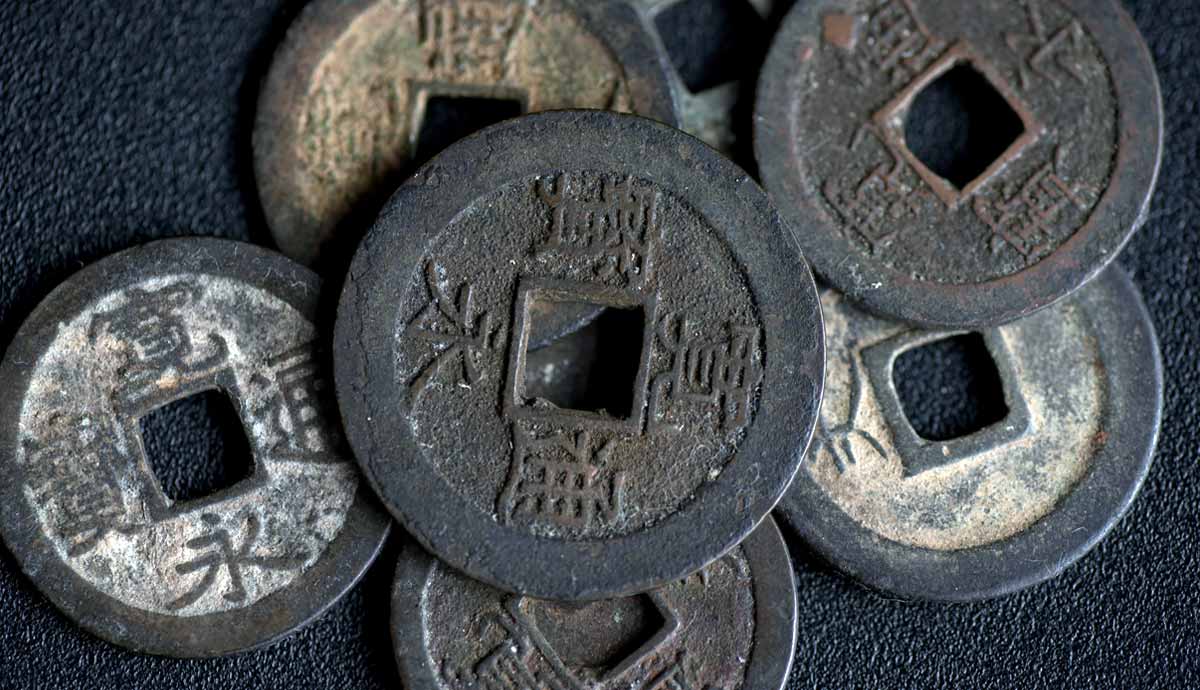
    On July 3, 2024, the Japanese government redesigned the 1,000-yen, 5,000-yen, and 10,000-yen banknotes to make the bills harder to counterfeit. At the time, it was considered a big step for the Central Bank of Japan. But it barely registers in the history of Japans monetary system. During the Edo Period (16031868), money was far from a picture of stability, always changing in a multitude of ways. Even if money does not make the world go round, it could make your head spin during Japans feudal era.From Square Holes to the Three MetalsWadokaichin Coin at the British Museum Room 68, Paul Hudson, 2015. Source: Wikimedia CommonsFor the longest time, it was believed that the copper wadokaichin, minted in 708, was Japans first official coin. It was round with a square hole in the middle, a design most likely borrowed from Tang Dynasty China where the roundness represented the heavens and the square the earth. It seems that even 1,300 years ago, money meant the world to some people. However, excavations conducted in 1998 revealed an earlier coin, the fuhonsen, which featured a similar design and was also made from copper. Although, there is a passage in the Nihongi, one of the oldest chronicles in Japan, quoting the 7th-century Emperor Temmu: Henceforth copper coins must be used, and not silver coins. This suggests that early fuhonsen were possibly made from silver.The quote may also refer to the mumonginsen, unadorned disks of silver that predate the fuhonsen but whose status as proper currency is still hotly debated among historians. Things changed a lot during the following millennium, and by the Edo Period, feudal Japan was using a tri-metallic system based on gold, silver, and copper. Gold, which was used for substantial transactions, was divided into various units like the ryo, oban/koban, bu, and shu. Silver, on the other hand, was found in the chogin or mameita-gin coins. It was also measured in monme, which was both a currency and weight unit. Copper (and occasionally iron) coins were used for everyday purchases and came in the form of mon, kanmon, or sen, which were often strung together in groups of 96 or 960 (Dunn, C. J., p. 88).The Price of Money in Feudal JapanKoban Evolution During the Tokugawa Period, World Imaging, 2007. Source: Wikimedia CommonsThe Edo government attempted to control the value of its money by occasionally increasing or decreasing the amounts of precious metals in gold and silver coins. This often led to inflation and social dissatisfaction. Ultimately, the value of each unit of currency was dictated by the market. So while the government might declare that, say, one ryo of gold was equal to 60 monme of silver or 4,000 mon of copper, it was the moneychangers who set the final price.Edo (modern-day Tokyo) operated primarily on gold while Osaka, Japans kitchen and an important financial center, preferred doing business in silver. If a person from eastern Japan wanted to buy or sell things out west, they needed to exchange their gold for silver first. This is where the moneychangers or ryogaesho came in. From humble beginnings as currency handlers, they quickly evolved into powerful financial institutions that eventually became Japans first banks. Merchants depended on the moneychangers not only to convert currency but also to provide them with credit lines, introduce them to trading partners, and, above all else, provide much-needed stability.Oban & Koban & Ichibuban in Edo Period, PHGCOM, 2007. Source: Wikimedia CommonsThe country looked to Osaka, specifically the Ten Menten families who advised the government and were involved in finances since the 1660sto determine the value of money at any given time (Dunn, C. J., pp. 91-92). They did not operate entirely independently. Their weights, measures, and scales (which were made by only two families) were constantly inspected to ensure that the exchange rates had a basis in reality. The Osaka moneychangers were so important to maintaining Japans monetary system that the government granted the Ten Men the right to carry swords, a sign of great honor for non-samurai.The changing value of money in feudal Japan also makes it nearly impossible to provide the equivalent of, for example, one ryo in modern dollars. However, a common trope in Japanese revenge literature during the Edo Period was to use 50 ryo to indicate an outrageous amount of money (Jones, S. and Watanabe K., p. 41).The Rise of PaperYamada Hagaki First Japanese Banknote Circa 1600, PHGCOM, 2008. Source: Wikimedia CommonsAnother service provided by the Osaka moneychangers was the issuance of furitegata, which were promissory notes that acted a lot like modern checks. It was essentially a piece of paper with written instructions for a ryogaesho to pay the holder a certain amount of money. The original issuer of the furitegata would of course need to first have an account with the proto-banks. The notes allowed merchants to conduct business without cash, but the furitegata were not always redeemed immediately. They were often traded between people like modern paper money and became a sort of currency. In the end, they could be traded in for silver or gold or for merchandise the same value as the amount on the note. They made the occasional appearance in Edo but were primarily circulated in Osaka and its surrounding area.However, they were not feudal Japans first paper money. The oldest examples of that are probably the Yamada Hagaki, which appeared around 1600, a few years before the unification of Japan under the Tokugawa Shogunate. It is also the same year that the show Shogun (9919) takes place. Similarly to the furitegata, they were promissory notes, but in this case, they were issued by the priests of the Ise Grand Shrine in modern-day Mie Prefecture.Hansatsu from the 1700s, Donald Trung, 2022. Source: Wikimedia CommonsDedicated to the sun goddess Amaterasu (9742), Ise has long been one of the most important places of Shinto worship in Japan. The shrines reputation is what allowed the Yamada Hagaki to be traded for small amounts of silver by local merchants, eventually becoming a kind of local currency. It is important to note that this is basically how modern fiat money works as well. It works because we all agree on the value of a piece of paper (or, in the case of dollars, linen and cotton) backed by our faith in the government. Without faith, paper money cannot exist, so it makes sense that, in Japan, it originated at a shrine.Then there were the hansatsu notes issued by the lords of individual domains. Before Tokugawa Ieyasu unified Japan, the country was in a state of near total civil war during the Sengoku Period and every fief was essentially its own semi-independent kingdom. While they operated on silver and gold, sometimes, due to metal shortages or other reasons, they would issue their own promissory notes, which survived until the Edo Period where they thrived alongside cold, hard cash. At the peak of hansatsu, 80% of Japanese domains were issuing their own notes to their retainers and merchants. The hansatsu were only good within their specific domain, and they tended to devalue fast, so the government was always fighting to squash them, but with little to show for it.Rice and the First Commodity Futures Market in the WorldRice Harvest of Japan, Elstner Hilton, 1911. Source: Wikimedia CommonsIt could be said that rice was the first currency in Japan thanks to a system called suiko that emerged before the widespread use of coins. Under the system, farmers would borrow seed rice in the spring to plant crops, and then pay back the loan after the harvest, in rice and with interest. It was essentially an agricultural form of credit that stabilized rice production and was a precursor to Japans financial system. With time, suiko became heavily codified, but by the Edo Period, it had been abandoned. This does not mean, however, that rice was no longer making appearances in the Japanese world of finances.It all starts with koku, a Japanese unit of volume equal to about 150 kilograms (330 lb), or roughly how much rice an adult could eat in a year. In feudal Japan, it became the measure of a domains power, which was determined by how much koku of rice it could produce. During the Edo Period, those lords with the highest koku counts were known as daimyo, lit. Big Names. It was also common for fiefs to pay their retainers a rice stipend. Since the majority of samurai resided in Edo, a large quantity of rice was transported from the country to the capital.Ukiyo-e of the Djima Rice Exchange, Yoshimitsu Sasaki, 1880. Source: Wikimedia CommonsAll the collected rice went into central granaries so it could be paid out three times a year, on the second (25%), fifth (25%), and tenth month (50%) of the year (Dunn, C. J., p. 96). However, many samurai took a cash payment instead of actual rice from the granaries, initially for a little bit above the market value, but eventually less. The system eventually became so complicated that rice brokers stepped in to help. They evolved from owners of teahouses set up around granaries where samurai could spend the entire day waiting for their stipend. So, one day, the teahouse owners came upon an idea, offering to deliver rice or money (for a fee) to the samurai so they would not have to spend an entire day down at the granaries. Even hundreds of years ago, people were willing to pay a premium for convenience and soon the rice brokers grew into powerhouses of Japans world of finance.Barring a sudden drought or other extreme weather, the rice deliveries were punctual and solid. Therefore, some lords started selling the rice merchants their future rice that would be delivered in a few months or even next year. This opened up possibly the worlds first futures commodity market in Osakas Dojima district, which in the late 17th century became the site of the Dojima Rice Exchange. Officially recognized by the shogunate in 1730, the DRE was a place where traders could buy and sell notes promising the delivery of an amount of rice at a future date. Changes in supply could radically alter the price of rice, so a lot of speculation happened at the exchange, not unlike during the Dutch tulipmania. The traders reportedly relied on a complex system of flag signals and couriers to get the information about the most recent prices as fast as possible to gain an advantage in dealmaking.Birth of the YenYen Coins, Astelus, 2020. Source: Wikimedia CommonsJapans old monetary system went away after the start of the Meiji Period (18681912). An 1871 act created the yen (which was originally divisible into 100 sen or 1,000 rin) and in 1882, the Bank of Japan became the only issuer of banknotes in Japan, marking the end of the convoluted feudal financial system. Given that Japan is now the fourth largest economy in the world, it would be fair to say that the switch worked out in the countrys favor.Works citedJones, S. Watanabe K. (eds.) (2013). An Edo Anthology, Literature from Japans Mega-City 17501850. University of Hawaii Press.Dunn, C. J. (2008). Everyday Life in Traditional Japan. Tuttle Publishing.
    0 Commentarii 0 Distribuiri 7 Views
  • WWW.THECOLLECTOR.COM
    Who Was the Real Good King Wenceslas Behind the Christmas Carol?
    Most people recognize the name King Wenceslas from the popular Christmas carol. But who was the good king, and why did someone choose to celebrate his generosity in a Christmas song? Discover the story behind the song and the man who inspired it.Good King Wenceslas: A Classic Christmas CarolGood King Wenceslas Words, from The Oxford Book of Christmas Carols, Music and Illustration by the Brothers Dalziel. Source: Wikimedia CommonsGood King Wenceslas looked out on the Feast of StephenWhen the snow lay round about, deep and crisp and even.Brightly shone the moon that night, though the frost was cruelWhen a poor man came in sight, gathering winter fuel.No evening of carol singing would be complete without a joyful, spirited round of Good King Wenceslas. It has been a festive favorite since its publication almost 200 years ago. Out of an estimated 10,000 Christmas carols, in 2023, Classic FM ranked Good King Wenceslas number 21 on a list, between The Three Kings at number 20 and The Holly and the Ivy at number 22.Photograph of John Mason Neale, January 1st, 1910. Source: Wikimedia CommonsThe tune of the song was written over 400 years ago as Tempus Aest Floridum, which translates as Eastertime Is Come. Yes, the tune of Good King Wenceslas was originally intended to accommodate words that hailed the return of spring and celebrated the annual remembrance of Christs resurrection. Its first appearance can be found in the 1582 collection of music entitled Piae Cantiones, which was compiled by Jacobus Finno, a Finnish clergyman and musician.In 1853, the lyrics to Good King Wenceslas were written specifically to fit the music. The iconic poem was composed by the English hymn writer John Mason Neale (1818-1866) with his editor Thomas Helmore (1811-1890). The finished product was published in a book called Carols For Christmas-tide, which was published by a company called Novello & Co. later that year.The Story of Good King WenceslasIllustration of Good King Wenceslas, 1904. Source: Wikimedia CommonsAs well as being a Christmas caroling classic, Good King Wenceslas is also a perfect song to sing on Boxing Day. This is because the story it tells is set on the 26th of December, otherwise known as Saint Stephens Day. This annual festival is mentioned in the opening line: Good King Wenceslas looked out on the Feast of Stephen. Saint Stephens Day commemorates the death of Saint Stephen, the first Christian martyr, whose story appears in the Book of Acts.The poem is set on a cold Boxing Day, with the land covered in snow. In the first verse, our protagonist, King Wenceslas, looks out from his home and sees a poor man gathering fuel to feed his fire.Moving onto the second verse, taking pity on those less fortunate, Good King Wenceslaus summoned his servant (hither page come stand by me) and requested to know more about the unknown man in the distance (where and what his dwelling?) Understanding that the man would very likely be cold and hungry, Good King Wenceslas decided to share the abundance of his Christmas feast with him (bring me flesh and bring me wine, bring me pine logs hither, thou and I will see him dine, when we bear him thither). We may bear in mind that the 26th of December was only the second of the twelve days of Christmas and that the festivities at Wenceslass castle would only just have begun.Saint Stephen in Assisi, Italy. Source: Wikimedia CommonsThe remaining verses tell the story of the duos journey through the bitter weather. Amid the venture, the page confessed that he did not have the strength to carry on (Sire the night is darker now and the wind blows stronger, fails my heart I know not how, I can go no longer). So that he might shield his page from the harsh weather, Good King Wenceslas generously advised his page to walk directly behind him (Mark my footsteps my good page, tread thou in them boldly, thou shalt find the winters rage freeze thy blood less coldly).The carol ends with a charming piece of advice: Therefore Christian men be sure, wealth or rank possessing, ye who now will bless the poor, shall yourselves find blessing.The Real King WenceslasEmma of Bohemia adoring Saint Wenceslaus, from Bolesaw II Przemylida, 1000s CE. Source: Wikimedia CommonsTo find the real King Wenceslas behind the song, we must travel back to 10th-century Bohemia. There we meet Wenceslas, who was not a king but the Duke of Bohemia. It was the Holy Roman Emperor Otto I who posthumously conferred the title of king on Wenceslaus.The young Wenceslaus was born around 907. His birth took place in the town of Stochov in the Czech Republic, which at the time formed part of the Kingdom of Bohemia. His father was Vratislaus I of the house of Premyslid, and his mother was known simply as Drahomira. He had one brother called Boleslav, who, in contrast to his brother, would later become known as Boleslav the Cruel.Despite common assumptions, although he was a dedicated Catholic himself, Wenceslaus did not come from a long line of Christians. His paternal grandfather had been converted to Christianity by Saint Cyril and Saint Methodius, so the religion had only been in his family for two generations. Drahomira, on the other hand, was the daughter of a pagan tribal chief.Coat of arms, Medieval Bohemia. Source: Wikimedia CommonsIn 921, Vratislaus, Duke of Bohemia, died unexpectedly. This left his eldest son, Wenceslas, to inherit not only the Dukedom but all the responsibility that came with it. At the time of his accession, Wenceslaus was just 13 years old. His paternal grandmother, Ludmila, a devoted Christian, acted as his regent,Jealous of the influence that she wielded over her son, and disapproving of their shared love of God, the pagan Drahomira arranged to have her ruling mother-in-law killed. Ludmila was accosted at Tetin Castle by assassins. Legend has it that Ludmila was strangled to death with her own veil. Drahomira assumed the role of regent immediately; her first action was to initiate harsh measures against Christians.Four years later, when Wenceslas turned 18, Wenceslas and his Christian nobles rebelled against Drahomira and her government. His uprising was successful, and he sent his mother into exile. From then on, he ruled independently, answering only to the Pope and to God.Statue of Saint Wenceslas, Prague. Source: Wikimedia CommonsWenceslaus may not have been a true king, but he certainly acted like one. Praised for his Christian charity and virtues, he earned the epithet the Good. He also fostered the spread of Christianity in collaboration with the German church and took a vow of virginity. He ruled Bohemia from February 13th, 921, until his death in either 929 or 935.An Untimely End: The Assassination of WenceslausThe Burial of Saint Wenceslas, by the Master of Eggenburg, c. 14901500. Source: Metropolitan Museum of Art, New YorkSadly, Wenceslas was killed by his own younger brother, Boleslav. The story of these competing brothers began in September of 935 when a group of like-minded nobles allied themselves with the young and ambitious Boleslav. Together, these conspirators plotted to kill Wenceslas and make Boleslav their ruler. Boleslav was motivated not only by jealousy but also by a dislike of Wenceslauss Christian attitudes and behaviors. Boleslav was encouraged by his pagan mother, Drahomira, now in exile.With all the innocence of a beloved younger brother, Boleslav invited Wenceslas to a celebration. Supposedly, the event was being held in celebration of the Feast of Saint Cosmas and Saint Damien. During the festivities, at what we can only imagine was an opportune moment, Wenceslas was unexpectedly murdered, stabbed to death by three of his brothers companions, Tira, Cesta, and Hnevsa. As the Duke of Bohemia fell to the floor, Boleslav finished the job by running his elder brother through with a lance.At the age of either 22 or 28, Wenceslas had lost not only his dukedom but also his life. After his untimely demise, Good King Wenceslas was recognized as a martyr.Wenceslaus: Duke, King, Martyr, SaintThe Murder of Wenceslaus, from Liber Vaticus, 14th century. Source: Wikimedia CommonsAccording to legend, one of Boleslavs sons was born on the same day as Wenceslass murder and Boleslavs succession. Boleslav named his boy Strachkvas, which translates as dreadful feast. A further legend states that a loyal servant of Wenceslas, named Podevin, avenged his masters death by killing one of Boleslavs chief conspirators, for which he was executed. Podevin was the page referenced in the carol.The remains of Wenceslas now lie in St Vitus Cathedral, the largest and most important Church in Prague. The Catholic Encyclopaedia explains that Wenceslauss body, hacked to pieces, was buried at the place of murder, but three years later Boleslav, having repented of his deed, ordered its translation to the Church of St Vitus in Prague.King Wenceslas Chapel, Prague. Source: Wikimedia CommonsImmediately after his death, Wenceslas was considered both a martyr and a Saint. Within just a few decades, several biographies had been penned and had entered circulation. Consequently, devotion to Saint Wenceslas became extremely popular, particularly in Bohemia and England.One of the most notable admirers of Wenceslaus was the priest, chronicler, and historian known as Cosmas of Prague. He claimed that all the myths now surrounding the life of Wenceslas should be considered as genuine facts. Of Wenceslas, he wrote the following praise: No one doubts that, rising every night from his noble bed, with bare feet and only one chamberlain, he went around to Gods churches and gave alms generously to widows, orphans, those in prison and afflicted by every difficulty, so much so that he was considered not a prince, but a father of all the wretched.A few centuries later, Pope Pius II (1405-1464) decreed that all legends regarding Wenceslaus should be regarded as true. In remembrance of the duke, and as an act of thanksgiving to God, Pius mimicked the actions of Wenceslas by walking ten miles barefoot in the snow to give alms to the poor.The Lasting Legacy of Good King WenceslasWenceslas Cathedral. Source: Kevin Andre via UnsplashThe Feast of Wenceslas of Bohemia is now celebrated annually on the 28th of September. It is so important in the Czech Republic that it is now regarded as a national holiday traditionally celebrated with roast goose and potato dumplings. Famously, Wenceslas is the only Czech Saint whose name appears worldwide on the calendar of the Roman Catholic Church.Wenceslas Square is one of the main city squares and the undoubted center of business in Prague. It is customary to pay tribute to the life and works of Saint Wenceslas by laying a wreath on his statue on the 28th of September.
    0 Commentarii 0 Distribuiri 7 Views

  • 0 Commentarii 0 Distribuiri 7 Views

  • 0 Commentarii 0 Distribuiri 7 Views

  • WWW.BGR.COM
    5 CISA Security Rules Every iPhone User Should Know
    The Cybersecurity and Infrastructure Security Agency (CISA) has issued guidance surrounding hardening your iPhone from security threats. Here's the advice.
    0 Commentarii 0 Distribuiri 7 Views
  • TECHCRUNCH.COM
    Reddit argues it isnt like other social platforms in case against Australias social media ban
    Reddit, one of the world's largest social platforms, is arguing that it doesn't meet the definition of "social media platforms" as it seeks to overturn Australia's law banning children under 16 years of age from social media.
    0 Commentarii 0 Distribuiri 7 Views

  • 0 Commentarii 0 Distribuiri 7 Views

  • Fire Testing Market: An In-depth Analysis of the Fire Testing Market
    Overview of Fire Testing Market United States of America – December 12, 2025 - The fire testing market continues to play a crucial role in ensuring safety, regulatory compliance, and risk mitigation across construction, manufacturing, transportation, oil & gas, and aerospace industries. With global infrastructure expansion, stringent fire safety mandates, and rising awareness of...
    0 Commentarii 0 Distribuiri 13 Views
  • YUBNUB.NEWS
    Kremlin Conditions Ceasefire on Ukrainian Withdrawal From Donbas, Ushakov Says
    A senior Kremlin adviser said a ceasefire in Ukraine would only be possible if Ukrainian forces leave the Donbas region, placing remaining territory under Russian control. By yourNEWS Media Newsroom A
    0 Commentarii 0 Distribuiri 7 Views
  • YUBNUB.NEWS
    EU and Canada Move to Interlink Digital Identity and AI Infrastructure
    New agreements between European and Canadian officials deepen cooperation on digital credentials, artificial intelligence systems, and online information governance, expanding a partnership launched in
    0 Commentarii 0 Distribuiri 7 Views