



WWW.THECOLLECTOR.COM
How Did the Mongol Empires Expansion Impact the West?
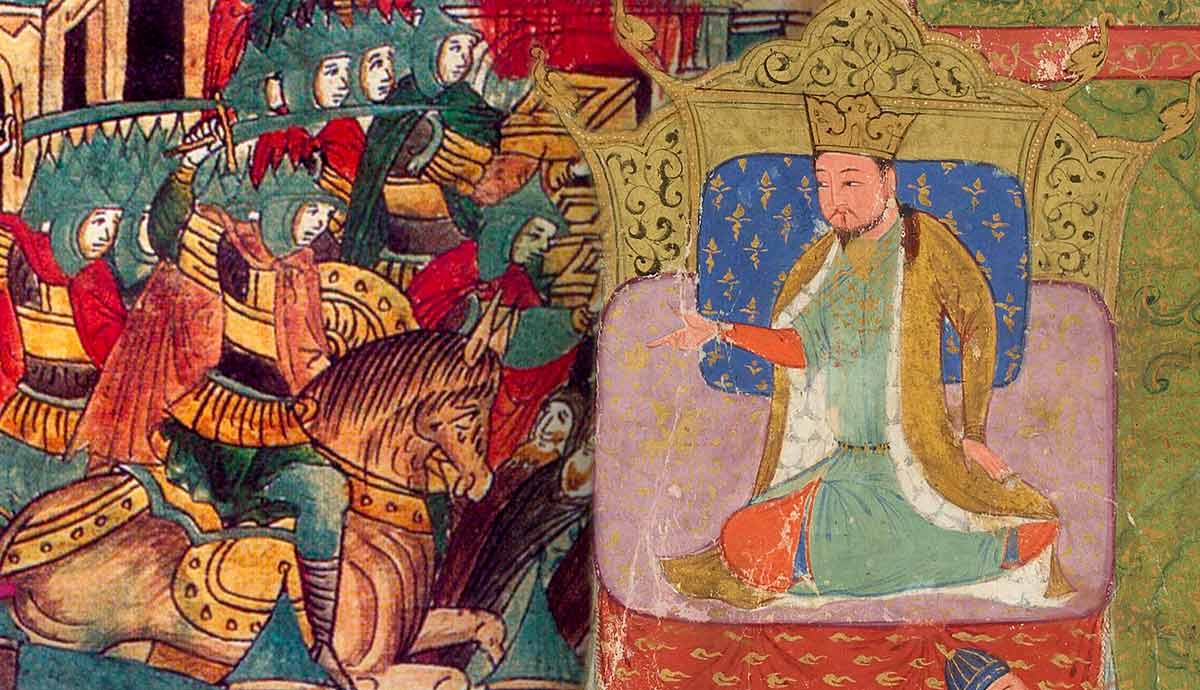
In the 13th century, the Mongol Empire exploded out of the Asian steppe and spread westward across Eurasia. As the first horsemen clashed with the princes of Eastern Europe, the continents conception of itself and the world began to shift.Rumors of a Powerful New PlayerPrester John as Emperor of Ethiopia from the Queen Mary Atlas, by Diogo Homem, c. 1555-1558. Source: British LibraryIn 1221, the leaders of the Fifth Crusade were in Damietta, a port city on the right bank of the Nile, contemplating their next steps. The crusade, which had started four years earlier, had been largely disappointing. Campaigns in Syria had failed, one before the enemy had even been engaged. The familiar themes of disunity, domestic concerns, and lack of funds had hampered a concerted war effort.Then, a story spread through the Crusade leadership and their gathered armies within the city walls. A king, far off to the east, was attacking the Muslim world with devastating ferocity. The Khawarazmian Empire, a power that encompassed vast swathes of Central Asia and Iran, had been humbled. The word was that this new force was not only hostile to Islam, but was Christian. Whats more, its leader was called, portentously, David. The story grew in complexity and excitement.The Crusader leaders quickly fired off an account of what had happened back to Europe: the new King David was a conqueror devoted to retaking Jerusalem for Christ, sweeping through the infidel armies and liberating Christian prisoners as he went. In Acre, the local bishop was certain that David was the grandson of Prester John, the long-awaited leader of an Asian Christian kingdom. Confident that they were part of a gigantic pincer movement on the Islamic Middle East, they fasted for three days, then marched southwards, ultimately to disaster and retreat.Two years later, the Pope received a letter from the Kingdom of Georgia. It was an apology for not joining the Crusade themselves. They had been distracted by incursions from a new enemy from the east. That same year, the king of Hungary wrote that the Rus and the Cumans were being attacked by unknown eastern barbarians. The Tours annalist hypothesized that these were the barbaric peoples who followed the army of King David. Others, though, werent convinced. One writer at a French monastery mused whether the newcomers may not be Christian or Muslim, but something else entirely.The Mongol Empire and the Golden HordeGenghis Khan and Wang Khan, illustration from the manuscript Jami al-tawarikh, Rashid al-Din Hamadani, early 14th century. Source: Bibliotheque Nationale de FranceThe something else were the Mongols. There are scanty sources for the Mongol world, but historians are relatively confident in the basic outline of events. After years of fragmentation and domination by the Chinese dynasties, Temujin united the nomadic tribes of the Mongol steppe in 1206, adopting the title of Genghis Khan, and set about conquering his neighbors.The Mongols were not the uncontrolled, bloodthirsty bands of myth, but a cultured and technologically-capable people. Their conquests were as much a consequence of their adoption of Chinese gunpowder, their horsemanship, and their innovative military tactics and use of subterfuge as their sheer violence. They adopted the Chinese philosophy of universal empire, that all the world had been given by providence to their ruler. As the Great Khan Guyug would later tell Pope Innocent IV, All lands, from the rising of the sun to its setting, have been made subject to us. Their drive to conquer in all directions, and their confusion when dealing with Western figures seeking equal treatment, must be seen in this context.Upon his death in 1227, the empire was divided into khanates under the suzerainty of the Great Khan. The khanate that would most prominently figure in Western imagination became known as the Golden Horde, though not until the 16th century. Contemporary Muslim sources referred to it as the Realm of Jochi after its first khan. At its peak, it covered most of modern Ukraine and western Russia. To the south was the Ilkhanate, known to Mongols as the Realm of Hulegu. The Ilkhanate was the primary Mongol power threatening the Muslim powers of the Middle East, although Westerners often did not distinguish between the two khanates, partly correctly assuming a continuity between the two. The Il-Khans would themselves convert to Islam from 1295, although they remained a threat to their fellow Islamic rulers, as well as Christian ones.On the Frontiers of EuropeBela IV of Hungary depicted fleeing the Mongols in the Chronica Picta, Mark of Kalt, c. 1370-1373. Source: Web ArchiveThere was relative quiet for the next two decades, but garbled stories of distant attacks on the Islamic empires continued to filter through. At some point, the realization dawned that these were not Christian soldiers, and the stories were greeted with an air of foreboding. By 1237, they had become known as Tatars, in part, a nod to an ancient name for Hell. There is even a story that, in 1238, a Muslim delegation traveled across France and England to beg for assistance.Then the first full report of the Mongols, from a member of Latin Christendom, reached Western eyes and ears. The Dominican Julian had traveled out into what had been Greater Hungary and deep into southern Russia, only to find that it had already been subjugated. He returned with a letter demanding the submission of the king of Hungary and a verification of the Mongols hostile intent from a local prince. Soon, Christian refugees were pouring into Hungary, and its king, Bela IV, began forging alliances. Georgia begged for help from the Pope. Russian princes were exploring closer links with the papacy as a prelude to support.Latin Christendom, though, was not worried enough to act. There are numerous theories as to why everyone, including the Pope, believed the external threat was serving the papacys interests. There was a hopeexpressed for one by the bishop of Winchesterthat the Muslims and Mongols would destroy each other.The Mongol AttacksDepiction of the Battle of Liegnitz, from the Legend of Saint Hedwig, unknown artist, 1353. Source: John Paul Getty MuseumThey came in 1241. Four Mongol armies attacked Hungary, as Julian had warned, but some divisions invaded the fragmented Poland, probably to target a potential Hungarian ally. There is little detail on the form of these attacks, but a combined Polish and Moravian force was crushed at the Battle of Liegnitz. Two days later, there was a similar outcome for Bela IV at the Battle of Mohi, at which it is likely that Europeans were first introduced to Chinese gunpowder. The stories of the Mongols in Hungary fit with what we know of their actions elsewhere, killing or enslaving local populations, but also engaging in subterfuge, issuing fake decrees ordering populations ahead of them not to flee but to remain in their homes.No help was forthcoming. Pope Gregory IX wrote to the Germans, Austrians, and Norwegians to call for assistance and the Holy Roman Emperor summoned a crusading army to Nuremberg. Apart from minor scuffles with Mongol raiding parties, the force did not move into Hungary, for reasons that are still unclear. Nevertheless, the German chroniclers were already clear why Hungary fell: the ineptitude of its leaders, the disloyalty of its nobility, and the poor defenses of its borders and towns. Many must have feared a coming storm. Rumors, again, flew around western capitals, saying that they were targeting Rome.The Battle of Mohi, from The History of the Oriental Kingdoms, unknown artist, c. 1350-1374. Source: Osterreichische NationalbibliothekBut, as quickly as they came, the Mongols vanished again. After scarcely a year, they withdrew from Hungary and Poland. Contemporary Western writers grasped for explanations, including that the Hungarian grassland was insufficient for their horses. More likely, it was that the Mongols objectives were far more limited than most appreciated. Although Western chroniclers assumed themselves the center of the destiny of Gods world, the fact was that the relatively backward and poor petty kingdoms of Western and Central Europe were less of a prize than the empires of the Near and Middle East.Hedging BetsInnocent IV from MS. Laud Misc. 632, unknown artist, 14th century. Source: Bodleian Library, OxfordThis was not the end of Mongol interactions with the West. The dream of King David or Prester John may have faded, but there was still hope that the Mongols could be a potential ally against the real enemy in the Holy Land and Iberia. Just three years after the devastation of eastern Hungary, Pope Innocent IV sent embassies out to the Mongols. Each embassy carried two letters from the pope himself, one exhorting the Mongol king to cease attacks on Christian peoples, and the second extolling the virtues of Christianity and inviting the Mongols to receive baptism. The destinations of these representatives speak to the breadth of the Pax Mongolica that historians speak of, created by Mongol conquest and depopulation, but also by their trading and administrative nous. Two monks, Caprini and Benedict, went as far as Mongolia itself, witnessing the enthronement of the new Great Khan, Guyug.Caprini and Benedict did not return with good news. Guyug had no interest in baptism and apparently misinterpreted Innocents overtures as the first step towards submission, something that would recur with Western outreaches to the Mongol court. Innocent did not give up immediately, but over the coming years, the papacy would simultaneously try to forge good relations with the Mongolsspurred on by repeated rumors that the Khans conversion was imminentand alliances with the peoples that stood between them and the Latin heartland. There were even fleeting moments of alignment with Muslim armies. In 1259, the Mongols attacked Poland and threatened Prussia, demanding the submission of European monarchs. Only a succession crisis and the outbreak of civil war within the Mongol Empire prevented them from encroaching further into Latin Christendom.Caprini meeting with the Great Khan, fresco in the Council Hall of Magione, Italy, Gerardo Dottori, 1949. Source: Ambasciata dItalia UlaanbaatarThereon, the direct Mongol threat to the west diminished, limited largely to minor raids and skirmishes with the Teutonic Knights. However, they remained the dominant presence in the east, ruling over enormous stretches and demanding tribute from their neighbors. In 1340, the papacy tried to organize a crusade to push them away from Poland, but there was little international support.Ultimately, the threat of the Golden Horde was diminished by the Black Death and further weakened by yet more succession struggles. The papacys attention turned south against the Turks. New powers emerged to fill the vacuum, often in former client states such as Lithuania. For some, the Mongols started to become a useful ally against more threatening neighbors, with the Poles utilizing them as a counter-weight to the Teutonic Knights.A new Mongol force under Tamerlane began threatening Western merchant activities in the Mediterranean in the early 15th century, leading again to some tentative alignment between the Christian city-states of Italy and the Mamluk Turks, although kings further west viewed his attacks against the Islamic Middle East more favorably. Again, hopes grew of an alliance against the Turks, with freshly embellished rumors of Tamerlanes favorable treatment of Christian prisoners, conveniently dismissing the fact that he was a second-generation Muslim himself. In fact, the reverse was often true: Christian populations in Armenia and Anatolia often fared much worse under their new conquerors than Muslims.The Mongol RusThe sacking of Suzdal, depicted in the Raziwill Chronicle, 15th century. Source: Web ArchiveAlthough the Mongol incursion into Europe was limited to its eastern reaches and was relatively short-lived, it did have a profound impact, not least on the areas occupied. They shifted the area of focus in medieval Rus from Kyiv to Moscow, due to the devastation of the former, and the latter being their preferred client state, a trend with long-lasting repercussions. According to Carpini, the population of Kyiv dropped from 50,000 people to just 200 houses. As once prosperous cities declined, crafts ceased, links with rural centers rotted, and the economy regressed, falling behind Western Europe. The Russians also adopted many of the basic functions of Mongol statecraft, including military organization and its tax and courier systems. Perhaps as much as 15 percent of the Russian nobility as late as the 17th century traced their roots to the Mongol invaders.It also pulled Russias attention and cultural gravity away from Europe and towards Asia, foreshadowing Moscows eastern expansion. Although the papacy made opportunistic efforts to bring the princes and kings of eastern Europe into its orbit with the offer of military aid, rulers such as Alexander Nevsky, prince of Novgorod, realistically knew that Mongol power was simply more overwhelming and proximate that the phantom crusades from the west. This exacerbated the cultural and political divide between Orthodox Eastern Europe and the Latin West. We still live with the implications of this today.Demystifying the EastPanotii, depicted in the Nuremberg Chronicle, Hartmann Schedel, 1493. Source: Beloit CollegeAnother impact was breaking the long-held Western ideas about the far-east that had taken hold since the dissipation of Romes trading links with India and China. Classical texts, translated from Arabic into Latin, such as Ptolemys Geographia, were neglected. Arabic texts were ignored. Instead, accounts of the world beyond Jerusalem were gleaned from classical sources such as Plinys Natural History, Isidores Etymologiae, and the largely fictional Alexander Romance. These were combined with biblical allusions, such as the deportation of the Ten Tribes of Israel to Asia by the Assyrians.What the West imagined lay in Asia is preserved in depictions such as the lintel of the tympanum of Vezelay Abbey in France, carved in the early 12th century. These include the dog-headed Cynocephali, the pig-snouted Sciritae of India, the Panotii with their enormous ears, and even one man with feathers. Their physical grotesqueness was supposed to reflect their lack of morality and true religion. It therefore was not difficult to project Prester John into this confusion, a myth perpetuated by a forged letter circulated from the 1160s onwards, mixed with reports of a Central Asian nation, actually the Buddhist Qara-Khitan defeating the army of the Seljuk Sultan Sanjar.The arrival of the Mongols in Europe shattered these ideas, not just because of their lack of feathers, but also because they re-established Eurasian trade networks, allowing Europeansmost famously, Marco Poloto travel further east and dispel old myths. Eastern fabrics and goods now found their way into Europe with greater regularity, with even popes wearing Mongol cloth. The prices of previously expensive Asian products, such as Chinese silk, dropped markedly in the early 14th century. This had two effects. In one sense, the expanse of Mongol domains and the sheer number of people made Latin Christians feel like a very small part of the world. On the other hand, tantalizing reports of great wealth and exotic peoples in the Far East, and a greater comprehension of the sheer scale of the Eurasian landmass, would later spur on the push for safe routes to the region after the decline of Mongol power, leading inadvertently to the European discovery (or re-discovery) of the Americas.Global Cooling and the Black DeathDance of Death leaf from the Nuremberg Chronicle, Michael Wolgemut, 1493. Source: Metropolitan Museum of ArtPerhaps the greatest impact of the Mongols on the history not just of Europe, but of the world, is one that wasnt recognized until the growth in interest in environmental and climate history over the last three decades. Although there have been some revisionist attempts to qualify the bloodthirsty image of Genghis Khan and his successors, there is a consensus that they wiped out perhaps as much as 10 percent of Eurasias population. Gradually, nature reclaimed the now-vacant towns, villages, and agricultural land. One theory is that the consequence of all this was a small but significant reduction in the amount of carbon dioxide in the atmosphere, which may have resulted in a climactic cooling effect. Some have associated this with the increase in abnormal weather events and famines in the period. The Mongol trade empire would later allow the Black Death to spread across the landmass, infecting populations already under stress from the changing weather. Some have even suggested that unfavorable rat population reductions contributed to the infectious fleas seeking alternative hosts.The plague killed even moreperhaps as much as 50 percent of Europes populationwhich repeated the pattern of depopulation, reclamation, and carbon output reduction. The combination of all the above resulted in a marked increase in societal violence and political instability from the late 14th to early 16th centuries. This weakened some politiesnotably, in the Americasbut the following political and institutional reforms would strengthen others, such as England, France, and Spain.The link between climate change and the Mongols has likely been exaggerated by writers too keen for a headline. The original study was more skeptical of its impact. In any case, it speaks to the dramatic and often underestimated impact that the spread of the Mongol Empire and its confrontation with Eastern Europe had on the history of the West. It may be too much of a strength to directly link the Mongol conquests to the rise of global European empires, but it at least helped establish the conditions in which great change on a global scale could take place.Select BibliographyAllsen, T. (2004) Culture and Conquest in Mongol Eurasia, Cambridge.de Hartog, L. (1996) Russia and the Mongol Yoke: The History of the Russian Principalities and the Golden Horde, 1221-1502, London.Jackson, P. (2005) The Mongols and the West, 1221-1410, Harlow.Katzenellenbogen, A. (1944) The Central Tympanum at Vzelay: Its Encyclopedic Meaning and Its Relation to the First Crusade, The Art Bulletin, 26: 141-151.Morgan, D. (2007) The Mongols (2nd ed.) Oxford.Phillips, J.R.S. (1998) The Medieval Expansion of Europe (2nd ed.) Oxford.Pongratz, J., Caldeira, K., Claussen, M. (2011) Coupled climatecarbon simulations indicate minor global effects of wars and epidemics on atmospheric CO2 between ad 800 and 1850, The Holocene, 21: 843-851.N.I. Samia, K.L. Kausrud, H. Heesterbeek, V. Ageyev, M. Begon, K.S. Chan, N.C. Stenseth, Dynamics of the plague-wildlife-human system in Central Asia are controlled by two epidemiological thresholds. Proceedings of the National Academy of Sciences of the United States of America, 108 (2011), 1452714532
0 Comments
0 Shares
3 Views








 Arabic
 French
 Spanish
 Portuguese
 Deutsch
 Turkish
 Dutch
Dutch
 Italiano
 Russian
 Romaian
 Portuguese (Brazil)
 Greek
Greek