How Frederick Barbarossas War With the Papacy Shook the Empire
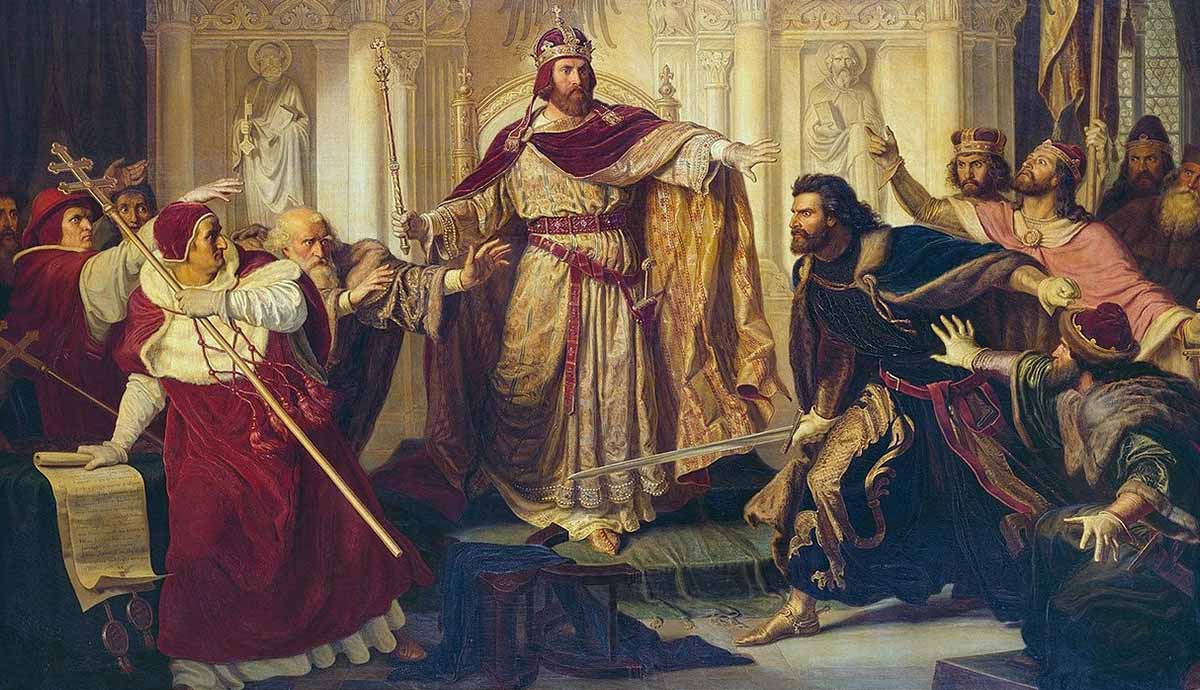
After his election as emperor in 1152, Frederick I Hoenstaufen, later nicknamed Barbarossa (Redbeard), set out to restore the imperial rights in Italy, where the northern communes had increasingly claimed their independence from the empire. The result was a long struggle with the papacy, with the popes seeing Frederick Barbarossas policy in the peninsula as a challenge to their authority. In a series of six Italian campaigns, the emperor and the popes clashed over political and theoretical matters, with each side vying for prestige and authority in a dualistic 12th-century society.The Empire & the Papacy in the High Middle AgesEnamel panel depicting the investiture of a bishop, ca. 1160/1170. Source: Museum of Art and Crafts HamburgThe High Middle Ages (1000-1300) saw the empire and the papacy battle for supremacy in a struggle centering on matters such as power, legitimacy, and the spheres of secular and spiritual jurisdiction. In the late 11th century, this conflict reached its peak with the Investiture Controversy, the result of a series of sweeping reforms of the church introduced by Pope Gregory VII.Seeking to claim the independence and supremacy of the papacy, in the 1075 Dictatus Papae, Gregory VII asserted the pope alone might use the imperial insignia, depose emperors, and appoint bishops. The popes statements, a revival of the theory identifying the empire as the secular arm of the church, were a challenge to imperial authority and a denial of the sacred character of the emperor.In the ensuing Investiture Controversy, a conflict ostensibly centering on the authority of lay rulers to invest (appoint) bishops and abbots, the pope and the emperor both claimed primacy over Christian Europe.St. Peters Cathedral in Worms, where Henry V and Callixtus II signed the 1122 Concordat of Worms. Source: Wikimedia CommonsThe conflict came to an end in 1122 with the Concordat of Worms, a compromise signed by Emperor Henry V and Pope Callixtus II. By the terms of the concordat, the clergy would appoint bishops and abbots. However, the emperor would be allowed the right to settle contested elections. Additionally, to emphasize the distinction between the spiritual and temporal sides of a prelates office, the emperor was authorized to invest prelates with the regalia only after their election by the clergy.While the Concordat of Worms settled the investiture struggle, the conflict between the papacy and the empire was far from over.Frederick Barbarossa, the Papacy, & the Italian CommunesFrederic I Barbarossa and his sons, King Henry VI and Duke Frederick VI. Source: Wikimedia CommonsThe son of Frederick II, duke of Swabia, of the Hohenstaufen dynasty, and Judith, daughter of the duke of Bavaria, of the Welf line, Frederick Barbarossa succeeded his father as duke of Swabia in 1147.Five years later, he was elected German king in the hope that, being related to the rival Hohenstaufen and Welf dynasties, he would be able to mend the kingdoms internal divisions. Thus, in March 1152, Frederick succeeded his uncle Conrad III as emperor of the Holy Roman Empire.From the beginning, the new emperor made it clear his intention to restore the imperial rights in Italy and challenge the supremacy claimed by the papacy over the empire. In open violation of the Concordat of Worms, for example, he filled a number of vacant episcopal sees with candidates of his own choosing.Meanwhile, Pope Eugenius III was enmeshed in a struggle with Italian radical reformer Arnold of Brescia, who had taken control of Rome and openly criticized clerical corruption and the temporal power of the clergy.Topography of Milan in 1158, by Domenico Aspari. Source: Wikimedia CommonsIn 1153, Eugenius III signed the Treaty of Constance with Frederick I, promising to crown him emperor and maintain the imperial rights in northern Italy, where the Lombard communes had grown more powerful. In exchange, the emperor promised not to alter the status quo in the Italian peninsula without the consent of the papacy and to recognize the papal supremacy. The agreement, however, did not hold, and the empire and the papacy soon resumed their struggle.Situated in the Po River Valley, a key transit point for the trade routes between the Mediterranean and trans-Alpine Europe, the Lombard towns had significantly increased their prosperity by the 11th century. Overthrowing their feudal ruler, towns like Milan, Bergamo, Cremona, and Brescia self-proclaimed themselves as comuni (communes), or self-governing municipalities.A Bad Translation? The Besanon IncidentFrederick Barbarossa at Besanon, by Hermann Plddemann, 1859. Source: Staatliche Kunstsammlungen DresdenIn 1155, after Frederick I defeated and arrested Arnold of Brescia, he received the imperial crown from the new pope, Adrian IV, on June 18. A lack of military backing from the German princes, however, prevented the emperor from attacking the Norman kingdom of Sicily, which was experiencing a period of crisis. When the new king, William I, managed to regain control of the kingdom, he signed the Concordat of Benevento with Adrian IV, whereby the pope, in violation of the 1153 Treaty of Constance, granted Sicily and the principalities on the southern mainland to William I.As relations between the emperor and the pope worsened, an open conflict broke out in 1157 at the Diet of Besanon in France, when the translation of a specific word in Adrian IVs letter to Frederick I provoked outrage among the German delegates.In the missive, delivered by Cardinal Roland (Rolando) Bandinelli, Adrian IV reminded the emperor how joyfully thy mother the holy Roman church received thee in a former year, adding he intended to confer on him even greater benefices (beneficia).Pope Adrian IV. Source: BnF Gallica Digital LibraryThe Latin term beneficia, which could mean either offices or favors, was translated by the imperial chancellor Rainald of Dassel as fief. Thus, the implication was that the empire was a benefit to be granted by the papacy, making the emperor a de facto vassal of the pope. Cardinal Bandinelli later attributed the incident to a bad translation. However, the ambiguity of the term had already led to a heated controversy.In the so-called 1157 Manifesto of the Emperor, Frederick I declared that the kingdom, together with the empire, is ours by the election of the princes from God alone, thus emphasizing the secular foundations of the Holy Roman Empire. He further remarked that whoever shall say that we received the imperial crown as a benefice from the lord pope, contradicts the divine institutions and the teaching of Peter, and shall be guilty of a lie.Frederick Barbarossa & Pope Alexander IIIPope Alexander III, by Artaud de Montor, 19th century. Source: BritannicaTo make matters worse, the following year, Emperor Frederick Barbarossa launched his second campaign in Italy to restore the rights that the Lombard communes had usurped. The campaign was part of his plan to create a strong empire, where a network of imperial officials was to put into effect a systematic financial administration throughout the imperial territories.After conquering Milan in September 1158, Frederick Barbarossa met with the representatives of the Lombard communes on the plain of Roncaglia, a small town on the south bank of the Po River near Piacenza (Emilia-Romagna). At the end of the Diet of Roncaglia, Frederick defined the royal rights in the Constitutio de regalibus, a decree detailing all regalia (prerogatives) belonging to the emperor, including the right to collect taxes, wage war, control trade routes, and appoint judges, aimed at reducing the communes autonomy.The plan to secure direct control of the Italian territories antagonized not only the communes but also the papacy, as it threatened the popes political and territorial interests. In 1159, after the death of Adrian IV, in a highly contested voting session, Frederick sought to secure the election of Cardinal Octavian, a candidate favorable to his Italian policies. While only a minority of cardinals voted for Cardinal Octavian (Pope Victor IV), the majority chose Cardinal Bandinelli, a strong opponent of the emperors claims in Italy, who became Pope Alexander III.Frederick I, from a miniature in the Vatican Library, 13th century. Source: BritannicaThe result was a schism. At the 1160 Council of Pavia, in the absence of Alexander III, Frederick Barbarossa officially recognized Victor IV as the true pope, initiating a 17-year-long struggle with the papacy and its allies: the Lombard communes. In the same year, Alexander III excommunicated the emperor, and, in 1162, fled to France as Frederick Barbarossa attacked and destroyed Milan and the nearby Crema with exceptional brutality.Meanwhile, from his exile in France, Alexander III managed to secure the support of the French and English rulers in his anti-imperial struggles. In 1164, upon the death of Victor IV, a new imperial candidate, Paschal III, was quickly elected. However, Frederick Barbarossa failed to pry Henry II of England away from his alliance with Pope Alexander III. Then, two years later, when King William I of Sicily, a key ally to the papacy, died, the emperor decided to launch a fourth Italian campaign, seeking a decisive solution to the conflict with the papacy and the Italian communes.The campaign, however, ended in disaster as an outbreak of malaria in the emperors army prevented his forces from reaching Rome. In the face of the renewed threat, Alexander III formed with the Lombard communes the anti-imperial Lombard League, a move that increased Frederick Barbarossas isolation in Italy.The Lombard League & Frederick Barbarossas Last YearsBattle of Legnano, by Amos Cassioli, 1860-70. Source: Web Gallery of ArtIn 1176, the opposing imperial forces and troops of the Lombard League clashed at the decisive Battle of Legnano, where Frederick Barbarossa, without the military backing of Henry the Lion, duke of Saxony and Bavaria, suffered a defeat. After signing the Treaty of Agnani with Alexander III, Frederick I then finally acknowledged him as the true pope at the 1177 Peace of Venice.After a six-year truce with the Lombard cities, Frederick renounced the regalia claimed in the Constitutio de regalibus, thus granting the Italian communes their liberties, at the 1183 Peace of Constance. However, he managed to retain their fealty to the imperial crown. The communes saw the Constance agreement as the final acknowledgement of the legitimacy of their governing bodies.Frederick Barbarossa submits to the authority of Pope Alexander III, detail from a fresco by Spinello Aretino. Source: Wikimedia CommonsA year later, Frederick Barbarossa launched his sixth and last expedition in Italy, where, in a diplomatic turnabout, King William II of Sicily agreed to a marriage between his aunt, Constance of Altavilla, and his second son, Henry. The marriage gave the Hohenstaufen dynasty a claim to the throne of Sicily, greatly alarming the papacy.Frederick Barbarossa, however, did not live long enough to see the result of his renewed efforts to secure the imperial crowns hold in Italy. He drowned on June 10, 1190, while crossing the Saleph River in Anatolia during the Third Crusade, inspired by the fall of Jerusalem, which had been conquered in 1187 by Saladins forces.











 English
 Arabic
 French
 Spanish
 Portuguese
 Deutsch
 Turkish
 Dutch
Dutch
 Italiano
 Romaian
 Portuguese (Brazil)
 Greek
Greek