Conservatives and Nazis in Weimar Germany: Dancing With the Devil
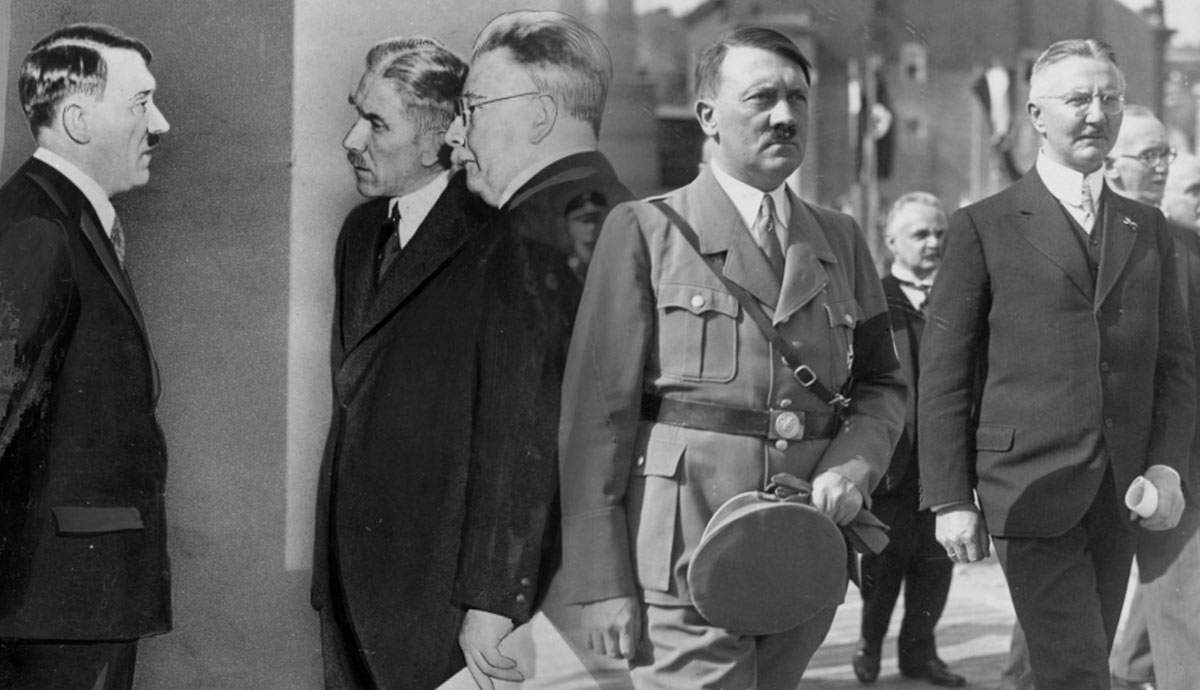
Towards the end of the 1920s, the right-wing Establishment of Weimar Germany allied with the Nazi movement. They hoped to use the Nazis popular support to banish left-wing parties from government. Mistakenly, the Establishment believed that the Nazis could be tamed. All the signs of the Nazis extreme radicalism and unwillingness to be a junior partner in a right-wing coalition were ignored. In the end, the beast that the Establishment had hoped to tame consumed it and took up residence at the helm of the German state.The Nazis and the EstablishmentHitler with Crown Prince Wilhelm, son of the deposed Emperor Wilhelm II and supporter of the Nazis, 21 March 1933. Source: Das BundesarchivBetween 1912-20, the German Right went through a period of transformation. The traditional conservatism of the nobility was replaced by agrarian economic and Pan-German ideological agendas. During this watershed period, there was a conflict between the old right and the new right. However, the threat of the Left in the emerging era of mass politics gave incentives to the various groupings on the Right to coalesce.While organizational unity remained elusive, greater strides were made in terms of ideological unity. A new, shared ideology emerged: based on an ethno-nationalist, anti-particularist populism. In this ideology, the will of the people overshadowed the old emphasis on harmony between estates (Eley, 1990). Organizational disunity continued throughout the 1920s until the Nazi Party began to show signs of its capacity to appeal to the masses and unite the Right.The taming strategy was a strategy employed by the right-wing Establishment, who hoped to tame the Nazis by saddling them with the responsibility of government. However, the Establishments attempts to tame the Nazi beast were far from altruistic. Right-wing Establishment figures had hoped to use the Nazi Partys populist power to promote their own political agendas and weaken the Left. Hitler encouraged the delusions of those on the Right who thought the Nazis were their friends. Many in the aristocracy, for example, had hoped that through him, the nobility [would] once more become a political estate (Noakes, 1990).Underestimation of Hitlers ambition led the Establishment to overlook the danger of elevating the Nazis and allowing them entry into the halls of power. A rare voice of reason (Ewald von Kleist-Schmenzin) warned against this course of action, though his words were not heeded: Do not think that when you board an express train, the driver of which is deranged, you can somehow take over the controls.Schacht, Hitler, and the Desire to Reshape GermanyHitler with Hjalmar Schacht, May 5, 1934. Source: German History in Documents and ImagesOriginally a member of the liberal Deutsche Demokratische Partei, Hjalmar Schacht was a longstanding member of the political Establishment who had drifted increasingly to the Right. An entry in his autobiography expresses the two central assumptions at the foundation of the taming strategy. Firstly, that Hitlers growing popularity could be useful to the right-wing Establishment. Secondly, that participation in government would tame the Nazis.Having met with Hitler on January 5, 1931, Schacht was convinced that his power of propaganda would have a tremendous pull with the German population Following the experience of this evening. He continued, I took the opportunity during the ensuing weeks of urging the Chancellor and other politicians with whom I was in touch to incorporate the National-Socialists in a Coalition Government as soon as possible In a coalition, so far as one could foresee, National-Socialism might have been kept within reasonable bounds by having to share the responsibilities of government (Schacht, 1955).However, the center-right Chancellor Bruning proved resistant to entering into coalition with the National Socialists. Later that year, a disillusioned Schacht joined with Hitler at the far-right Harzburg Front rally. There, he voiced his opposition to those in power and the Republican system more broadly. The right-wing Establishment in interwar Germany had long yearned for a return to a more dictatorial, less democratic form of government. However, they had failed to gain the mass support needed to realize this goal.Hitler and the Nazi movement had the capacity to reach sections of society that Establishment figures had struggled to appeal to. For the right-wing Establishment, an alliance with Hitler seemed to be an opportunity to gain a popular mandate to reshape Germany as they saw fit.Collaborating With the Nazis: Hugenberg, Schleicher, and GroenerHitler, Hugenberg, and Papen, January 1933. Source: Hitler ArchiveAlfred Hugenberg was a powerful businessman and media magnate. In the late 1920s, he took over the leadership of Germanys largest right-wing political party, the Deutschnationale Volkspartei (DNVP). He transformed it, turning it into a hub of fundamentalism. Hugenberg was one of the earliest Establishment figures to collaborate with the Nazis. First, they worked together to campaign against the German governments payment of reparations to the victors of WWI. Later, they joined up as part of the ultra-right Harzburg Front, forming a national opposition to the center-right government.Like Schacht, Hugenberg recognized Hitlers capacity to reach the masses and was determined to use it to further his own political agenda. However, his hopes that Hitler would be happy as a junior partner in a coalition of the Far-Right were bitterly disappointed. Hitler soon outgrew his former patron and swiftly went on the attack, successfully branding the DNVP as rich, reactionary, and out of touch.In 1932, the Prussian Minister of the Interior ordered police to investigate the Nazis paramilitary the SA. They found evidence that the National Socialist paramilitary was planning a coup if Hitler achieved a parliamentary majority in the next elections. This discovery increased pressure on the government to impose a ban on the SA. However, the Nazi paramilitary had friends in high places.General Kurt von Schleicher, a military man and politician, wished to integrate the SA into the state military. On April 24, 1932, he wrote to General Groener, the Minister of Defence, arguing against a ban. He argued that the Nazis were a useful counterweight to the Left (Noakes and Pridham 1983). Although Groener still imposed a ban on the SA, he spoke favorably of giving the Nazis a role in government. The right-wing Establishment thought incorporation into government would tame the raging fire of National Socialism; how wrong they were.A False Sense of Security: Trying to Settle HitlerA satirical cartoon showing a subservient Hitler showing up to work for Papen, by Karl Arnold. Source: Wikimedia CommonsOn June 1, 1932, Franz von Papen was made Chancellor of the Reich. Papen was picked for his closeness to President Hindenburg and his pliable nature, as part of a plan devised by Schleicher. Seeking to form a right-wing government with Papen as Chancellor, Schleicher had negotiated with Hitler to secure his support. He wanted a promise that the National Socialists would tolerate Papens government. In return, Schleicher proposed to lift the recently imposed ban on the SA and call new elections.Papen is recorded as having basked in the glory of his new position in the most ridiculous way, fussing around, kissing the hand of this lady here and that lady there, complacent and conceited. Schleicher was in a similarly confident mood, talking to too many and too much about how he [proposed] to settle Hitler (Kessler, 1971).Far from being in control of the situation, Schleicher was in fact being played by the Nazis. Hitler and the SA were the chief beneficiaries of Schleichers intrigue. The lifting of the ban on the SA left them free to go ahead as they liked. The promise of new elections gave the Nazis another opportunity to roll out their unmatched propaganda machine and pursue their goal of becoming the largest parliamentary party. Moreover, Hitler refused to give any written guarantee that he would support Papens government.Clearly, Schleicher had overestimated his capacity to settle Hitler and had underestimated the single-minded determination of the Nazi movement to become the sole ruling power in Germany. From the beginning, their plan was to eradicate, engulf, or criminalize all other political agendas.Electoral Success and IntrigueReich President Paul von Hindenburg Receives Newly Appointed Reich Chancellor Adolf Hitler, January 30, 1933. Source: German History in Documents and ImagesOn July 31, 1932, the Nazi Party became the largest party in parliament for the first time, winning 37% of the vote. After their resounding success at the polls, they saw no reason that they should play second fiddle to the Establishment. In their eyes, the people had chosen them. President Hindenburg hoped to tame the Nazis by giving them a role in government. Hitler rejected this offer: notes from a meeting with the President record that he demanded the full and complete leadership of government and state for himself and his party (Noakes and Pridham).The Establishments plan to co-opt the Nazis had failed and left the newcomers in a stronger position. Hitler had never been willing to take the subordinate role in a coalition; the taming strategy was a dangerous chimera that had been doomed from the start.Having masterminded the rise of Franz von Papen, Schleicher then oversaw his fall, taking the role of Chancellor for himself. Papen resented this turn of events and sought to return to power. Hitler promised that if he was elected chancellor, Papen and his followers could serve as ministers in his government. Papen successfully lobbied President Hindenburg, and Hitler was made Chancellor. Hindenburg died soon after, clearing the way for Hitler to become President, then Fhrer, with full dictatorial control over Germany.Just over two years after Schleicher had spoken freely about how he proposed to settle Hitler, he and his wife were assassinated by the Nazis during the Night of the Long Knives, the purge of the SA and other internal opponents of the Nazi Party. The Establishment thought that through collaboration it could tame the Nazi beast and harness its power. Instead, the beast grew stronger. The Nazis devoured the Establishment that had tried to tame it, giving rise to a new state in their own image.BibliographyNoakes, Jeremy; Pridham, Geoffrey (eds.). Nazism 1919-1945: Volume 1, The Rise to Power 1919-1934, (Exeter, 1983).Kessler, Harry. Berlin in Lights: The Diaries of Count Harry Kessler (1918-1937), (London, 1971).Dillon, Chris (ed.), BKF Source Pack (London, 2024).Schacht, Hjalmar. My First Seventy-Six Years: The Autobiography of Hjalmar Schacht, (London 1955).Blinkhorn, Martin (ed.), Fascists and Conservatives: The radical right and the establishment in twentieth-century Europe (London, 1990).









 English
 French
 Spanish
 Portuguese
 Deutsch
 Turkish
 Dutch
Dutch
 Italiano
 Russian
 Romaian
 Portuguese (Brazil)
 Greek
Greek