The Chamorro in WWII & the Battle of Guam
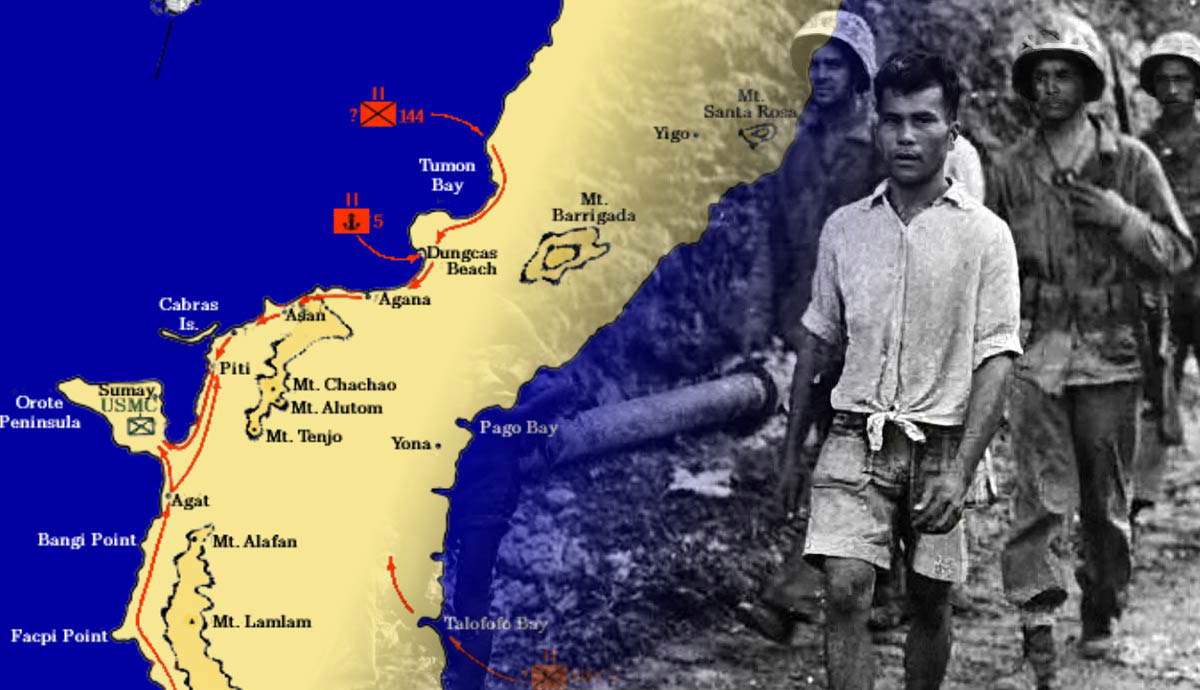
The Chamorro people are a Malayo-Indonesian ethnic group native to the Mariana Island chain in the central Pacific. They mostly reside on the island of Guam, a US overseas territory. During the Second World War, they found their home to be a battleground between the United States and Japan. The experiences and suffering at the hands of the Japanese occupiers and the destruction of much of the island during the subsequent American invasion are an important tale that helped shape their identity as a people.Who Are the Chamorro People?Chamorro mayor in the Guam Liberation Day Parade, 2018. Source: Knox NewsFor nearly 4,000 years, the Chamorro people (also spelled CHamoru) have resided on the island of Guam and some other islands in the Marianas archipelago. For centuries, they built a robust seafaring culture to ensure their survival and protect themselves from external occupiers. Archaeologists believe that they have roots in Indonesia and Malaysia. Their culture was influenced by other people they came into contact with: other Pacific islanders, the Spanish, the Japanese, and the Americans. While there have been changes through the centuries, much of their culture and identity has remained unchanged since their first arrival in the Marianas.Before they embraced Catholicism, Chamorros believed that the world around them was full of spirits known as taotaomona who provided both daily protection and assistance in their tasks, but also created dangers and problems. In the 1500s, explorer Ferdinand Magellan arrived in the Marianas, leading to the first contact with the Europeans. The Chamorros drove his ships away and it was not until the 1660s that Spanish ships landed in Guam and launched a brutal war of conquest, which meant that only 5,000 Chamorros survived by 1700.While Spanish rule led to mass conversion to Catholicism and changes to the Chamorro language, Chamorro culture and lifestyles survived. The population rebounded after 1700. Madrid had little interest in settling the islands, and only Caroline islands natives were allowed on Guam besides the Chamorro. This was the state of affairs when America seized Guam in 1898.US Occupation of Guam Before 1941USS Charleston, the ship that seized Guam, in drydock, 1890. Source: NavSourceA combination of imperial ambition and outrage after the explosion of the USS Maine in Havana harbor led to the Spanish-American War in 1898. The US Navy had long aimed to have a series of bases in the Pacific to extend its reach towards Asia. On June 20, 1898, the USS Charleston anchored in Agaa Bay and its captain demanded surrender from the Spanish garrison. The garrison did not resist, thinking that Spain and the US were still at peace. Within a couple of days, the Spanish formally surrendered the island, ending centuries of Spanish rule.Most Chamorros had no idea what to expect of the American occupation. The Treaty of Paris in 1898 formally transferred control of Guam to the US, designating the island as an overseas territory. However, the territory did not become a state due to a controversial set of Supreme Court rulings known as the Insular Cases. Dating from the early 1900s, the Insular Cases claimed that territories seized from Spain were not suitable for democratic government because their inhabitants were savages.Like the Spanish, the American presence on Guam was initially very limited. The US Navy did use the island as a fueling stop but did not have major dockyard facilities there. Life was slightly better for the Chamorros; in 1933 they received voting rights in local elections and the writ of habeas corpus under a set of codified laws passed by the US-appointed governor. This lasted until the coming storm.The First Battle of Guam, 1941Map of the Japanese invasion, 1941. Source: Wikimedia CommonsA major part of Imperial Japans plan of conquest after Pearl Harbor included seizing several islands in the central Pacific. Their motives were somewhat similar to the United States: to use the island as a staging point for future expansion. Japan also wanted control of the islands resources and Guam was to be a part of the Greater East Asia Co-Prosperity-Sphere.One hour after the Pearl Harbor attacks started, Japanese carrier aircraft started striking American targets on the island, launching the First Battle of Guam. The defenses were very weak due to a shortage of funds for American garrisons in the Pacific. Guams military contingent consisted of 274 sailors, 153 Marines, and 120 Insular Force guardsmen, many of whom were Chamorros. On December 10, 400 Japanese marines landed and drove the American and Guamian defenders inland.The governor of Guam, USN Captain George McMillin, knew that the garrison had no chance to resist. After offering some token resistance, McMillin ordered the garrison to lay down their arms after two days, fearing total annihilation of the garrison and civilian population. 19 Americans and Guamians were killed and 42 wounded in the short battle. Some 5,500 Japanese were landed over the following days to take over the American fortifications. This battle enabled Japan to establish firm control over the entire Marianas chain. It also heralded a new era for the Chamorro people.Japanese Occupation PoliciesTwo Chamorro women pass a Japanese sentry on Guam, 1942. Source: National Park ServiceDuring its 31 months under Japanese occupation, Guam was ruled by a Japanese military government supported by a few thousand soldiers, sailors, and marines. The Japanese expanded the islands airfields and developed the port facilities to accommodate warships and submarines to support operations to the east of the island. Unlike Saipan or Tinian, Guam did not have a large Japanese population on the island to support the military administration.The Japanese briefly renamed the island Great Shrine Island and sought to incorporate it into its Pacific empire. Under Japanese occupation, locals were required to have a white paper to be allowed to move around the island. Food was rationed to feed the garrison and a curfew was in place every day. Anyone who violated the rules or was accused of assisting the Americans was brutally tortured or murdered. However, most Chamorros were allowed to go about their daily lives without harassment for much of the war. While the Japanese made an attempt to encourage locals to adopt the Japanese language and culture, this had little impact.As the Americans advanced closer to the Marianas, Japanese attitudes started to change. The garrison drew larger and their commanders grew more paranoid. In July 1944, the Japanese ordered 18,000 civilians (mostly Chamorros and some others) into concentration camps in the Manenggon Valley. Japanese forces tortured and murdered anyone who refused. They remained there until their liberation by American troops.Chamorro Resistance to Japanese RuleStained glass image of Father Jesus Baza Duenas, 2009. Source: findagrave.comMany Chamorros resented the Japanese occupation and resistance was common, especially as liberation grew near. Their resistance was not like their Filipino counterparts; it was mostly nonviolent and small in scale. Nonetheless, it was crucial for the islanders to resist in order to maintain their dignity, help the Americans, and ensure their survival.After the surrender in 1941, six American sailors escaped into the center of the island, fearing Japanese captivity. American radioman George Tweed was one of them. For a brief period, he wrote an underground newspaper for the Chamorro. He was hidden on a ranch after the other five were caught and executed. Right before the American landings, he was rescued by an American warship. Japanese patrols had spent the war hunting him, but the locals managed to protect him.In order to control the island, the Japanese relied on collaborators, mainly Chamorros brought there from Saipan. They also allowed two priests to preach to the locals in an effort to earn their cooperation. One of them, Father Jesus Baza Duenas, publicly denounced Japanese rule and refused to collaborate with them. In their frustration, they murdered him and his nephew. Today, he is considered one of Guams most important martyrs of the war.Desperate for news, Chamorros began creating a network of illicit radio stations in small villages in Guam. Owning a radio not tuned to a Japanese frequency was a serious crime and risked capital punishment. Despite such risks, the Chamorros were encouraged by reports of an American invasion to liberate the island in the summer of 1944.The Second Battle of Guam, 1944A group of Chamorro with US Marines, 1944. Source: Micronesian Area Research Center at the University of GuamThe Second Battle of Guam began on July 21, 1944 when US marines and soldiers assaulted the beaches on the western side of the island as part of Operation Forager. For two weeks, the US Navy had been shelling and bombing Japanese fortifications across the island. 59,000 American attackers faced off against 18,000 Japanese defenders in a brutal battle that lasted a month. By the end, around 3,000 Americans died and the Japanese garrison was pretty much wiped out.For the Chamorros, the battle was a nightmarish experience. Unlike the Japanese takeover in 1941, this battle destroyed much of the island, including historical sites. The conditions in the camps at Manenggon worsened and Japanese soldiers suspected the locals of aiding the Americans. Part of the collective punishment of the islanders involved them being forced to build fortifications for the Japanese. Refusal could lead to death. Many people prayed that they would not get killed in the crossfire. Others were concerned that the Americans did not know where they were.Local resistance continued through the battle. American reconnaissance platoons were guided by Chamorros who knew where the Japanese positions were. Chamorros hoped that by helping the Americans, they could ensure the safety of the people in the concentration camps. They also hoped to identify Japanese stragglers after the war was over. Many American commanders credited the locals with helping them win the battle. The liberation allowed people to go back to their homes and rebuild their lives.Reparations for the Chamorro PeopleMaria Pablo receives her reparations check at the Governors Complex, 2020. Source: GuampediaThe Chamorro people suffered terribly under Japanese occupation, especially in 1944. Over 1,000 Chamorros died as a result of battle, Japanese atrocities, and diseases. The survivors also suffered severe psychological trauma following their experiences. Naturally, at the end of the war most Guam residents demanded reparations for their suffering. This proved to be a difficult struggle that lasted many decades.Since Guam returned to being a US territory, people there were not eligible to apply for Japanese reparations payouts. Those were only for people living in independent states after the war. For decades, the Chamorros insisted that they receive compensation for their wartime suffering. The US government did not push the issue because it wanted to preserve its new relationship with Japan. The Japanese did not express an interest in offering any more money than it was already giving. This kept the Chamorros in limbo for decades.In the 21st century, this all changed. The US Congress decided to pay the Chamorros directly instead of demanding Japan pay more reparations. The Guam World War II Reconciliation Act of 2021 mandated funds for people who survived the war. If survivors applied for restitution, they could receive it. By 2023, $4.13 million had been issued to survivors and their families. This marked a measure of closure for a people who suffered terribly during the Second World War and stayed loyal to the United States since then. The Chamorro story was one of horror and resilience in the face of cruelty.








 English
 Arabic
 French
 Spanish
 Portuguese
 Deutsch
 Turkish
 Dutch
Dutch
 Russian
 Romaian
 Portuguese (Brazil)
 Greek
Greek