Secretive Chinese probe snaps first photo of Earth's mysterious 'quasi-moon' and it may pose a big problem
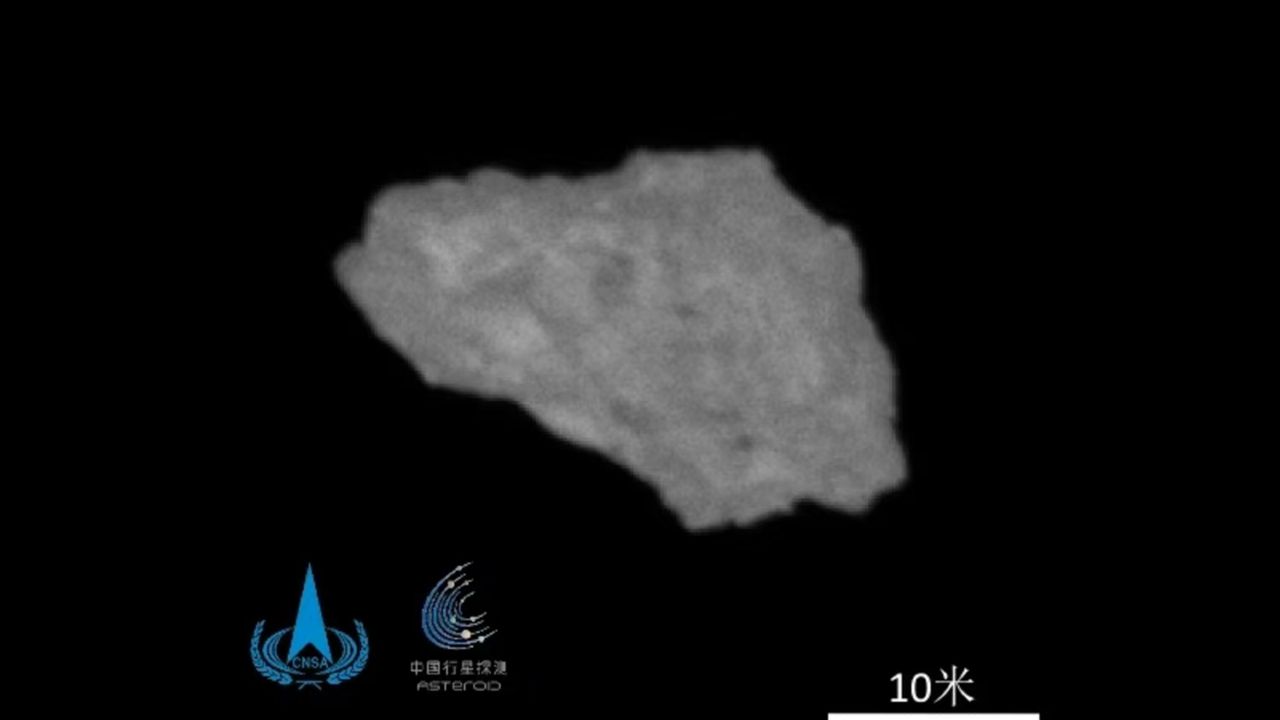
A secretive Chinese spacecraft has captured the first-ever close-up photo of one of Earth's temporary "quasi-moons" after arriving there for a potential first-of-its-kind landing. The space probe is supposed to scoop up samples from the newly imaged space rock and return them to Earth next year. However, the blurry photo and the timing of its release hint that this may be trickier than initially thought. The Chinese National Space Administration (CNSA) probe, named Tianwen-2, launched from Xichang Satellite Launch Center in southern China on May 28, 2025, according to Live Science's sister site Space.com. Its primary target is Kamo'oalewa, also known as 2016 HO3, a fast-spinning asteroid that is classified as a quasi-satellite of Earth. That means it circles the sun alongside our planet, making it appear as if it were gravitationally bound to Earth when, in fact, it isn't. (This is only a temporary association; Kamo'oalewa will eventually fall out of sync with Earth and drift away from us.)The CNSA has released minimal information about the parameters and timeline of the Tianwen-2 mission and only shared the first photo of the spacecraft several weeks after its launch. Based on one unverified timeline, Live Science previously reported that the probe had most likely arrived at Kamo'oalewa on June 7. However, Chinese officials have remained tight-lipped about the probe's progress.But on Monday (July 6), the CNSA finally confirmed that, after a roughly 400-day-long journey spanning more than 600,000 miles (1 million kilometers), Tianwen-2 is now circling Kamo'oalewa, according to the state-run news outlet Xinhua. The agency also revealed that the probe first inserted itself into the asteroid's orbit on June 7, as originally predicted.This photo of one of Tianwen-2's decagonal solar panels, captured in orbit, was the first image of the probe released by the CNSA. (Image credit: CNSA)The announcement was accompanied by the first clear photograph of Kamo'oalewa, captured at a distance of around 12.5 miles (20 km) from the quasi-moon. The blurry image suggests the space rock is around 130 feet (40 meters) across, according to the South China Morning Post, which is on the lower end of previous estimates that suggested the asteroid was up to 330 feet (100 m) wide. Initial readings also suggest that Kamo'oalewa is a rubble-pile asteroid, which means it is loosely bound together and has an unstable surface. Until now, researchers were unsure of the asteroid's composition and hoped it had a solid, rocky surface, which would have allowed the spacecraft to attempt a first-of-its-kind landing using an "anchor and drill" technique. (It now seems unlikely that this sampling method will be used.)The asteroid's small size, fragile composition and fast spin will make it harder for the probe to collect samples from the space rock's surface, even with other tried-and-true techniques. The new image also hints that there are few flat spots on the space rock where the probe could land safely. "This greatly increases the complexity of the sampling process and the risk of the mission, making it much more difficult," CNSA representatives wrote in a report, according to the South China Morning Post. Tianwen-2 launched into space May 28, 2025 on board one of China's Long March 3B rockets. (Image credit: VCG/VCG via Getty Images)The unverified mission timeline, which correctly predicted the probe's arrival date, stated that the sampling attempt would commence July 4. However, the fact that this has seemingly not happened yet further suggests that Chinese scientists are struggling to figure out how to collect their desired samples. CNSA officials wrote that the probe "will progressively conduct more detailed scientific exploration to acquire data on the asteroid's morphology, material composition and internal structure, laying the groundwork for subsequent sample collection operations."If Tianwen-2 does manage to snag some samples, the probe will release them in a capsule during a flyby of Earth in November 2027, and they will reenter the atmosphere at around 27,000 mph (43,500 km/h). This would make China the third country to successfully collect and return asteroid samples to Earth, following Japan, which returned samples from the asteroid Ryugu in 2020, and the U.S., which acquired material from the space rock Bennu in 2023.Kamo'oalewa (a.k.a. 2016 HO3) circles Earth but does not orbit our planet. This simulation shows its predicted movements relative to Earth over the next few centuries. (Image credit: NASA/Pheonix7777/Wikimedia)Researchers hope the returned samples will help unravel the secrets of the early solar system and potentially shed light on how key compounds, such as organic molecules and water, ended up on Earth. They may also shed light on the seven other quasi-moons that are currently known to co-orbit the sun with our planet.RELATED STORIESChina's top-secret 'dragon' space plane just released another unidentified object over EarthChinese satellite with robotic 'octopus arm' passes key refueling test in orbitChina launches 'human artificial embryos' to space in bid to see whether reproduction is possible off-worldSome experts previously theorized that Kamo'oalewa may be a fragment of the moon that was knocked loose from our permanent companion by an ancient meteor strike. Others have even attempted to pinpoint which crater the asteroid may have come from and hope that the samples will help confirm their hypothesis. "I am curious to find out the answer about its origin, since the debate on its [potential] lunar origin is still very open," Marco Fenucci, a mathematician at the European Space Agency's Near-Earth Object Coordination Centre who has co-authored multiple studies on Kamo'oalewa, previously told Live Science. Any returned samples should "definitely give us an answer to this matter," he added.After its close approach to Earth next year, Tianwen-2 will slingshot farther into the solar system to begin its secondary mission to study 311P/PanSTARRS a peculiar object beyond Mars that displays characteristics of both comets and asteroids in 2035.







 English
 Arabic
 French
 Spanish
 Portuguese
 Deutsch
 Dutch
Dutch
 Italiano
 Russian
 Romaian
 Portuguese (Brazil)
 Greek
Greek