Was Jaime Lannister Right? The Fatal Flaw in the Famous Code of Medieval Chivalry
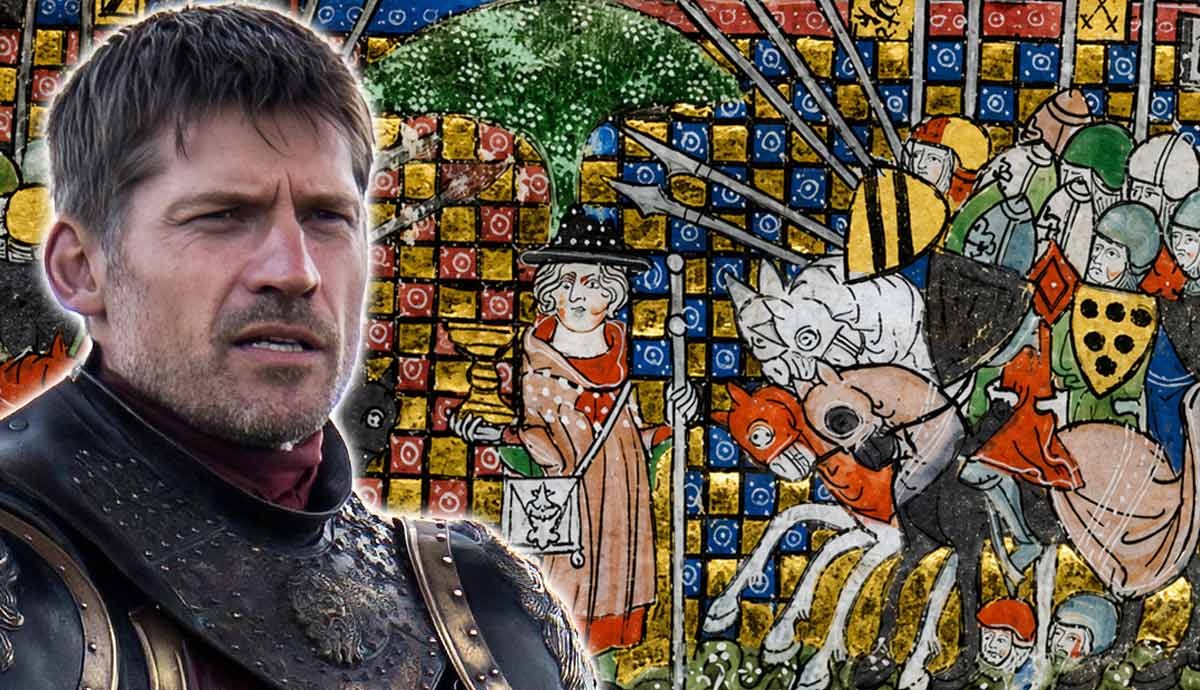
In George R.R. Martins A Game of Thrones, Ser Jaime Lannister says of knighthood that No matter what you do, youre forsaking one vow or the other. Jaimes vows put him in impossible positions, ordering him to both obey his tyrannical king and protect the weak, who his king threatens to destroy. In Westeros, the chivalric code seems impossible, but was this true of the real Medieval chivalric code? This article explores how chivalric ideals of honor, fortune, and courtly love conflicted with the violent world of the medieval knight.Great Deeds of Arms & WarfareMiniature of a pilgrim between two armies, manuscript BL Royal 20 A XVII Roman de la Rose/la Bataille dAnnezin, 1300-1350. Source: British LibraryIn the mid-14th century, a French knight named Geoffroi de Charny wrote A Knights Own Book of Chivalry, setting out the virtues and rules of good knightly etiquette. Charny addressed his work not just to an audience of knights, but to men-at-arms more generally, from the lowly foot soldier to the hardened mercenary. This indicates that chivalry may not have been reserved simply for knights, but expected of all military men.However, while this inclusivity may seem appealing at first, applying a single code to people from very different social and military backgrounds is the first clue that this chivalric code might not be particularly practical. To keep things simple, we will focus on the code as it applies to knights.Above all else, Charnys code places the greatest importance on feats of arms, which are demonstrations of skill using weaponry. Feats of arms are usually performed during tournaments and in warfare. He encourages a knight to exert yourself, take up arms, fight as you should, go everywhere across both land and sea (pg. 195). Charny presents waging war, fighting battles, and taking part in tournaments as the best way for a knight to prove his chivalric honor. Instead of labeling the knights violence as brutish, it is reframed as glorified, honorable, and righteous.However, reality does not match this idealized picture. For example, warfare is rarely noble or honorable. What might seem justified from one side may be seen as barbaric from another. The brutal and bloody nature of war and the psychological impact upon those who survive it have been recorded throughout history.(Le roi Jean la) Bataille de Poitiers (King John at the battle of Poitiers), by Eugene Delacroix, 1830. Source: LouvreThe mounted knight was at one time the most effective weapon on the medieval battlefield; the degree of damage they could inflict cannot be understated. It is therefore probable that many knights witnessed and participated in great bloodshed. There is little mention in the code of the deep mental and physical injuries that can result from warfare, or how to recover from the devastation that can result from the pursuit of glory.Another complication a knight may face is a lack of power or authority, particularly in battle. Knights were among the lowest of the upper class and functioned more as a tool for those in power to use against their enemies. Their orders were given by the higher-ranking noble they served, much the same as for mercenaries or foot soldiers. Therefore, a knight seeking chivalric honor on the battlefield may find himself in the service of one whose intentions are neither noble nor just. Caught between the expectation to obey authority and a desire to follow the chivalric code, a knight could be forced to perform deeds that were anything but chivalrous and end up losing honor in their quest to gain it.The Financial Reality of Knightly GreedModern replicas of knightly armor masks at the Rochester Medieval Festival (Son et Lumires). Source: Wikimedia CommonsWhen it comes to guidance on wealth, the chivalric code is not only impractical but also contradictory. Charny writes that one should praise and value those men-at-arms who are able to make war on, inflict damage on, and win profit from their enemies (pg. 99). This makes it seem like gaining wealth from defeating foes is chivalrous behavior and should be encouraged.On the other hand, he also advises to refrain from enriching yourselves at others expense (pg. 131). This is despite the fact that taking profit from those who have been defeated is the same as enriching yourself at the expense of others. This demonstrates just how difficult it must have been to follow the chivalric code. Adhering to one rule often meant breaking another.Charny also advises that you should not care about amassing great wealth (pg. 117), as the more wealth a knight has, the more likely he is to fear death, and fear of death is dishonorable among knights. Yet he also advises that if a knight wants to establish their good reputation, they must maintain themselves at a certain level in terms of their appearance. This refers not only to their conduct, but also their clothing, arms, and armor.Album of Tournaments of Parades in Nuremberg, late 16th century. Source: Metropolitan Museum of ArtOnce again, the chivalric code contradicts itself by discouraging the pursuit of great wealth while encouraging displays of wealth. After all, a full set of armor correctly fitted and with the embellishments to make one stand out on the tourney field was incredibly expensive. There are also the other associated expenses, such as weaponry, horses, and servants or squires.Both arms and armor were easily damaged, and repairs or replacements could be costly. Additionally, a knight would need more than one horse in case of sickness or injury and would have to provide for their upkeep. Similarly, any servants or squires would require food, shelter, and clothing appropriate to the status of the knight they served. Add in the cost of traveling in pursuit of glory, and a knight is left with little choice but to pursue great wealth if they wish to afford all of the things they need to follow their impractical code of chivalry.Real Warfare Versus Courtly RomanceThe Champion, by Sir Charles Lock Eastlake, 1824. Source: Birmingham Museums TrustTales of courtly love, such as the doomed affair between Guinevere and Lancelot, were incredibly popular during the Middle Ages. It is, therefore, no surprise that the chivalric code encouraged knights to recreate the romance of literature in real life.Just as Lancelot and Guinevere attempted to keep their love for each other secret, Charny writes that we should know for certain that the most secret love is the most lasting and truest (pg. 170). It is unclear whether Charny means a knight must keep a relationship secret or simply not tell a person that they love them. This could cause confusion, leading a knight to believe he is behaving honorably by having an affair with a married woman because he is keeping it a secret. Nonetheless, keeping a love affair under wraps was preferred, as it protected the pure reputation of the lady. However, the discovery of a secret romance, no matter how lasting or true the love, might inflict as much shame upon the knight as it would the lady.The Dedication, by Edmund Blair Leighton, 1908. Source: Wikimedia CommonsCharny also writes that the best knights marry for love over political alliance or the pursuit of wealth. The reasoning for this is that it provides heirs and saves the man and woman from sin (pg. 173). It should be noted that producing heirs and avoiding living in sin were often part of the motivation in medieval marriages, particularly among the noble classes, regardless of whether love was involved. In this, the chivalric code is aligned with reality. On the other hand, knights who pay no regard to the person when entering into the marriage, but do so out of greed for riches (pg. 173) were to be looked down upon.However, in light of the high costs of maintaining a knights lifestyle, marriage for money may have been unchivalrous, but it was certainly practical. Charny often mentions how a knight must constantly strive to achieve great deeds, yet ways to fund themselves were limited, especially for noble second or third sons who often became knights after being pushed down in the line of succession. If they adhered to the rule of not enriching themselves at the expense of others, then a marriage dowry was the only other option to secure a suitable income. A knight who refused to do either would struggle to pay for all that was required to reach the greatness he aspired to.Chivalry: An Impossible Idea?Nikolaj Coster-Waldau as Ser Jaime Lannister in Game of Thrones, by Sky/HBO, 2017. Source: HBOSo, do Jaimes complaints about knighthood reflect the real-world chivalric code?It must be acknowledged that there is still much we do not know about the details of the chivalric code or how widely it was actually practiced. There may have been many unwritten and unspoken rules within knighthood that helped make sense of chivalrys contradictions. Charnys work gives only one interpretation of chivalry, while the ideals presented would have been familiar across European noble classes.Given chivalrys tendency to contradict itself, it is doubtful that any knight would be successful in following every one of its rules. Just as Jaime said, in following one vow, you were just as likely to forsake another. Furthermore, chivalry rarely seems to reflect the complex reality of a knights world. Violence brings with it the risk of death, injury, and psychological trauma. The promise of glory and honor are not always strong enough to overcome such natural human responses. Also, the practical requirements of knighthood, such as money and the need to form alliances through marriage, could often outweigh more impractical ideals.Chivalry undoubtedly gave knights a code of conduct to aspire to, and that is no bad thing. However, its inconsistencies and impracticality meant it was far easier for a hero from Arthurian romance to follow than for the real knight living in the complex and turbulent medieval world.Find the full text of Geoffroi de Charnys Book of Chivalry here.














 English
 Arabic
 French
 Spanish
 Portuguese
 Deutsch
 Turkish
 Dutch
Dutch
 Italiano
 Russian
 Romaian
 Portuguese (Brazil)