Apollo-Soyuz Test Project: A Soviet-American Handshake in Space
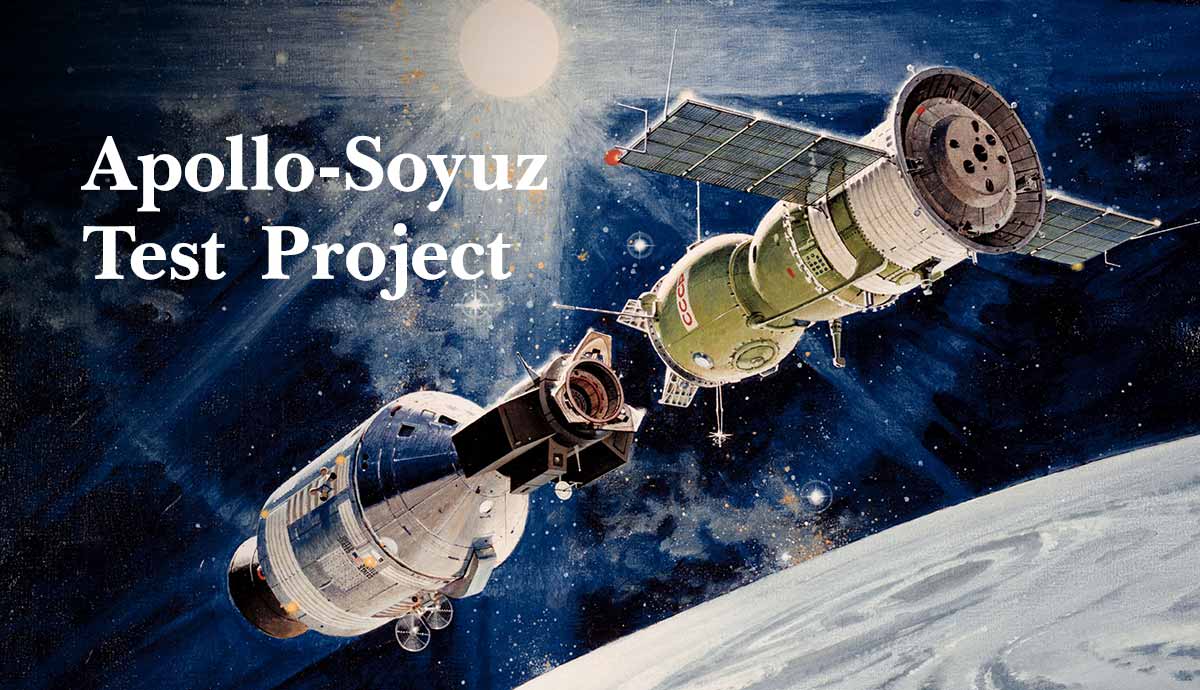
On July 17th, 1975, an American Apollo spacecraft docked with a Soviet Soyuz capsule, and two astronauts representing each side of the Cold War divide shook hands in space. The Apollo-Soyuz mission not only illustrated a profound technological innovation but heralded a new era of diplomatic detente for both sides. The Apollo-Soyuz mission also laid the foundation for future space missions between the US and the USSR and signaled a new era of scientific collaboration. Heres how the Apollo-Soyuz mission came to be.Apollo Soyuz Test Project: Planning and CoordinationPresident Nixon and Soviet Premier Alexei Kosygin signing the agreement governing the Apollo-Soyuz Test Project, 1972. Source: NASAThe groundwork for the Apollo-Soyuz mission was laid during a series of negotiations between the US and USSR in the late 1960s, as both sides sought to de-escalate Cold War tensions. These negotiations were intended to allow both sides to share meteorological and astronomical data gathered during space missions, and eventually led to the signing of the Dryden-Blagonravov Agreement in 1962. Remarkably, US President John F. Kennedy floated the idea that a Soviet crew could take part in an Apollo mission. However, after Kennedys assassination and Khrushchevs removal from office, no such mission ever took place. Regardless, the desire for joint collaboration in space and the diplomatic channels to make it possible remained.The Apollo-Soyuz mission began to take shape as the new Soviet leadership under Leonid Brezhnev sought to improve US-Soviet relations in the wake of the Vietnam War. It was seen as an essential act of peace by both sides that would symbolize a thaw in hostilities and bring about further collaboration in space. In 1972, the Authorization for Cooperative Activities in the Exploration and Use of Outer Space for Peaceful Purposes Agreement was signed by Soviet Premier Alexei Kosygin and US President Richard Nixon. This treaty laid the groundwork for a joint space mission between the two Cold War enemies.As plans for the Apollo-Soyuz mission were drawn up, NASA and the Soviets began working on the technology that would allow an Apollo capsule to dock in orbit with a Soviet Soyuz module. This cooperation was an engineering and diplomatic undertaking on a global scale, necessitating compromise and ingenuity from both parties to overcome procedural and technological gaps. To facilitate easy communication between the teams, NASA and the Soviet space program organized multiple cooperative workshops, exchanged engineering delegations, and started language training programs.Mission Objectives and GoalsThe control room during the Apollo-Soyuz mission, 1975. Source: NASAThe objectives of the Apollo-Soyuz mission extended far beyond the original diplomatic motivations. Both NASA and the Soviet Union sought to achieve a variety of engineering and scientific goals. Primarily, both sides sought to develop universal docking technology that could be used on any spacecraft that would allow two capsules built by separate space agencies to be docked and assembled in orbit. Together, both sides developed a modular system for docking that would be used in subsequent missions going far beyond the goals of Apollo-Soyuz.In addition, the mission was a vital opportunity for the conducting of various scientific experiments, including research on the consequences of extended space flight, and analysis of the Earths atmosphere. In the spirit of collaboration, both space agencies planned to conduct various experiments together and share their findings. For instance, a study conducted by both teams of astronauts regarding the levels of UV absorption within the Earths atmosphere provided valuable insights to the global scientific community and assisted both sides in future space missions.In terms of diplomacy, the Apollo-Soyuz mission was a significant step for both sides. It signified a historic reduction in tensions between the Soviets and Americans just a few years after the Cuban Missile Crisis had almost brought about a full-scale conflict. Perhaps the most significant goal of the Apollo-Soyuz mission was to establish space exploration as a neutral field free from political and ideological motivations. The success of the project helped both sides to recognize the value of collaboration and sparked a decades-long collaboration between the USSR and the USA in space exploration.The Astronauts and CosmonautsThe American and Russian Crew of The Apollo-Soyuz Mission, 1975. Source: NASA / Wikimedia CommonsThe diplomatic and scientific significance of the Apollo-Soyuz mission called for the careful selection and training of the right crew members for both NASA and the USSR. Five crew membersthree American astronauts and two Soviet cosmonautswere chosen for the mission. Due to the highly sensitive nature of the mission and the recent scandal that took place during the Apollo 15 mission, NASA carefully vetted each crew member individually.Originally, NASA astronaut Jack Swigert was assigned to command the American side of the Apollo-Soyuz mission. However, as a result of the fallout from the Apollo 15 postal covers scandal, he was barred from ever flying into space again. Instead, Deke Slayton was chosen to pilot the Apollo docking module. Slayton had previously been chosen to take part in Project Mercury but was prevented from carrying out his mission due to medical reasons. Slayton was joined by Thomas P. Stafford, who served as mission commander, and Vance D. Brand, who piloted the command module.Representing the Soviet side of Apollo-Soyuz were two veteran cosmonauts. Alexei Leonov, the first person to perform a spacewalk, was chosen as mission commander. He was joined by Valery Kubasov as the flight engineer. To enable the successful completion of the docking procedure, the five chosen crew members were given an intensive training regime. Each astronaut had to familiarize themselves with the systems and command functions of their counterparts spacecraft systems. They also had to become proficient in each others languages in order to communicate and perform the tasks of the mission properly.Technical Challenges and SolutionsThe Soyuz capsule in orbit, 1975. Source: NASA / archive.orgOne of the most significant challenges faced in the lead-up to the Apollo-Soyuz mission was the design and construction of a docking mechanism that would allow an American and Soviet space capsule to come together in Earths orbit. Not only did both sides have to contend with the different size and weight of their counterpart module, but classified blueprints and state secrets had to be shared. The eventual design of the mechanism also had to take into account the various orbital procedures and differing air pressures of the two spacecraft. The eventual design incorporated both a docking port and an airlock that would allow Soviet and American astronauts to enter into each others module.The final docking mechanism consisted of two unique parts. On the Apollo capsule, a long pole or probe was installed that would slide into a coupling mechanism on the Soviet Soyuz vessel. To make sure the mechanism worked in zero gravity, extensive testing, and simulation were carried out in a vacuum simulation chamber to ensure each part of the docking mechanism would function properly. Both the crew and the engineers had to exercise an amazing amount of precision and flexibility to do this while maintaining the relative position of their own spacecraft.The language barrier between the two flight crews also presented another major obstacle. To enable clear communication during the mission, both crews received considerable language instruction along with their counterparts on the ground. Joint training sessions were also carried out and translators were on hand to make sure that everyone on each crew could communicate clearly and perform their tasks properly.The Day of the Handshake: July 17, 1975Astronaut Donald K. Deke Slayton and cosmonaut Alexey A. Leonov, 1975. Source NASAOn July 17th, 1975, the docking procedure of the Apollo-Soyuz mission was broadcast live to millions of people around the world. Notably, the Soviet part of the mission was the first space mission of the USSR to be televised. After the Apollo and Soyuz successfully docked, Soviet cosmonaut Alexei Leonov and NASA astronaut Thomas P. Stafford made history when they crossed the threshold between the two vessels and shook hands in space.This historic handshake above the Earth represented not only the successful completion of the docking procedure, but also signaled a key moment in the Cold War dtente, as it heralded the possibility of harmony and collaboration between the two opposing superpowers. The handshake was full of symbolism as it demonstrated how human ingenuity and science could transcend the political divide. For many, it offered a positive outlook for upcoming international cooperation and suggested a possible thawing of Cold War hostilities.After the handshake, a number of planned gestures were carried out to celebrate the successful docking procedure. Flags of both nations were exchanged, freeze-dried space food was passed between both sides, and the leaders of the USA and the USSR dialed into the Apollo-Soyuz capsule to offer their congratulations.Experiments and Activities in SpaceThe Apollo-Soyuz commemorative plaque, 1975. Source: NASAAfter the successful docking procedure, both teams began a series of planned scientific experiments. The purpose of these experiments was not simply to gather useful data but to show that two crews from rival space agencies could work together to carry out observations on the same mission. One experiment was a study of the Earths atmosphere, which involved conducting experiments on UV absorption in Earths orbit. The data obtained from this study was vital as it gave new insight into the nature and composition of Earths atmosphere that would otherwise not have been possible.In addition, detailed biological experiments were carried out on the crew themselves to study the effects of prolonged space flight on the human body. The results of these experiments proved vital for further long-duration space missions. Furthermore, a study on the effects of zero gravity was carried out on a sample of fish eggs that the NASA astronauts had brought with them into orbit.After nearly two days docked together, the Apollo craft decoupled from the Soyuz, and the NASA crew maneuvered the Apollo capsule into the Suns path to create an artificial solar eclipse that gave the Soviet crew on board the Soyuz the opportunity to study the Suns solar corona. After re-docking with the Soyuz, both crews continued their experiments until the Soviet crew de-coupled and returned to Earth. The NASA team remained in orbit for three more days and conducted vital experiments on the Earths atmosphere before returning home.Apollo-Soyuz Test Project: Legacy and ImpactAn artists impression of the Apollo-Soyuz Test Project, 1974. Source: NASA/Robert McCallAs a milestone in space exploration and Cold War diplomacy, the legacy of the Apollo-Soyuz mission cannot be overstated. The success of the mission led to further collaboration between NASA and the Soviet space agency, which eventually led to further joint missions such as the Shuttle-Mir Program, and continued after the fall of the Soviet Union with the construction of the International Space Station (ISS).The Apollo-Soyuz mission showed that cooperation between the United States and the USSR was possible despite the considerable tensions between them. The success of the mission helped to create a precedent for collaboration and fostered a more cooperative international environment that further reduced Cold War hostilities.The two men who shook hands in space, Stafford and Leonov, remained friends after the Apollo-Soyuz mission was completed. Stafford made Leonov the godfather of his children and even gave a eulogy at Leonovs funeral in Russia in October 2019.












 English
 Arabic
 French
 Spanish
 Portuguese
 Deutsch
 Dutch
Dutch
 Italiano
 Russian
 Romaian
 Portuguese (Brazil)
 Greek
Greek