0 Comments
0 Shares
14 Views
Directory
Elevate your Sngine platform to new levels with plugins from YubNub Digital Media!
-
Please log in to like, share and comment!
-
A new platform gives you ChatGPT, Gemini, Claude, and more for life — now only $55A new platform gives you ChatGPT, Gemini, Claude, and more for life — now only $55 TL;DR: ChatPlayground lets you send one prompt to multiple AI models, and it’s only $55 for Deal Days. Credit: ChatPlayground AI...0 Comments 0 Shares 26 Views
-
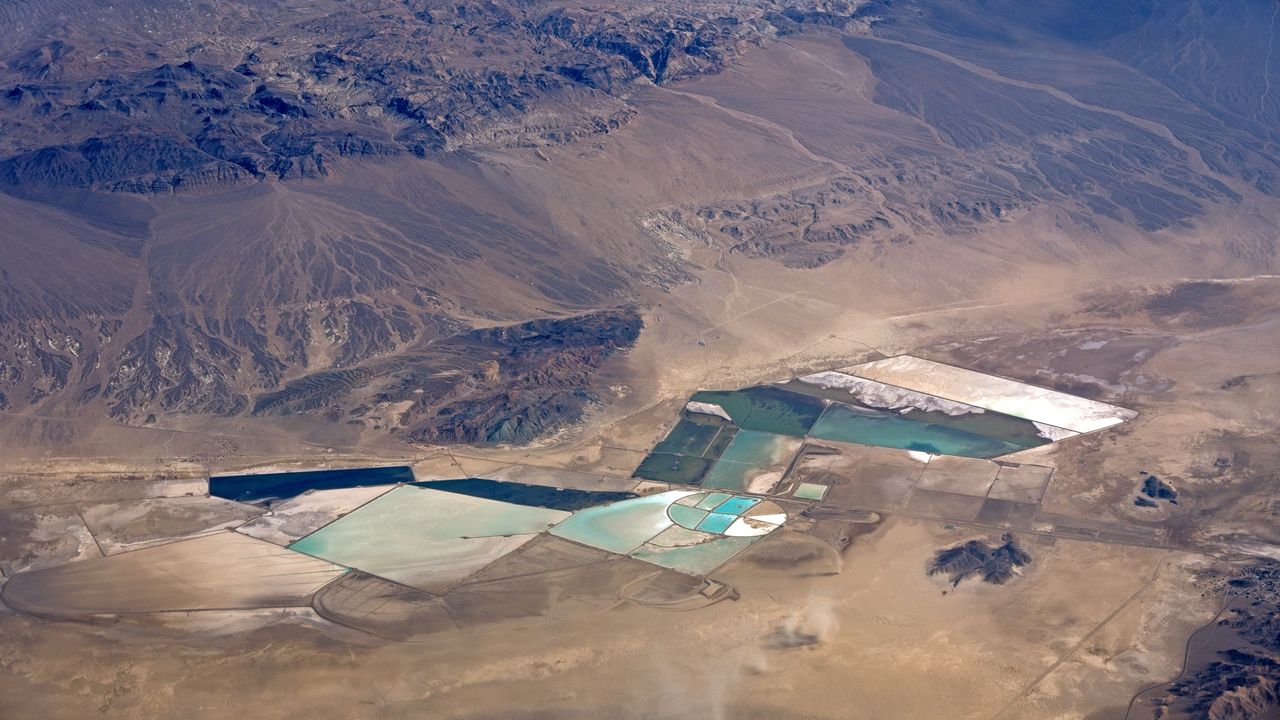
WWW.LIVESCIENCE.COMWater shortages could prevent the US from mining more lithium, deepening reliance on foreign importsGrowing water scarcity could hamper the expansion of lithium mining in the U.S., deepening its reliance on foreign imports over the coming decades, a new study finds.Lithium is used in electric-vehicle and energy-storage batteries due to its high energy density and low weight compared with other minerals, but mining it requires a huge amount of water. Currently, the U.S. has only one active lithium mine, in Nevada, and with demand for the metal projected to explode over the next few years, the government and private companies are planning to open at least 115 new mines across the country, according to the study.However, most of the proposed mines that are in advanced stages of development overlap with water-stressed areas, specifically in the western U.S. In the new study, published May 28 in the journal Communications Earth & Environment, scientists found that if lithium mines start operating in these regions, they will compete for water not only with households, agriculture and industry, but also with one another and with other proposed mineral mines."Future water availability under climate change may constrain whether new lithium mines will have sufficient water to operate," study senior author Jennifer Dunn, a professor of chemical and biological engineering and the director of the Center for Engineering Sustainability and Resilience at Northwestern University in Illinois, told Live Science in an email.The U.S. imports more than 50% of its lithium, mostly from Chile and Argentina. Policymakers and corporations want to reduce this dependence, but even with the existing Nevada mine and the 22 proposed mines that are the closest to coming online, the U.S. won't have enough lithium to meet domestic demand, Dunn said."Every mine produces a different amount of lithium depending on its deposit type, lithium grade, and final product so we are unable to determine how many mines exactly would be needed," she said. "Our analysis estimated that if all 22 advanced [stage] proposed mines and the sole operating mine continued operation into 2050, 0.14 [to] 0.25 million metric tons [0.15 to 0.28 million tons] of lithium content in products could be produced per year."This range falls short of the 0.83 million to 1.9 million tons (0.75 million to 1.7 million metric tons) of lithium per year that other researchers previously estimated the U.S. would need to cover its own demand.However, the water demand to produce more lithium would be astronomical. That's because lithium is typically extracted from brines and rocks known as pegmatites, which require large-scale evaporation and aggressive processing with fresh water, respectively.To find out if the U.S. would have enough water to support additional lithium mines under intensifying climate change, the researchers calculated the future water use of the 23 lithium mines most likely to be active in 2050, using data from mining companies. Then, they layered this projected water use on top of projected water uses from other sectors, such as agriculture and manufacturing, under four modeled socioeconomic-climate scenarios between 2040 and 2060.The researchers found that the available water supply will, in most cases, be insufficient to support new lithium mines. The starkest example was Southern California's Salton Sea, which contains roughly 4.5 million tons (4.1 million metric tons) of lithium. The Salton Sea is fed by the Colorado River and showed the least water available to support lithium mining and other water demands, owing to the river's dwindling flow.Southern California's Salton Sea has been shrinking for decades, partly because inflow from the Colorado River has declined. A deposit of geothermal brine beneath the sea area is believed to hold one of the planets largest reserves of lithium. (Image credit: Mario Tama via Getty Images)Lithium deposits in the U.S. are clustered in Nevada, Arizona and California. These are also some of the most arid and water-stressed states. Although the study found an increase in rainfall under a high emissions, "business as usual" climate scenario, these regions likely won't have enough water to support other activities, let alone additional lithium mining, Dunn said.There were four exceptions in the study, including lithium-rich sites in North Carolina and Arkansas, which may have enough water to support future mines. However, there are other concerns related to lithium mining."Many of the lithium deposits in the United States reside near federally-recognized Indigenous and Tribal reservations, and the mines could violate Indigenous rights," Dunn said. "Lithium mining could also disturb sensitive ecosystems and biodiversity. And, like many other mineral mines, pollution, soil erosion, and water contamination are concerns."Together, the findings highlight a catch-22 in the quest to source lithium: Lithium is essential to support a green energy transition and curb climate change, but shrinking water availability due to global warming is making it harder to extract lithium.RELATED STORIESScientists just discovered an enormous lithium reservoir under PennsylvaniaDays numbered for 'risky' lithium-ion batteries, scientists say, after fast-charging breakthrough in sodium-ion alternativeSalar de Uyuni: The world's largest salt desert and lithium reservoir surrounded by volcanoesThe study did not explore potential improvements to water-use efficiency that could reduce the pressure on some water resources and increase the availability for activities such as lithium mining. Nor did the researchers include water exchanges known as interbasin transfers (IBTs) in their analysis, due to the lack of studies about these transfers under climate change."IBTs could help supply water to arid or water-stressed regions," Dunn said.Still, there is likely an upper limit on how much water can be allocated to lithium mining in a warming world, according to the study. This means the U.S. will probably continue to partially rely on foreign supply chains for lithium and other critical minerals.0 Comments 0 Shares 28 Views -
WWW.LIVESCIENCE.COMNew chip harnesses quantum computing's biggest weakness and tries to turn it into a strengthResearchers have created a new chip that turns one of quantum computing's biggest frailties into a programmable feature. They say this first-of-its-kind experiment could carry implications for developing error-corrected, fault-tolerant quantum computers in the future.Unlike digital bits in a classical computer, which are represented as either "on" or "off," a quantum bit (qubit) has a much higher failure rate roughly 1 in 1,000, compared with 1 in 1 billion for digital bits. That's because quantum computers are susceptible to "noise" interference that's often cited as the biggest barrier preventing quantum computers from being more capable than the fastest supercomputers.As engineers develop quantum systems that are large enough in scale to perform useful functions, the amount of noise generally increases. Scientists can combat this noise using various error-correction techniques. But despite recent progress in this field, the challenge of developing a truly fault-tolerant quantum computer remains.That's because noise comes from various sources, many of which scientists have no control over. These include unpredictable disturbances in Earth's magnetic field, nearby radiation from Wi-Fi routers and other electronic devices, cosmic rays from space, and even neighboring qubits. This unpredictability has made it difficult to study this noise.But researchers have now devised an experiment that turns the error-correction paradigm on its head. Instead of trying to rid a quantum system of noise, they have created a chip that lets them introduce errors at will so they can examine noise and signal loss in a controlled environment. In the new study, published May 9 in the journal Nature Communications, the researchers described how this quantum computing chip uses photons captured from laser pulses as qubits. It also has what the researchers called a "side channel" that photons can be diverted to so the team could imitate the losses that occur under normal operating conditions and study them in detail."In many quantum experiments, anything that does not fit the ideal textbook picture is simply treated as loss and ignored," Govind Krishna, first author of the study and a doctoral student at the KTH Royal Institute of Technology in Sweden, said in a statement. "The chip enables us to simulate those nonideal processes in a controlled way."(Image credit: David CallahanCC by 0)The chip can be programmed to imitate errors in multiple ways, thus making it possible to simulate specific types of loss due to noise. The researchers can essentially modulate the amount of noise the system simulates in order to generate conditions for practical study. They do this by adjusting the number of photons that get sidetracked and the degree of quantum superposition, in which qubits share information over space and time through a process called quantum entanglement."The chip works a bit like a programmable railway junction for quantum light," Krishna explained. "By changing the control signals, we can decide whether the photons mostly stay on the main track, are mostly diverted to the loss channel, or end up in superpositions that depend on their quantum interference." This means the noise itself becomes an asset that scientists can use to further improve quantum computing systems, rather than trying to eliminate it.Related storiesMicrosoft breakthrough could reduce errors in quantum computers by 1,000 timesQuantum internet inches closer thanks to new chip it helps beam quantum signals over real-world fiber-optic cablesScientists trained an AI model using an IBM quantum computer and it answered questions correctly that the base model couldn'tAccording to the study, the novel chip design can model errors in any type of quantum system even a non-photonic system, like a superconducting qubit-based quantum computer or one designed with neutral atom qubits. The scientists ultimately want to give researchers more tools to study how noise infiltrates and accumulates in quantum circuits. This could, in theory, lead to a greater understanding of how to perform more effective error-correction techniques in future systems, especially as those systems scale and interact with their environment even more. "Understanding how quantum systems behave under this messiness is crucial if we want our experiments to say something about nature as it really is, not just idealized setups," Krishna said.0 Comments 0 Shares 28 Views -
WWW.PCGAMESN.COMTerraria 1.4.5.7 is finally giving my favorite weapon type the love it's deserved for yearsThere's not much you could have said to get me more excited for the next Terraria update than this. Re-Logic is currently working on a big round of balancing and additional weapon changes for the upcoming patch 1.4.5.7, with the goal of making every class feel worthwhile and fun to play. As part of that, it's finally taking a look at what is unquestionably the most fun offensive option in the sandbox indie game - yoyos. In a new Terraria State of the Game for June 2026, Head of Business Strategy Ted 'Loki' Murphy talks about yoyo upgrades, crossplay plans, and the largest hotfix in Terraria's history.0 Comments 0 Shares 10 Views -
Cryogenic Equipment Market to Reach US$ 48 Billion by 2033 from US$ 26.31 Billion in 2025Cryogenic Equipment refers to specialized systems and devices engineered to produce, maintain, store, and transport materials at extremely low temperatures, typically below -150°C. These systems are essential for handling liquefied gases, preserving biological materials, and supporting industrial processes that require precise temperature control. Common cryogenic equipment includes storage...0 Comments 0 Shares 31 Views
-
WWW.GAMEBLOG.FRRed Dead Redemption 2 : cause de GTA 6, l'une des plus grosses attentes des fans aurait t reporteAu cur de nombreuses rumeurs depuis des mois, la version next-gen de Red Dead Redemption 2 pourrait avoir t reporte par Rockstar au profit de GTA 6.0 Comments 0 Shares 10 Views -
WWW.GAMEBLOG.FRa va tre extraordinaire Battlefield 6 annonce une importante mise jour qui va tout changer, c'est ce que tout le monde voulaitBattlefield 6 se prpare accueillir l'une des mises jour les plus importantes de son existence, qui entend le transformer en profondeur pour reconqurir son public.0 Comments 0 Shares 10 Views -
WWW.GAMEBLOG.FRXbox Series: sa prochaine mise jour sera norme et va tout changer, c'est ce que voulaient les joueurs depuis longtempsIl y a du changement pour les joueuses et joueurs Xbox Series et a ne concerne pas que les prix. Ces nouveauts vont transformer votre exprience sur la console.0 Comments 0 Shares 10 Views -
Future of the North America DCSPs Market: Cloud Computing, AI Integration, and Industry Forecast 2034The North America Distributed Stream Computing Platforms (DCSPs) market holds a significant share of the global market, driven by the region's advanced digital infrastructure, widespread cloud adoption, and strong presence of leading technology companies. Organizations across industries such as banking, financial services, healthcare, retail, telecommunications, manufacturing, and media are...0 Comments 0 Shares 30 Views