10 Scandalous Marriages that Rocked Early European History
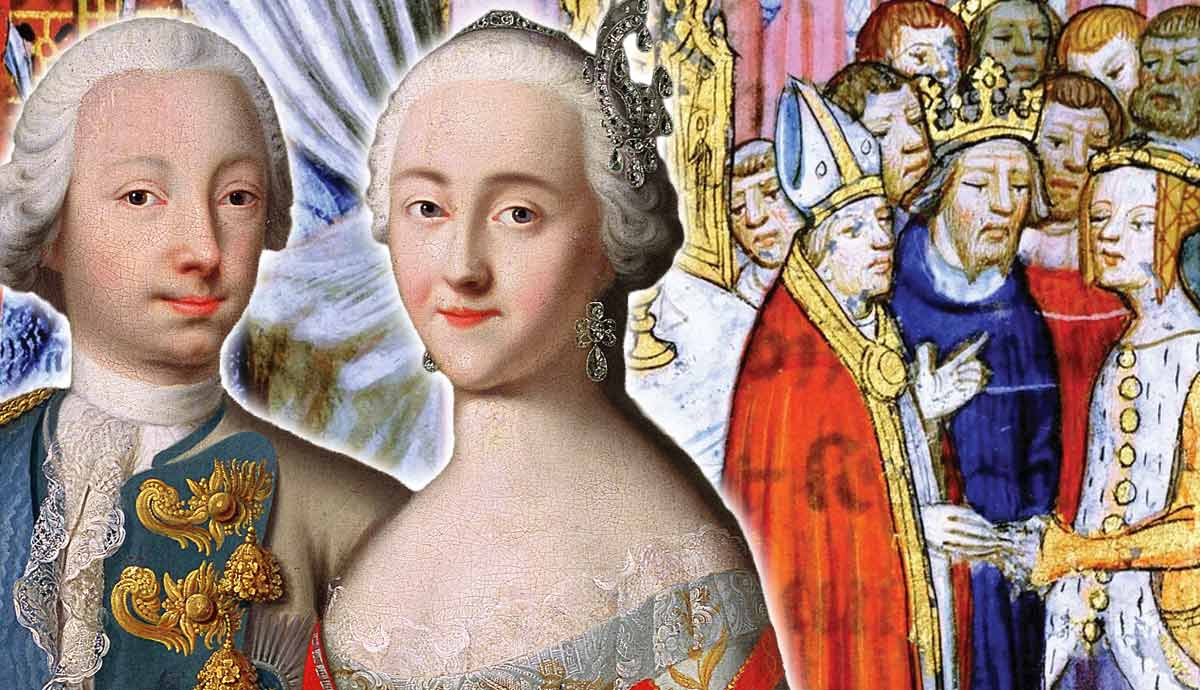
For centuries, royal marriages have been plotted by the nobility, strategized by popes, or, in rare cases, struck in the name of love. Most unions were carefully strategized like moves on a chessboard for the enrichment, protection, and stability of ones kingdom, dynasty, or empire. Yet, concubines still became sultanas, queens left their kings, and undying love turned into deranged madness. From infamous affairs that sparked Reformations, to forbidden love that dismantled centuries of custom, these scandalous marriages really question if love conquers all.1. Cleopatra and Mark AntonyCleopatras Banquet, by Gerard de Lairesse, c. 1675-1680. Source: RijksmuseumThe legendary romance of Cleopatra VII (6930 BC) and Mark Antony (8830 BC) led to the end of 3,000 years of Egyptian sovereignty, gave rise to the Roman Empire, and captivated Shakespeare. After meeting in 41 BC, the pair began a passionate and public affair that scandalized the ancient world. The former lover of Julius Caesar, Cleopatra, sought to preserve Egypts autonomy against the encroaching might of Rome. Similarly, Antony was desperate to consolidate his power against his bitter rival and co-ruler Octavian.The two wed in a lavish celebration in 37 BC, despite Antony still being married to Octavians sister, Octavia. In 34 BC, Antony conquered the Kingdom of Armenia, dividing the land between his and Cleopatras children and celebrating in Alexandria instead of Rome. Adding insult to injury, Antony declared the son of Cleopatra and Caesar, Caesarion, the true heir of Rome. Octavian publicly smeared Antony, claiming Cleopatra bewitched him away from Rome.Octavian officially declared war on Cleopatra after Antony divorced Octavia in 32 BC. He delivered a brutal blow against the pair at the Battle of Actium in 31 BC, forcing them to flee. With Alexandria encircled, Cleopatra hid in her tomb and sent a false report to Antony of her suicide. Struck with grief, Antony stabbed himself and was brought to Cleopatra. To avoid humiliation and capture, she followed suit, possibly by poisoning herself on August 12, 30 BC. Her death ended the Ptolemaic Dynasty and the Roman Republic, enabling Octavian to consolidate power and become Augustus, the first Emperor of Rome.2. Justinian and Theodora of the Byzantine EmpireMosaic of Justinianus I, Basilica San Vitale, photographed by Petar Miloevi, 2015. Source: Wikimedia Commons; with Theodora mosaic, Basilica San Vitale, photographed by Petar Miloevi, 2015. Source: Wikimedia CommonsThe marriage between Theodora (c.490/500548 AD) and Justinian I (483565) rewrote Roman law and solidified the dominance of the Eastern Roman (Byzantine) Empire. Justinian shattered norms in 525 AD by choosing his mistress, a former actress, to be his wife and co-ruler. Enthralled by her beauty, intelligence, and wit, he outmaneuvered a 500-year-old law forbidding marriage between actresses and the elite. Instead, he forced an imperial decree to amend the law, granting these unions if the actress reformed her previous lifestyle. He then elevated Theodora to the patrician rank to legally wed her.Despite infuriating his family and the aristocracy, their marriage became a dynamic force of imperial power. Trusted as his equal ruler and confidant, the pair codified Roman law, birthing modern civil law, and commissioned grand public works like the Hagia Sophia. Theodora became infamous for her dynamic politics and her ruthlessness. When Justinian wished to flee during the Nika Riots in 532 AD, she forced him to stay, fight, and order the massacre of 30,000 rioters.Yet, her contemporaries, like historian Procopius of Caesarea, never accepted or respected her rise to power. Instead, their accounts demonized her image, creating grotesque pornographies annihilating her character as a demonic and power-hungry sex fiend. In reality, Justinian revered and worshiped Theodora even after her death, never taking another lover. Her legacy is also cemented in her dedication to legal protection and autonomy for women. For example, she banned forced prostitution, freed prostitutes, and built rehabilitation centers for them, rape victims, and homeless women.3. Eleanor of Aquitaine and Henry II of EnglandWedding of Louis VII and Eleanor of Aquitaine, her previous husband before Henry II of England, by an unknown author, c. 14th century. Source: Wikimedia CommonsThe union of Eleanor of Aquitaine (11221204) and Henry II (11331189) birthed the Plantagenet Dynasty, elevating England into a formidable medieval power. However, their marriage began as an immense scandal. Prior to their wedding in 1152, Eleanor was the wife and queen of King Louis VII of France. Yet, after 15 years, no sons, mutual animosity, and multiple kidnappings from eager suitors, Eleanor annulled their marriage and married Henry within two months.Together they established the Angevin Empire, adding her inherited Duchy of Aquitaine, covering half of medieval France, to his English territories. They had eight children, including Richard the Lionheart, and three future European queens. Despite their triumphs, Eleanor supported her sons revolt against Henry in 1173. In retaliation, he imprisoned her for 16 years. Following Henrys death, Eleanor regained her influence, ruling England in place of her sons during Richards participation in the Third Crusades, negotiating his ransom, and securing the throne for her next son, John. She remained a key political figure until her death at age 82.Despite Eleanor being one of the most powerful, educated, and wealthy women in the Medieval Period, her contemporaries framed her as unholy and demonic for her independent attitude and political aptitude. Yet, these generalizations minimize how she is regarded as the most important woman of the medieval world. Likewise, her patronage of music and poetry developed quintessential themes still associated with this period, like the development of Arthurian Legends and tales of chivalry, knighthood, and courtly love.4. Queen Jadwiga of Poland and the Grand Duke Jogaila of LithuaniaBaptism of Lithuania, by Wadysaw Ciesielski, 1900. Source: Wikimedia CommonsThe union between Queen Jadwiga (c. 1373/13741399) and King Jogaila (1352/13621434) remains a pivotal moment in Eastern European history. Their marriage unified Poland and Lithuania, converted Europes last pagan stronghold, and established the Jagiellonian Dynasty. Serving as Polands first and last female monarch, Polish nobles organized Jadwigas marriage to the Lithuanian duke to counter the Teutonic Order, Hungary, and Austria. Confirmed by the Union of Krewo in 1385, they agreed to wed and unify the Polish and Lithuanian crowns in exchange for the conversion of Jogaila and his people.Adopting the name Wadysaw II Jagieo, Jogaila was baptized and married Jadwiga in 1386. Their partnership thrived with Jadwiga serving as an advantageous diplomat and Jogaila as a fierce military leader. Jadwiga additionally expanded access to education and religion, funding schools to help Lithuanian converts and establishing the first centers for Polish academia, culture, and art.However, their marriage was not rooted in love. Often portrayed as an innocent girl sacrificing all for her country, Jadwiga was only twelve when she wed Jogaila, who was ten to 20 years older. After ten years, they were able to conceive, but she and their baby died from childbirth complications in 1399. Jogaila kept the Polish throne for 35 years, defeating the Teutonic Knights in 1410 at the Battle of Grunwald and establishing the Jagiellonian Dynasty with his fourth wife. Jadwiga remains a national hero, canonized in 1997 by Pope John Paul II for her sacrifices and her devotion to her faith and nation.5. Isabella I of Castile and Ferdinand II of AragonQueen Isabella I of Spain, Queen of Castile, c. 1470-1520. Source: Wikimedia Commons; with King Ferdinand V of Spain, King of Aragon, c. 1470-1520. Source: Wikimedia CommonsThe union of Isabella of Castile (14511504) and Ferdinand II of Aragon (14521516) unified Spain and forged the first European global superpower. The pair secretly wed on October 19, 1469, defying Isabellas brother and lacking the papal support required for second cousins to wed. After merging their thrones in 1479, they unified Spain by defeating the Emirate of Granada in 1492. After completing the 800-year Reconquista, they cemented their legacy by funding Christopher Columbuss maiden voyage.Their zealous pursuit of a homogenous, Catholic nation in Europe and abroad earned them the title, The Catholic Monarchs, at the cost of untold millions. In 1478, they launched the Spanish Inquisition to persecute, torture, and execute perceived heretics. Between 1492 and 1502, tens of thousands of Jews and Muslims were forced to convert, be executed, or flee. The Monarchs also supported severe economic policies and forced conversions of indigenous populations under Columbuss governorship in Hispaniola. After years of complaints of tyranny, brutality, and the sex trafficking of indigenous children, the Monarchs arrested Columbus in October 1500. They pardoned him by December, endorsing his fourth voyage.Isabella and Ferdinand also redrew the map of European diplomacy. Their daughters were married to future kings in England, Portugal, and the Holy Roman Empire. The Monarchs cemented their strong favor with the Borgia papacy, preserving their support for their colonial endeavors. By Isabellas death in 1504, Europe was either connected to, intimidated by, or loyal to Spain.6. Anne Boleyn and Henry VIII of EnglandThe Courtship of Anne Boleyn, by Emanuel Gottlieb Leutze, 1846. Source: Smithsonian American Art MuseumThe union between Anne Boleyn (c. 1501/15071536) and Henry VIII (1491-1547) sparked the English Reformation and the first execution of an English queen. Henry became enamored with Anne in 1522 while she served as a lady-in-waiting for his wife, Queen Catherine of Aragon. After 24 years of marriage, they were unable to have a male heir. Unlike her sister Mary, Anne refused to become the kings mistress and demanded marriage.Henry pursued an annulment from Catherine to marry Anne in 1527. However, Pope Clement VII refused because Catherine was the aunt of Charles V and the daughter of the Catholic Monarchs (Isabella and Ferdinand). By 1534, Henry severed all ties with Rome, declared himself the ruler of the Church of England, executed his closest Catholic confidants, and ignited the English Reformation. Despite the Privy Council, nobles, and his spiritual advisors enabling Henry, Anne is often painted as a conniving witch responsible for the sectarian violence that ensued.Already pregnant, they secretly wed on January 25, 1533, and by June, Anne was crowned as Queen. She dutifully provided welfare, hospitals, and schools for the poor. But after multiple miscarriages, Henry blamed Anne for not producing a male heir. On May 19, 1536, he had her executed under false charges of incest, adultery, and treason. Henry famously went on to have four more wives, none of whom had a son who lived or reigned into adulthood. Despite his attempts to remove all traces of Anne, her legacy was forever cemented through the reign of her daughter, Queen Elizabeth I.7. Catherine de Medici and Henry II of FranceCopy of the Portrait of Catherine de Medici, first painted by Franois Clouet, 1580. Source: The Walters Art Museum; with Henry II, King of France, by Franois Clouet, 1559. Source: Wikimedia CommonsThe marriage of Catherine de Medici (15191589) and Henry II (15191559) oversaw civil wars, artistic revolutions, and the end of the Valois Dynasty. While the French nobility slighted Catherine as a foreign Merchants Daughter, King Francis I and Pope Clement VII organized their union on October 28, 1533, to unify the Papacy and France against the Habsburgs and Protestantism. After a decade of infertility and Henrys infidelities with his beloved mistress Diane de Poitiers, the couple had ten children. However, in 1559, Henry died in a jousting accident, thrusting his non-royal Italian queen consort into decades of regency, overseeing the tumultuous reigns of three sickly sons.Her cunning approach to legitimize her childrens rule and stabilize France during the French Wars of Religion led to her moniker, the Serpent Queen. History blames Catherine for this bloody period of civil unrest and sectarian violence despite the involvement of the Royal Council, the aristocracy, and the military. For instance, Catherine is often scapegoated as the architect of the infamous St. Bartholomews Day Massacre in 1572. But her son King Charles IX ordered the assassination of Huguenot leaders gathered in Paris for his sisters wedding, which turned into a month-long massacre, slaughtering up to 30,000 Huguenots.Often ignored is Catherines life-long dedication to stabilizing the throne, unyielding diplomacy with Huguenot leaders, and life-long patronage of the arts. She introduced the Italian Renaissance to France, birthed French ballet, commissioned iconic palaces in Paris, and even introduced the fork to French etiquette.8. Hrrem Sultan (Roxelana) and Suleiman the MagnificentRoxelana, wife of Sultan Sleyman the Magnificent, c. 19th century. Source: Wikimedia Commons; with Portrait of Suleiman the Magnificent, by Titian, 1530. Source: Wikimedia CommonsThe marriage between Hrrem Sultan (c. 15051558) and Suleiman I (14941566) revolutionized gender norms, succession, reproductive politics, and charity within the Ottoman Empire. Roxelana, an enslaved Slavic woman, was brought to the Ottoman harem in 1520. Converting to Islam and adopting the name Hrrem, Suleiman immediately fell in love with her. Breaking 200 years of custom by producing one son for the sultan, then relocating to a provincial capital, Hrrem birthed five more children, ultimately becoming his wife and co-ruler.To the shock of the Ottoman world, in 1534, Suleiman married his former concubine in the most lavish wedding of the century. She continued horrifying the elite by moving the Imperial Harem permanently to Topkapi Palace, establishing the Sultanate of Women whose political influence is often demonized or oversexualized. While Suleiman was named the Magnificent for ushering in the empires golden age, Hrrems influence has branded her as an evil seductress and witch responsible for imperial decay.Her cunning nature and suspected role in the executions of Grand Vizier Ibrahim Pasha and Suleimans firstborn son, ehzade Mustafa, further demonized her legacy. However, Hrrems brilliance and political tact made her a skilled diplomat and philanthropist. She was the first sultana devoted to supporting the most vulnerable members of Ottoman society. She commissioned new public schools, baths, and soup kitchens in Jerusalem, Mecca, and Medina. Hrrem also founded the Haseki Sultan Complex, the first women-only hospital that provided free healthcare for pregnant, poor, sick, or disabled women.9. Anastasia Romanovna and Ivan the TerribleA Boyar Wedding Feast, circa 16th-17th centuries, by Konstantin Makovsky, 1883. Source: Wikimedia CommonsThe marriage of Anastasia Romanovna Zakharyina-Yurieva (15301560) and Ivan IV Vasilyevich (15301584) preceded one of the most violent eras in Russian history. Ivans volatile childhood, scarred by boyars (Russian nobilitys) power struggles, caused lifelong paranoia. Orphaned young, Ivans mother was believed to have been poisoned when he was just eight. By age 16, Ivan was crowned the first Tsar of Russia in 1547.Ivan continued distrusting and defying the boyars, choosing his bride in 1547 from a lower-ranking family out of 1,500 candidates. Ivan fell deeply in love with Anastasia, calmed by her gentle and nurturing disposition. But, after 13 years of marriage and six children, Anastasia fell ill and died in 1560. Convinced the boyars poisoned her like his mother, Ivan suffered a complete emotional breakdown that he never recovered from. He ripped his hair out, banged his head on the floor, and sobbed uncontrollably at her funeral.His sadistic nature spiraled, earning him the nickname the Terrible. From 1562 to 1572, his secret police, the Oprichnina, terrorized and slaughtered hundreds of thousands of suspected traitors, especially boyars, rivaling Stalins purges. In 1581, Ivan beat his daughter-in-law, inducing a miscarriage, then killed his son and heir Ivan in a fit of rage. After Ivans death in 1584, the Rurik Dynasty rested upon the heirless Feodor I. Feodors death triggered a 15-year civil war that ended with the election of Anastasias great-nephew, Michael Romanov, to the throne. Through her lineage, the Romanov dynasty was established and ruled Russia until its fated end in 1917.10. Catherine the Great and Peter IIIPortrait of Grand Duke Peter Fedorovich (future Peter III) and his wife Grand Duchess Catherine Alexeevna (future Catherine II), by Georg Christoph Grooth, 1745. Source: Wikimedia CommonsThe marriage of Catherine the Great (17291796) and Peter III of Russia (17281762) is a tale of betrayal and murder that marked the beginning of the Golden Age of the Russian Empire. Empress Elizabeth chose Catherine, previously known as the German princess Sophia of Anhalt-Zerbst, to be the future wife of her nephew and successor. Unfortunately, these second cousins hated each other but were wed on August 21, 1745.While Peter remained a boring, childish, and cruel drunk, Sophie replaced her German identity with that of a legitimate empress by learning Russian, converting to the Orthodox faith, adopting the name Ekaterina, and pursuing intensive studies in politics, philosophy, and art. Upon learning of Peters intentions to divorce months after their ascension to the throne, on July 9, 1762, Catherine usurped her husband with the help of her lover Grigory Orlov. Peter mysteriously died eight days later under the watch of Orlovs brother Alexei, leaving Catherine as the sole ruler of Russia.Catherine went on to revolutionize Russia as the longest ruling female leader until her death in 1796. Inspired by the Enlightenment, she transformed Russian politics, the economy, welfare, and the legal system while championing the arts. Her reforms introduced schools, orphanages, and hospitals across Russia. Expanding the Empire, she wiped Poland off the map for centuries as a main architect of the Polish Partitions. Catherine also protected serfdom, endorsed severe anti-Semitic policies, and violently thwarted any potential threats at the expense of her son, Paul Is, love and sanity.









 English
 Arabic
 French
 Spanish
 Portuguese
 Deutsch
 Dutch
Dutch
 Italiano
 Russian
 Romaian
 Portuguese (Brazil)
 Greek
Greek