Why 1492 Was By Far Spains Most Controversial Year
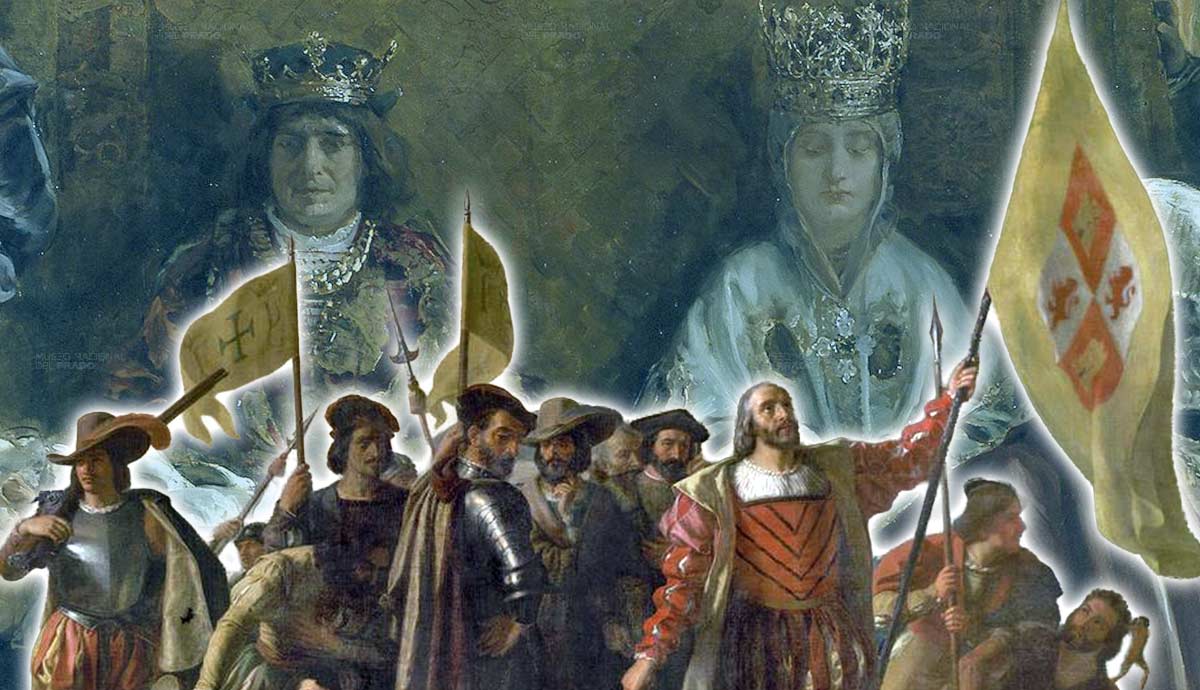
Famous historic years: 1666 (the Great Fire of London), 1776 (the year of American Independence), 1789 (the French Revolution), 1939 (the outbreak of the Second World War). All of these dates are ingrained in our minds, but few hold as much sway over history as 1492. In a year that saw the Jews expelled from Spain, the Catholic Monarchs also took over the Alhambra Palace, marking the end of Moorish rule, and funded Christopher Columbuss voyage to what would become known as the Americasall within the space of less than twelve months. Read on to learn about the key events of 1492.The Background to the Fall of GranadaWedding portrait of the Catholic Monarchs, Isabella and Ferdinand, 15th century. Source: Wikimedia CommonsA Spanish Christian from the 15th century would likely think January 2, 1492 was a glorious start to the year. However, if you asked a Moorish resident, they would likely say that the year had gotten off to a disastrous start. This is because the Fall of Granada was a huge victory for the Spanish and Catholicism, but a huge blow for Islam in the Iberian Peninsula.By the late 15th century, Granada was the last stronghold of Islam in the Iberian Peninsula, and since 1482, the Granada Wars had been raging on, as a means of expelling Islam from Spain. The wars generally stopped during the winter months, which gave both sides time to prepare for conflict in the spring and summer.Because Granada was the last stronghold, tensions on the Islamic side were high, and there was often bitter internal civil conflict. On the contrary, the Catholics were so determined to take Granada back into Catholic hands (it had been under Muslim rule for almost 800 years) that they were generally a united front.Perhaps the biggest reason that Christian Spain was united, though, was because of their monarchs, who would become known simply as the Catholic Monarchs. On October 19, 1469, Ferdinand of Aragon married Isabella of Castile in Valladolid. Their marriage united the crowns and thus the kingdoms of Aragon and Castile, making them a powerful unity. Their shared beliefs in Catholic doctrine also strengthened the beliefs of their subjects, perfect for raising a force to defeat the Islamic infidels in Granada.January 2, 1492: The Fall of GranadaThe Surrender of Granada, by Francisco Pradilla y Ortiz, 1882. Source: Wikimedia CommonsIn April 1491, a siege outside the city had begun, but both sides were prepared to endure the winter and see it through. Unfortunately for Muhammad XII, the ruler of the Emirate of Granada and the last ruler of the Nasrid Dynasty, Spains forces were simply stronger and more united.He retreated to the mighty Alhambra Palace, an incredible feat of Islamic architecture and engineering which can still be seen today, and stayed out of the siege behind its walls.The Catholic Monarchs, knowing how sacred and important the Alhambra was, refused to directly attack the palace, which is why it likely still stands today.Eventually, after an almost eight-month siege, Muhammad gave up the keys to the Alhambra Palace and wept bitterly. His mother was reported to have said, Weep like a woman over what you couldnt defend as a man.The Catholic Monarchs took control of the Alhambra Palace, but kept its beautiful Islamic architecture, preserving the character of the building. As for Muhammad XII, it was a disastrous loss. Islam had finally been expelled from Spain, and the addition of the Kingdom of Granada made the Crown even more united, and perhaps more importantly, even richer. This gave them the means to finance other things such as important overseas voyages, but more about that later on.March 31, 1492: The Expulsion of the JewsThe Expulsion of Jews from Spain in 1492, by Emilio Sala, 1889. Source: Museo del PradoFollowing on from the Fall of Granada, the next major event came just under three months later: the Alhambra Decree.The goal of this decree was to order the expulsion of all practicing Jews from their kingdoms, under the guise of religious unity under the Crown. The Christians argued that they had expelled the Muslims, and now it was time for the Jews to convert to Christianity or be expelled. Jews had until July 31 (four months) to make the decision to convert to Catholicism or to leave Spain, forfeiting their property.This, in turn, made the Crown even richer, as they claimed hundreds of properties in the aftermath of the thousands of Jews who left. Many of these Jews went to neighboring Portugal, while others went east across Europe, and some into North Africa. This became known as the Sephardic Diaspora. It is estimated that 180,000 Jews left Spain under the Alhambra Decree.This event was one of the shadows over 1492, and it was not (shockingly) until 1968 that this decree was officially rescinded by the Spanish government, over 400 years after it had been issued. The government offered the descendants of all Sephardic Jews Spanish citizenship if they wanted it.In the case of 1492, the Alhambra Decree often goes unnoticed, with most Westernized histories focusing on the Fall of Granada and Christopher Columbuss voyages to the Americas as the focal points of the year.From an Islamic and a Jewish point of view, 1492 was a terrible year. In essence, 1492 should rightly be seen as a controversial year rather than a wholly successful one, something which more historians are now acknowledging.The Background to Columbuss VoyagesThe Columbus Map depicting the Old World, drawn c. 1490 in the workshop of Christopher Columbus and Bartolomeo. Source: Gallica Digital LibraryIn the late 15th century, many European explorers and merchants believed that one huge ocean surrounded Europe, Africa, and Asia. While there had been a land route for centuries (the famous Silk Roads), this had been fraught with its own dangers, such as ambush attacks, diseases, and more. It was a treacherous route, and could take months to cross.In 1488, the Portuguese explorer Bartolomeu Dias became the first Westerner to round the Cape of Good Hope around South Africa (which he originally called the Cape of Storms). It offered a sea route around Africa, meaning that travelers could avoid having to traverse the land via caravan from Europe to Asia. Nine years later, in 1497, Vasco da Gama successfully used this route to reach India, which meant that there was now a definite route to reach Asia via the ocean from Europe.However, the Cape of Good Hope was notoriously dangerous, and as such, Christopher Columbus thought that there must be another way. He attempted several times to encourage the Catholic Monarchs to fund his expedition to sail west from Europe and reach Asia that way.Obviously, the dangers were inherent: Columbus was sailing into the unknown. Many had tried and failed, with the majority meeting their deaths far out at sea, dying of starvation, dehydration, or simply due to storms capsizing their boats. As such, the crew that Columbus was granted was primarily made up of prisoners and ex-prisoners; in other words, cannon fodder, should anything go wrong.August 3, 1492: Christopher Columbuss First VoyageThe Landing of Columbus, by John Vanderlyn, 1847. Source: Wikimedia CommonsJust three days after the Alhambra Decree had expelled 180,000 Jews from Spain, Christopher Columbus set off on his first voyage in an attempt to reach Asia.Perhaps the most important reason Columbus actually managed to reach the Americas when so many others had failed often goes under the radar. The Canary Islands were currently being fought over by the Berber people and the Spanish, and by 1492, both Lanzarote and Gran Canaria had been taken. La Palma would be taken the following year, and by 1496, Tenerife would also be under Spanish control. However, Columbus made a tactical stop on Tenerife with his three ships: The Nia, Pinta, and Santa Mara. This stop not only enabled them to take on board more supplies, but also gave them time to fix and repair any damage to their ships before sailing west.However, another reason why this trip was so successful is that the Canaries are south of the prevailing winds, which blow east across the Atlantic Ocean. As such, Columbus and his crew largely avoided these winds, when other explorers who had set off directly from the Iberian peninsula, or further north in Europe, had been caught in these winds, rendering their expeditions either useless or fatal.October 12th, 1492: Land Ahoy!Depiction of Columbus before the Catholic Monarchs upon his return from Spain, by Ricardo Balaca, 1874. Source: Wikimedia CommonsAround a month after his departure from the Canary Islands, land was spotted. Naturally, Columbus thought that they had reached Asia, which is why, when they landed, he referred to the natives as Indians. It is also why the Caribbean, for years afterwards (and still in the modern cricketing world) was referred to as the West Indies.The land that was spotted, and where the crew landed, was actually an island in the modern-day Bahamas, named San Salvador (it was called Guanahani by the locals, or Tainos as the Spanish referred to them as).Over the course of the next two months, until January, Columbus and his crew explored the Bahamas and other neighboring islands, including Cuba and Hispaniola (home to the modern-day countries of Haiti and the Dominican Republic).Columbus returned to the Catholic monarchs successfully, even bringing back some of the natives as well as other items that they had found and traded on the islands, much to the great joy of the monarchs. As such, Columbus had unintentionally discovered the Americas for Europe (despite never landing on the actual continent of North or South America), and thus opened up the New World for Spanish exploration, and later, colonization.Final ThoughtsThe Alhambra, Granada, Spain. Source: Wikimedia CommonsIt is inherently wrong to say that 1492 was a fantastic year for Spain. History is not so black and white, and contextually, 1492 was a successful year for the Catholic Monarchs, but they were not expelled from their homes or victims of early modern colonization. 1492 was certainly a controversial year, and the fact that so many key events happened in the space of less than twelve months (realistically, ten months) is something rarely experienced in history.1492, while controversial, was the key turning point for Spain to become a powerful European nation under the Catholic Monarchs and to become a global powerhouse. Thanks to these three major events, 1492 also marks the end of the Medieval Period, or Middle Ages, and the beginning of the Early Modern Period.1492 was one of the most controversial years on record, and it still remains that way in Spain to this day.














 English
 Arabic
 French
 Spanish
 Portuguese
 Deutsch
 Turkish
 Italiano
 Russian
 Romaian
 Portuguese (Brazil)
 Greek
Greek