World War I Overview: Causes and Key Events
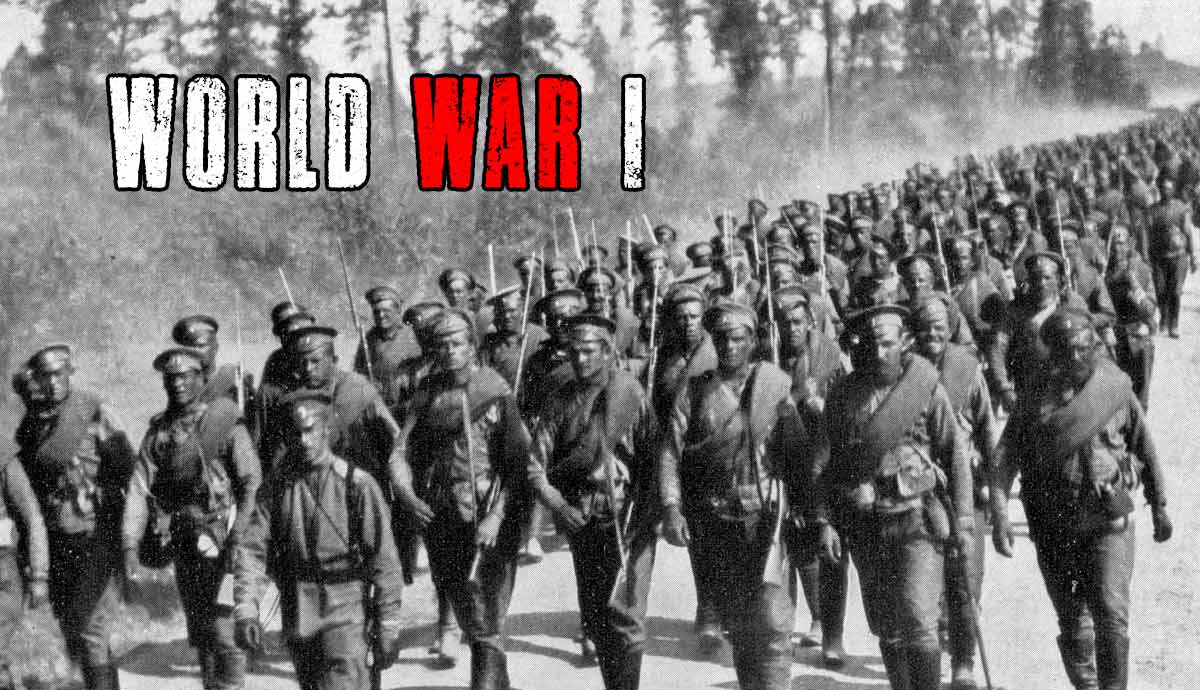
The First World War marked a turning point in global history. Spanning just four years from 1914 to 1918, the relatively brief conflict was one of the most catastrophic wars the world has ever witnessed. Due to a complex system of mutual defense alliances, the war plunged most of Europe and the rest of the world into an unrestrained conflict on an industrial scale.A Long Burning Fuse: The Main Causes of World War IA suspect is arrested by police after the assassination of Archduke Franz Ferdinand, 1914. Source: Serbian Archives via Wikimedia CommonsWhile the true causes of World War I are too complex to name, historians largely agree that the conflict was sparked by a number of long-standing tensions that had been growing across Europe for some time. These tensions were inflamed by feelings of nationalism, imperialism, and militarism across the continent which, when combined with a complex web of alliances, created a geopolitical environment where even a minor regional crisis could escalate into a multi-national war.Across Europe, national pride and self-determination fueled feelings of unity as well as division, which led to war. In the Balkan nations, Slavic nationalist movements sought to gain independence from the Austro-Hungarian Empire. This plunged the region into crisis. At the same time, major European powers such as Germany, France, and Britain stoked feelings of patriotism to strengthen public support for their global ambitions.Moreover, imperial ambitions led to an atmosphere of constant competition. The scramble to obtain overseas colonies, particularly in Africa and Asia, drove European powers into close conflict over dwindling resources, territory, and prestige. As Germany entered the colonial world at the turn of the century, confrontations were further fueled as newly imperial nations clashed with the established empires of Britain and France.In addition, the nature of World War I was made even more brutal by the doctrine of militarism. As the Industrial Revolution introduced new technologies at an alarming rate, an arms race between major powers resulted in a massive military buildup, notably in Germany and Britain. Throughout the 19th century, Germany was determined to challenge the Royal Navys dominance across the world, while military leaders in Europe began to embrace the notion that war was inevitable. For some, a war was even welcomed as a way to resolve centuries-old disputes.The Assassination of Archduke Franz FerdinandThe Archduke Franz Ferdinand, 1914. Source: Ferdinand Schmutzer via Wikimedia CommonsFurther complicating the tensions at the turn of the century was the system of alliances, which essentially divided Europe into two opposing sides. On one hand, there was the Triple Entente, made up of the large Imperial powers of France, Russia, and Britain. On the other hand, lay the Triple Alliance of the nascent German Empire, Austria-Hungary, and Italy. While these alliances were intended to provide security to their members, they led to a political situation in which a minor crisis could trigger a European war. This came on June 28, when the Archduke of Austria-Hungary, Franz Ferdinand, was assassinated by a Bosnian Serb in Sarajevo.The assassination was not a random act but rather a planned attack that was part of a broader movement for Slavic independence orchestrated by a group known as the Black Hand Gang. The government of Austria-Hungary was outraged by the attack and eager to assert dominance over the unruly Balkan region. Vienna initially accused Serbian officials of allowing the assassination to take place. On July 23rd, Austria-Hungary issued an ultimatum to Serbia demanding that Viennese officials be allowed to conduct their own investigations into the assassination on Serbian territory. While Serbia was initially open to the demands of the ultimatum, their refusal to accept every aspect of the document gave Austria-Hungary an excuse to escalate the situation. On July 28, Austria-Hungary declared war on Serbia, and the European system of defense alliances meant that a regional conflict soon became a Europe-wide war.The Alliance System of European PowersA mobilization order is read out in Berlin, 1914. Source: Imperial War Museum via Wikimedia CommonsThe complicated web of alliances that had developed in Europe since the turn of the century meant that the regional crisis in Serbia soon developed into a global disaster. The Russian Empire, which saw itself as the protector of all Slavic nations, immediately came to Serbias defense. At the same time, Germany was bound by its alliance with Austria-Hungary to come to the aid of its ally to the south, and on August 1, the German Empire declared war on Russia. Just two days later, France, an ally of Russia, declared war on Germany. On August 4, Germany invaded Belgium to get to France, and Britain was forced to enter the war on the side of Belgium, France, and Russia.In less than a month, the assassination of Archduke Franz Ferdinand in Sarajevo had developed from a regional showdown into a continent-wide war. The militaristic arms race, a system of alliances, and nationalistic ambitions, combined with the process of mobilization, left no room for a diplomatic solution. As a result, Europeand eventually much of the rest of the worldwas plunged into the horrors of the First World War.The Western FrontThe Western Front, 1915. Source: Delpher / National Library of the Netherlands / Arthur Tervooren via Wikimedia CommonsThe first stages of World War I were characterized by ambitious military maneuvers that ended in a lengthy stalemate, notably on the Western Front. Germany quickly launched the Schlieffen Plan, a military strategy that had been drawn up to avoid a war on two fronts against forces coming from Moscow and Paris. The plan was to first defeat France in the West by moving through Belgium before re-distributing the remaining troops of the German army to face Russia in the East. However, the plan soon fell apart because of unexpected resistance in Belgium and distinct logistical challenges. The forces of Belgium mounted a serious defensive campaign that severely hampered German forces. This allowed British and French forces to fully prepare to face Berlins troops as they marched through Belgium.In September 1914, the Battle of the Marne was a key Allied victory that forced German troops to retreat and effectively prevented the carefully drawn-up maneuvers of the Schlieffen Plan. Germanys failure to break through Belgium led to troops on the Western Front becoming mired in a grueling stalemate. Both sides fortified their positions using vast networks of trenches that stretched across almost the entire width of Western Europe.The major battles of World War I, such as Verdun and the Somme in 1916, epitomized the brutal nature of trench warfare. At Verdun, French troops mounted a heroic defense against a relentless onslaught of German troops. At the Somme, more than a million men died fighting a battle that resulted in almost imperceptible territorial gains. The Western Front became a symbol of the broader nature of the war, a stalemate in which two equally matched military powers sacrificed vast numbers of human lives for negligible strategic gains.The Eastern Front and BeyondRussian troops on the Eastern Front, 1914-1917. Source: Public Domain / Wikimedia CommonsWhile the fighting on the Western Front was largely static, the Eastern Front and beyond was highly unpredictable. Germany and its ally, Austria-Hungary, fought the Russian Empire in fluid battles. At the Battle of Tannenberg in 1914, the German generals Hindenburg and Ludendorff decisively defeated a much larger Russian force.Despite early strategic victories, German forces were unable to push back against the vast manpower of the Russian Empire. However, the huge losses Russia sustained during the early years of the war eventually led to a political implosion at the heart of Moscows empire: the Bolshevik Revolution.World War I was not simply a European war. It soon became a truly global conflict. In the Middle East, the Ottoman Empire, aligned with Germany and its allies, was a key player in the war. The Gallipoli Campaign was an Allied operation aimed at seizing control of the Dardanelles Strait to open a supply route to Russia. Instead, Allied troops were crushed and forced to retreat by the defending troops of the Ottoman Empire. Moreover, British figures like the legendary T.E. Lawrence inspired a revolt against Ottoman rule in Arabia.Meanwhile, in Africa, colonial troops were forced into World War I on the side of their ruling power. German troops frequently clashed with Allied forces across vast territories, while African troops fought under brutal conditions with little recognition for their service. Fighting spread to Asia, too, where Japan, who fought on the side of Allied forces, took advantage of the war in Europe to take control of German-owned colonies in China and the Pacific.The United States Enters the War: Beginning of the EndThe Zimmermann telegram, 1917. Source: National Archives and Records Administration via Wikimedia CommonsAfter years of stalemate, the final stages of World War I were marked by rapid geo-political changes that ultimately brought the conflict to an end. One of the most decisive moments in World War I came in April 1917, when the United States entered the conflict on the side of the Allied forces. The US had been drawn into the war as a result of the German policy of unrestricted submarine warfare.This policy sought to categorize all merchant navy vessels that transported goods across the Atlantic in support of the Allies as legitimate targets for German U-boats. This led to a number of American civilian and merchant vessels being destroyed by the German Navy. Moreover, Washington was forced to join World War I as an Allied nation after the Zimmermann Telegram was intercepted. This secret message proposed that Germany form a military alliance with Mexico in opposition to the United States. This discovery galvanized American public opinion and gave President Woodrow Wilson the support he needed to declare war on Germany.In the same year that the United States joined the Allies and began fighting on the Western Front, the Russian Revolution in 1917 led to major upheaval on the Eastern Front. After Vladimir Lenin seized power for the Bolsheviks, Moscow prioritized ending Russias involvement in World War I. The Treaty of Brest-Litovsk, signed in March 1918, formalized the withdrawal of Russian forces from the Eastern Front. This allowed Germany to redirect the bulk of its forces toward the Western Front in a renewed action known as the Spring Offensive. However, the new German offensive soon faltered, and the German militarys ambition to break the deadlock was not realized.The End of the WarThe Signing of Peace in the Hall of Mirrors, by William Orpen, 1919. Source: Imperial War Museum via Wikimedia CommonsThe stalemate on the Western Front was broken by the Allies Hundred Days Offensive, an unrelenting series of counterattacks launched in August 1918. Bolstered by the material and morale boost of American forces, the offensive drove German forces back, leading to a complete collapse of fighting morale both on the Western Front and within Germany. Faced with a full-scale Allied occupation, the German government sought an armistice. The treaty was signed on November 11, 1918, marking an end to the war.The human cost of World War I was staggering. The industrialized nature of the war led to the deaths of approximately nine million soldiers, while another seven million civilians lost their lives due to violence, famine, and disease. Europe lay in ruins, with entire towns and industrial centers destroyed by years of heavy fighting. The post-war economic recovery was slow, and the ensuing economic disarray led to a period of global instability that had far-reaching consequences.Politically speaking, World War I effectively changed the entire nature of global politics. The conflict led to the collapse of four major European imperial powers: the German, Austro-Hungarian, Ottoman, and Russian Empires. This led to the redrawing of national borders and the creation of new territorial disputes.The Treaty of Versailles in 1919, which formalized the end to the conflict, imposed harsh reparations on Germany and forced Berlin to concede vast areas of territory. This led to increased resentment in Germany against the Allied nations and resulted in a rise in extremism, eventually leading to the outbreak of World War II. After World War I, the League of Nations was created by Woodrow Wilson to avoid any future conflicts. However, without the United States as a member to uphold international order it proved ineffective.












 Arabic
 French
 Spanish
 Portuguese
 Deutsch
 Turkish
 Dutch
Dutch
 Italiano
 Russian
 Romaian
 Portuguese (Brazil)
 Greek
Greek