27 Victorian Death Photos And The Disturbing History Behind Them
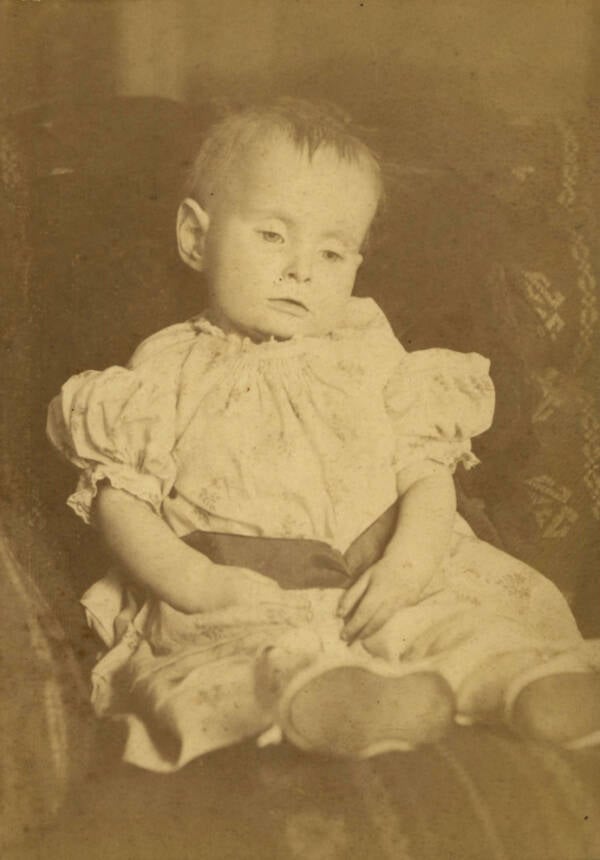
Click here to view slideshowThanks to high mortality rates and the rampant spread of disease, death was everywhere during the Victorian era. So many people came up with creative ways to remember the dead including Victorian death photos. While it may sound macabre today, countless families used post-mortem photos to memorialize their lost loved ones."It is not merely the likeness which is precious," said Elizabeth Barrett Browning, a Victorian-era English poet, as she gazed upon a post-mortem portrait, "but the association and the sense of nearness involved in the thing... the very shadow of the person lying there fixed forever!"For many people of the Victorian era, a post-mortem portrait might be their first experience with photography. The relatively new technology presented an opportunity to retain a permanent image of their deceased relatives many of whom had never been photographed while they were alive.Today, Victorian death photos may seem disturbing. But for people in the 19th century, they provided comfort during times of grief. You can see some of the most striking examples of this practice in the gallery above.Why Did People Take Post-Mortem Photos?Beniamino Facchinelli/Wikimedia CommonsThe Italian photographer Beniamino Facchinelli took this portrait of a deceased child around 1890.In the first half of the 19th century, photography was a new and exciting medium. So the masses wanted to capture life's biggest moments on film. Sadly, one of the most common moments captured was death.Due to the high mortality rates, most people couldn't expect to live past their 40s. And when disease spread, infants and children were especially vulnerable. Illnesses like scarlet fever, measles, and cholera could be a death sentence for young people in an era before vaccines and antibiotics. Photography offered a new way to remember a loved one after death and many Victorian death photos became family portraits of sorts. They often depicted mothers cradling their deceased children or fathers watching over their children's deathbeds. One photographer recalled parents who carried a stillborn baby to his studio. "Can you photograph this?" the mother asked, showing the photographer "a tiny face like waxwork" hidden away in a wooden basket.The concept of creating a post-mortem portrait long predated photography. But in the past, only the very wealthiest families could afford to hire artists to create an illustration of their loved one. Photography allowed people who were less wealthy to get a post-mortem image as well.Death photographers learned how to pose children to give the appearance of peaceful slumber, which brought comfort to grieving parents. Some photographers edited their daguerreotype an early form of photography that produced a highly detailed picture on polished silver by adding a tint and bringing a bit of "life" to the subject's cheeks. These images were deeply comforting to grieving family members. Mary Russell Mitford, an English author, noted that her father's 1842 post-mortem photograph "has a heavenly calm in it."The Creation Of Post-Mortem PhotosNational TrustThe tradition of preserving images of deceased children existed long before photography. In this 1638 painting, the artist memorializes the brother of the Duke of Devonshire.Photographing dead people may seem like a ghastly task. But in the 19th century, deceased subjects were often easier to capture on film than living ones because they weren't able to move.Due to the slow shutter speed of early cameras, subjects had to remain still to create crisp images. When people visited studios, photographers would sometimes hold them in place with cast-iron posing stands. As you might expect, Victorian death photos are often easy to identify because of their lack of blurring. After all, subjects in these portraits did not blink or shift suddenly. Unlike many portraits, which were taken in photo studios, post-mortem photos were usually taken at home. As the trend of death portraits took hold, families put effort into preparing their deceased relatives for the photoshoot. That could mean styling the subject's hair or their clothes. Some relatives opened the dead person's eyes. Photographers and family members sometimes decorated the scene to make the purpose of the photograph clear. In some images, flowers surround the deceased. In others, symbols of death and time like an hourglass or a clock mark the portrait as a post-mortem photograph. By capturing the dead on film, Victorian death photos gave families the illusion of control. Although they had lost a beloved relative, they could still shape the portrait to emphasize a sense of calmness and tranquility.In some cases, post-mortem photographs actively created the impression of life. Families could request makeup to mask a deathly pallor. And some photographers even offered to paint open eyes on the final image. Beyond Victorian Death Photos: Masks, Mourning, And Memento MoriBain News Services/Library of CongressThe creation of a death mask in New York. 1908.People in the Victorian era mourned deeply after the death of a loved one and this mourning certainly wasn't limited to photos. It was common for widows to wear black for years after their husbands died. Some even clipped hair from their dead loved ones and preserved the locks in jewelry. As if that wasn't dark enough, Victorians often surrounded themselves with memento mori, or reminders of death. The literal meaning of that phrase is "remember you must die." To Victorians, this phrase meant that the dead should be honored and that the living should never forget their mortality.The practice of creating death masks was another way that Victorians remembered the dead. According to the 19th-century collector Laurence Hutton, a death mask "must, of necessity, be absolutely true to nature." To capture the likeness of a dead person, a mask maker would spread oil over the face before pressing plaster over the person's features. Sometimes the process left a seam down the middle of the face or exaggerated beards and mustaches since the hair was slicked down. The Victorians did not invent death masks the practice dates back to the ancient world but they were notable for their obsession with creating and possessing the masks. Families placed death masks of loved ones atop mantels. Some doctors offered to make death masks after pronouncing a notorious criminal dead. And the booming phrenology industry a pseudoscience that studied bumps on the skull to explain mental traits used death masks as a teaching tool. Fake Victorian Post-Mortem PhotosCharles Lutwidge Dodgson/National Media MuseumAn 1875 portrait of the author Lewis Carroll, often incorrectly described as a post-mortem photograph.Today, some Victorian death photos shared online are actually fakes or they're photographs of the living mistaken for the dead.Take, for example, a commonly shared image of a man reclining in a chair. "The photographer posed a dead person with his arm supporting the head," many captions claim. But the photograph in question is a picture of the author Lewis Carroll taken years before his death.Mike Zohn, the owner of Obscura Antiques in New York, offers a handy rule of thumb when studying Victorian death photos: "As simple as it sounds, the big general rule is if they look alive they're alive."Although some Victorians tried to breathe life into photographs of the dead with the addition of color on the cheeks, for example the vast majority of them simply sought to preserve the image of a lost loved one. While many of us couldn't imagine doing this today, it's clear that this practice helped the Victorians with their grief during a time of great strife.After learning about Victorian death photography, check out these fascinating Victorian portraits. Then, read about the trend of spirit photography in Victorian England.The post 27 Victorian Death Photos And The Disturbing History Behind Them appeared first on All That's Interesting.











 English
 Arabic
 French
 Spanish
 Portuguese
 Deutsch
 Turkish
 Italiano
 Russian
 Romaian
 Portuguese (Brazil)
 Greek
Greek