How America Hunted Its Most Common Bird to Extinction
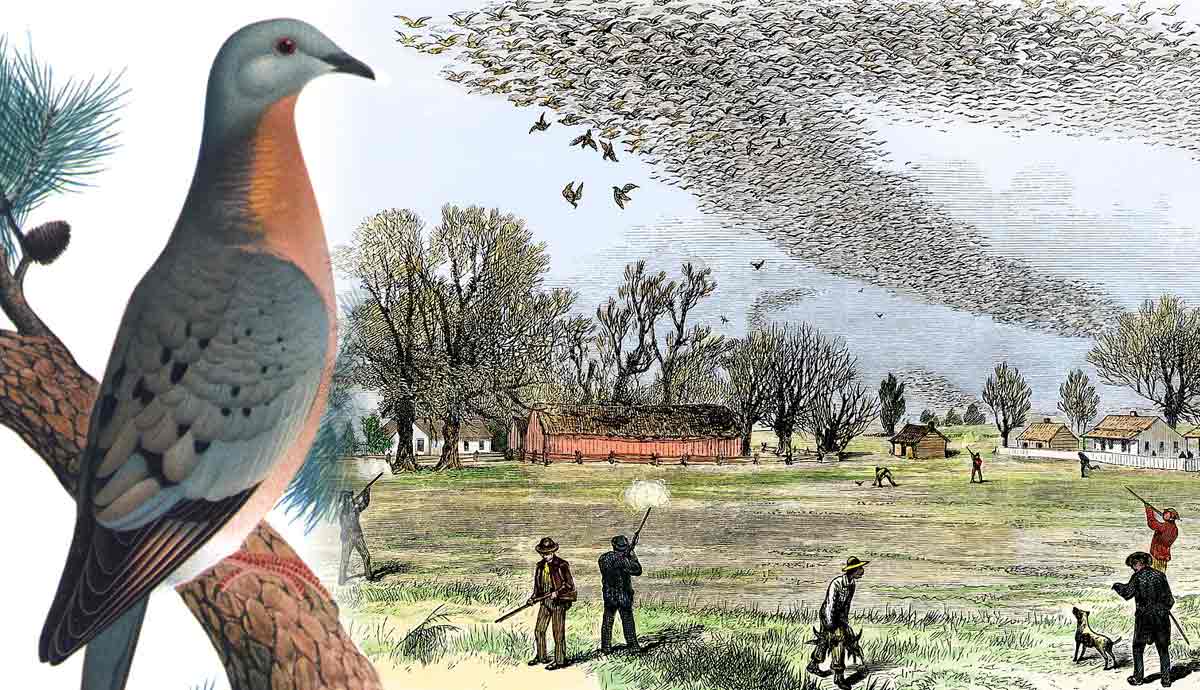
The humble passenger pigeon once dominated the skies of North America. As the most abundant species of bird on the continent, they became the avian rulers of both land and air. When gathered in great numbers, these beautiful creatures were said to blacken the horizons due to their unprecedented population.But a little over 100 years ago, in September of 1914, the passenger pigeon became officially extinct worldwide. Historians, ornithologists, and nature lovers may naturally question where it all went wrong. How did their number go from five billion to zero within the space of a few centuries?Why Was It Called the Passenger Pigeon?A depiction of three Passenger Pigeons, by Louis Agassiz Fuertes, 1910. Source: Wikimedia CommonsThe avian species Ectopistes migratorius was more commonly known as the passenger pigeon. Ectopistes migratorius translates as migratory wanderer. The genus name, Ectopistes, means to move about. The specific name, migratorius, implies a tendency to migrate. It is partly from these translations that the common name derives.The name passenger pigeon is snappier and more memorable than its scientific alternative. The word passenger is taken from the French word passager, which literally means passing by.Both common and scientific names refer to the migratory habits of the species. The passenger pigeon tended to migrate to the eastern part of North America in September or October.The Rise and Fall of the Pigeon PopulationPortrait of explorer Jacques Cartier, by Theophile Hamel, 1844. Source: Wikimedia CommonsFor around 15,000 years, enormous numbers of passenger pigeons coexisted with the Native Americans on the North American continent. Generally speaking, these centuries are thought to have been a time of relative peace and tranquillity for the species as a whole. Interestingly, archaeological evidence tells us that some Native Americans ate pigeons regularly. Although the creatures were probably hunted for their meat, the numbers being caught posed no real risk, and the passenger pigeon not only survived but thrived for many centuries.When Christopher Columbus first arrived in the Americas in 1492, the population of the passenger pigeon was at its all-time peak. In North America alone, numbers are thought to have reached between three and five billion. This means that of all avian life on the continent, passenger pigeons made up a shocking 40 percent.Not 50 years later, during a voyage of 1534, the French explorer Jacques Cartier became the first person to record a sighting of the species on paper. His observations were quickly followed by further comments by Samuel de Champlain (1574-1635) and Cotton Mather (1663-1781). The early accounts of the passenger pigeon feature descriptions of both their appearance and characteristics. They also focus largely on the stunning spectacle of a darkening, North American sky, created by the vast number of pigeons taking flight at one time.Painting of a Passenger Pigeon by K. Hayashi, created c. 1900. Source: Wikimedia CommonsBetween the 16th and 20th centuries, the number of passenger pigeons in North America fell into a downward spiral. Predictably, as the human population rose, that of the pigeons plummeted. Throughout the 19th century in particular, settlers pressed Westward, and the previous inhabitants were pushed out.By 1890, the wild population of passenger pigeons was thought to be no more than a few thousand. Seven years later, Michigan became the first state to ban the hunting of the passenger pigeon. Although this may have seemed like a step forward, efforts were futile, and it was ultimately too little too late.During the early 19th century, it had been noted that the situation of the passenger pigeon was desperate. Sightings of the species were so rare that it was practically unheard of to see one in the wild. There were a few recorded exceptions. The president Theodore Roosevelt claimed to have seen a single bird in Michigan in 1907, and an ornithologist named Alexander Wetmore recorded a sighting of a pair in Kansas in 1905.In 1910, the efforts to save the passenger pigeon were enhanced, and the American Ornithologists Union offered a reward of 3,000 dollarsthe equivalent of nearly 80,000 dollars in modern timesfor discovering and reporting a nest. Despite these final attempts at conservation, the last surviving passenger pigeonsGeorge and Marthadied at the Cincinnati Zoo in 1911 and 1914, respectively.Martha: The Last of Her KindA photograph of Martha taken in 1912. Source: Internet ArchiveOf the billions of passenger pigeons ever to have lived, there was only one who ever achieved any noteworthy level of fame. Her name was Martha, and she will forever be remembered as the worlds last of her species.It is thought that Martha hatched from her egg in 1885. Her owner was Professor Charles Otis Whitman, an American zoologist and Professor at the University of Chicago. It was he who gave his pigeon the name Martha, in honor of Martha Washington, the first first lady of the United States.Whitman was both fascinated and concerned about the potential extinction of his treasured birds, and therefore worked closely with the Cincinnati Zoo to attempt a breeding program. It was perhaps for this reason that Whitman willingly sent Martha to the Zoo in 1902, to reside in close proximity with two males.Despite the best efforts of professors and zookeepers, the program proved unsuccessful. By November of 1907, just five years after her arrival at her new home, Martha and her companions were the final three passenger pigeons known to man. Three soon became two, and then one, when Marthas potential mates died in quick succession, firstly in April of 1909 and secondly in July of 1910. This meant that Martha would suffer just over four years of complete solitude. She lived the last days of her lifeisolated and aloneas the last of her species.Martha died on September 1, 1914. As she was approximately 29 years old, the cause of death is thought to have been old age. Following Marthas death, her species was declared officially extinct.What Caused the Extinction of the Passenger Pigeon?Depiction of a shoot in Northern Louisiana, painted by Smith Bennett, 1875. Source: Wikimedia CommonsWhen it comes to the passenger pigeon, there is no doubt about the cause of decline and eventual extinction. Just like countless other species, they fell victim to overhunting by the human race. From the European arrival in America until the death of Martha in 1914, passenger pigeons were relentlessly hunted to extinction. People purposefully caught the species not only for their meat, but for the genuine enjoyment of sport.One of the earliest accounts of a hunt dates back to January 1565. A French explorer named Ren Laudonniere wrote that his party killed 10,000 passenger pigeons in their hunt over a few weeks. Of his supposed success, he said, There came to us a manna of pigeons in such great numbers, that over a span of about seven weeks, each day we killed more than two hundred with arquebuses in the woods around our fort.Unfortunately for the passenger pigeons, they were considered perfect for both food and entertainment. They were extremely easy to hunt, and so even unskilled hunters found themselves with an abundant catch. For this reason, the pursuit became popular with young boys who intended to practice their hunting skills. Trap shooting also became fashionable. Passenger pigeons were released from traps, and hunters would compete to shoot down as many birds as possible as the group passed overhead. For a person to win the competition, it was occasionally necessary to shoot around 30,000 birds.Ren Goulaine de Laudonnire, 1846. Source: Wikimedia CommonsFurthermore, passenger pigeon meat was said to have had a very desirable taste. The flavor of a pigeon apparently varied depending on how and when they were caught and prepared. Young pigeons were thought to possess optimum taste and texture. Fattened pigeons were also sought after and were therefore often overfed in captivity for months. To add variation, birds were sometimes smoked, salted, or pickled. As demand for pigeon meat reached its peak, the hunt intensified, and their number rapidly declined. Passenger pigeon as a dish was now a favorite, and so hunting became a commercial practice.It is thought that the first writer to publicly express concern about the passenger pigeon was Benedict Henry Revoil. After witnessing a hunt in 1847, he recorded his thoughts about their fate: If the world does not end this before a century, he began, I will wager that the amateur of ornithology will find no more wild pigeons, except those in the Museums of Natural History.Revoils predictions proved true. Less than a centuryjust 70 years laterthe last of the passenger pigeons had died and was preserved by the National Museum of Natural History in Washington, DC.More Than Hunting? Other Contributing Factors to ExtinctionA pair of Passenger Pigeons, by John James Audubon, 1827-38. Source: Wikimedia CommonsThere is no doubt that overhunting by humans was the main cause of the extinction of the passenger pigeon. However, there may have been a few more contributing factors. Some of these factors were completely separate from hunting, but others went hand in hand with it.One such factor was deforestation. Between 1850 and 1910 alone, 180 million acres of woodland was cleared for farms and expanding towns. The species did not cope well with finding new habitats. Another factor was the abandonment of nests, eggs, and chicks. Many attempts by the passenger pigeons to repopulate were futile. As adults were hunted, many eggs and chicks were left to remain unhatched or to die from lack of care.The combination of hunting and deforestation is known as the Blitzkrieg against the passenger pigeon.Final Thoughts on the Extinction of the Passenger PigeonDepiction of a Male and Female Passenger Pigeon, by Louis Agassiz Fuertes, 1907. Source: Wikimedia CommonsThe Encyclopaedia Britannica describes the lasting legacy of the passenger pigeon, Its greatest legacy to humans was the impetus its extinction gave to the conservation movement. It also informs us that, according to a monument in Wisconsins Wyalusing Park, the passenger pigeon became extinct through the avarice and thoughtlessness of men.Martha, the last of the passenger pigeons, has become something of an icon. She now represents the threat of extinction in a variety of species, and the ongoing requirement for conservation efforts all around the globe.The case of the passenger pigeon has been called the most senseless extinction in human history.












 English
 Arabic
 French
 Spanish
 Portuguese
 Deutsch
 Turkish
 Dutch
Dutch
 Italiano
 Russian
 Portuguese (Brazil)
 Greek
Greek